
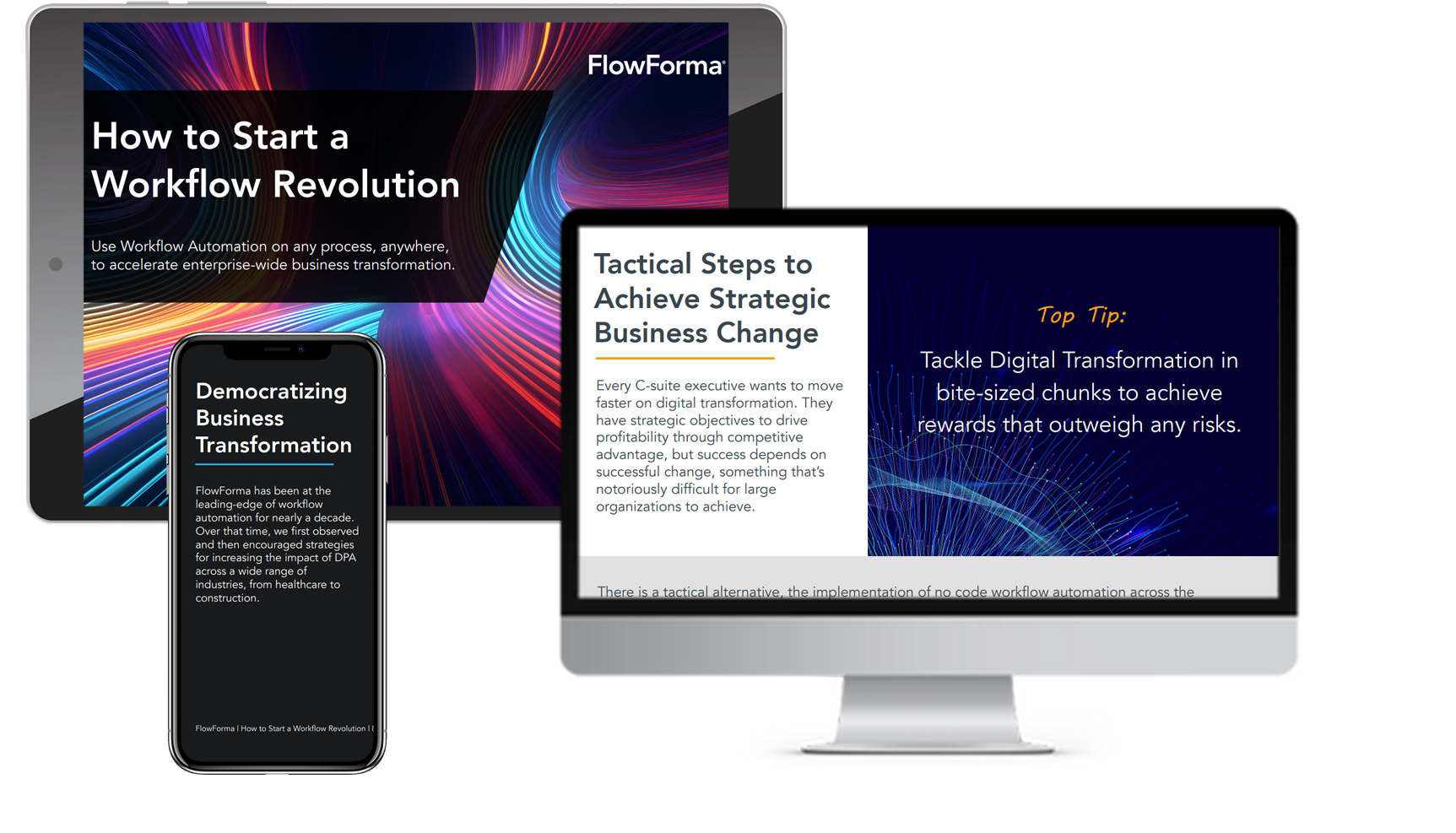
How to Start a Workflow Automation Revolution
Use workflow automation on any process, anywhere, to accelerate enterprise-wide business transformation. A practical eBook for leaders who want change to start with the people who own the processes.
- 45%of CIOs are shifting to co-owned digital leadership
- 64%of CIOs have deployed or plan to deploy low code
- 8processes that deliver the fastest return
Get the full eBook
- 4 tactics that consistently work
- 7 champion personas and 8 quick-win processes
- Champion stories from 6 sectors
What's inside the eBook
Five chapters on tackling digital transformation in bite-sized chunks, so the rewards far outweigh the risks.
- 01Tactical steps to achieve strategic business changeWhy no code workflow automation answers the biggest transformation challenges.
- 02Infinite possibilities unlockedSix benefits, from saving time and money to continuous improvement.
- 03Democratizing business transformationFour tactics that consistently work for organizations.
- 04The wildflower effectThe champions and processes that spread change across departments.
- 05FlowForma champion storiesWhat clients in six sectors achieved with workflow automation.
Why tactical workflow automation beats a big-bang program
Deploying digital process automation in a tactical way directly addresses four of the biggest challenges around digital transformation.
Not enough tech skills for large-scale projects
Non-technical people can use the tools that drive the change, with no drain on IT resources.
An embedded culture makes adoption hard
People are more open to change when no code tools empower them to make their own work easier.
Business and technology goals pull apart
Workflow automation is business-driven, and the technology that makes it happen is simple to use.
No way to show what success looks like
Analytics around no code tools help track benefits and point to continuous improvement.
"CIOs must co-own efforts with business leaders to place the design, delivery and management of digital capabilities with teams closest to the point where value is created."
"Software needs to be an expression of your business. This cannot be achieved if business isn't adequately involved to express itself."
Getting more people involved in change projects creates "a cascade of information throughout the business" that makes them successful.
4 tactics that consistently work
Strategies FlowForma has observed, and encouraged, across industries from healthcare to construction.
- 1
Establish champions
The champions are many, not necessarily managers, and they often build the very first workflows themselves.
- 2
Digitalize simple processes first
Templated forms take paperwork out of processes, show quick gains and teach the tool before bigger projects.
- 3
Measure success and improve
Centralized process data exposes bottlenecks and builds the business case for other teams.
- 4
Encourage cross-departmental workflows
Ease of use spreads adoption, standardizes processes and cuts training as the interface becomes familiar.
“Pick a few simple processes first, build and get buy-in internally rather than a difficult process that absorbs too much time.”
The wildflower effect: 7 champions who drive change
Seeds of change planted in one department flourish across many others. These are the roles that make it happen.
Procurement managers
Accelerate buying with easy-to-manage steps tailored to multiple suppliers.
COO
Gradual change with minimal risk, while maintaining high performance.
CFO
Low-cost solutions that advance transformation without straining resources.
Legal & compliance officers
Auditable processes that help meet increasing regulatory requirements.
Project managers
Fix pain points when bigger systems are cumbersome and deadlines are pressing.
CIO / head of IT
No code that relieves pressure, stays under IT control and fits the IT strategy.
Business process analysts
Quick wins that avoid getting bogged down in technology.
Which champion are you?
Get the eBook for the full persona guide.
8 processes that deliver the fastest return
Start here to see immediate efficiency gains and build momentum for more.
- 01
HR onboarding and offboarding
A quick, simple process every company can use and every employee will appreciate.
- 02
Approval processes
Pull every stakeholder into one sign-off, with alerts that cut time to completion.
- 03
Inspections
Paper procedures become digital forms on mobile devices, with no lost documents.
- 04
Expense claims
Spreadsheet exchanges become a transparent process with faster approval.
- 05
Materials requisition
Procurement becomes a matter of record, with data to make it more cost-effective.
- 06
Project requests
Prepopulated forms for IT requests to site access cut paper trails.
- 07
Fieldwork
Remote workers complete tasks on site from phones or tablets, connected in real time.
- 08
Checklists
Health and safety, compliance and QA checks become timely and auditable.
FlowForma champion stories
Clients in different roles and sectors describe what workflow automation changed for them.
It encourages everyone to act far more professionally than when we depended on paper. You can't submit half filled-in boxes because the system won't let you.

Mark LayFinance Director, Abingdon & Witney College
People are embracing FlowForma Process Automation and coming up with their own ideas. When I see similar types of questions coming into my inbox, I know there's a demand for a new workflow.

Imelda BettingerSharePoint Developer, Dresser Natural Gas Solutions
Digitalizing in FlowForma Process Automation has solved that by creating a centralized repository. It means we're not constantly reinventing the wheel.

Jimmy MonahanArchitectural Engineering Practice Leader, Rimkus Consulting Group
The speed of development and the opportunity to involve process owners in creating their own forms and workflows is a game-changer.

Mark GreenwoodSenior Developer, Blackpool Teaching Hospitals NHS
It has harmonized all the different sites and helped us achieve our goal to unify, simplify and amplify.

Katherine CoxProgram and Editorial Manager
It has to be easy with a familiar interface if it's going to be adopted and used to replace paper. FlowForma has done that.

Lampros ArvanitisBIM Manager, CVB
Starting a workflow revolution: common questions
What is the wildflower effect in workflow automation?
It's FlowForma's name for how change spreads when an easy-to-use workflow tool takes root in one department. Champions in different roles use the tool and see the benefits, and simple processes deliver a quick return. That triggers a "can-do" culture, and other departments start building their own workflows.
Which processes should you automate first?
Start simple. Templated forms such as HR onboarding, approvals, inspections and expense claims take paperwork out of processes, show immediate efficiency gains and help teams learn the tool before tackling complex, integrated workflows.
Who should champion workflow automation?
Champions are many, and not always managers. The eBook names seven roles that drive adoption: procurement managers, COOs, CFOs, legal and compliance officers, project managers, CIOs or heads of IT, and business process analysts.
How does no code workflow automation take pressure off IT?
Non-technical people build and improve the processes they own, which expands IT's capacity during skills shortages. IT still governs the tool, so it stays aligned with the wider digital transformation strategy.
How do you measure the success of workflow automation?
No code tools centralize process data, so you can spot recurring bottlenecks, such as delays in sign-off, track efficiency gains and use the results to build the business case for other teams.
Start your workflow revolution
Get the full eBook, with all four tactics, the seven champion personas and the eight quick-win processes.
