Security questionnaires have become a bottleneck for modern security and compliance teams in enterprise organizations.
Sales cycles slow down, vendor approvals pile up, and security reviews repeat the same manual checks across long forms, scattered security documentation, and inconsistent questionnaire responses. These time-consuming tasks stretch already thin teams and delay key operational goals.
FlowAssure, FlowForma’s AI-driven vendor risk management and security questionnaire automation platform, was designed for this growing challenge. Using specialized AI agents, FlowAssure provides an end-to-end system that reviews complex security questionnaires and helps teams maintain a strong security posture.
In this guide, we explain:
- How AI is reshaping the security questionnaire process
- Why leading AI agents for security questionnaire workflows are essential in 2026
- How FlowAssure delivers a complete, governed platform for security reviews
Key Takeaways
- As enterprise vendor ecosystems expand and security standards become stricter, teams are handling far more questionnaires and evidence than before. AI tools now play a critical role in helping organizations keep up with the demand for accurate, consistent security questionnaire responses.
- Trends such as continuous compliance monitoring, deeper evidence requirements, and the rise of AI-powered security questionnaire automation are reshaping how security teams manage risk and vendor assessments.
- FlowAssure improves the entire security questionnaire process by using multi-agent intelligence to deliver faster reviews, stronger security posture, and accurate, evidence-backed assessments.
|
Why AI Solutions are Becoming Non-Negotiable for Security Questionnaires
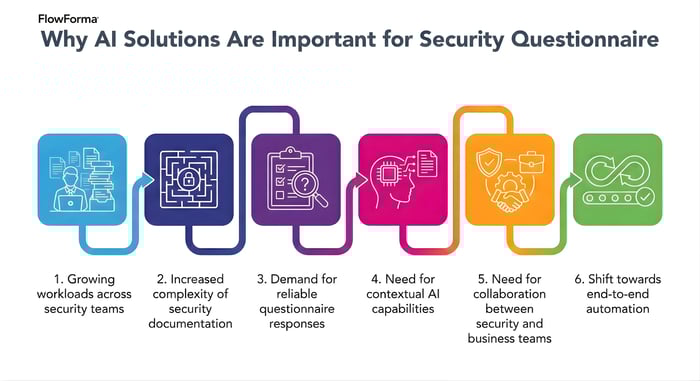
Why AI Solutions Are Non-Negotiable for Security Questionnaire
1. Growing workloads across security teams
Organizations now handle more security questionnaires than ever before—spanning procurement, renewals, enterprise onboarding, due diligence checks, and regulated-industry audits.
Each questionnaire comes in diverse formats, with lengthy evidence attachments and varying levels of detail. For security teams, maintaining accuracy and consistency across hundreds of responses is increasingly complex.
2. Increased complexity of security documentation
Most security questionnaires now require evidence such as SOC 2 reports, ISO 27001 certificates, penetration test results, DPIAs, and data protection policies.
Reviewing these manually is time-consuming and introduces risk when answers do not align with evidence.
AI security questionnaire tools use natural language processing to interpret long-form documents and identify contradictions and gaps.
3. Demand for reliable questionnaire responses
Organizations frequently encounter inconsistent answers across multiple questionnaires because information lives across email threads, spreadsheets, and legacy documents.
Leading AI agents for security questionnaire automation help standardize responses by referencing a centralized content library and an internal knowledge base, ensuring consistent, evidence-based responses.
4. Need for contextual AI capabilities
Modern AI security questionnaire tools must understand compliance frameworks, detect outdated evidence, validate policies, and assist human reviewers with meaningful insights.
This is why organizations increasingly seek AI-powered solutions like FlowAssure, which is explicitly trained in security and risk management.
5. Need for collaboration between security and business teams
Security questionnaires often involve procurement, legal, data protection, sales engineering, and compliance. AI enables seamless collaboration by providing summaries, automated response generation, and clear workflows for approvals.
6. Shift toward end-to-end automation
Organizations now expect AI tools to support full questionnaire automation—from evidence review and response generation to routing, reporting, and audit preparation.
Platforms like FlowAssure integrate AI with workflow automation to create a seamless, governed experience for security teams.
Why AI Agents for Security Questionnaire Solutions Matter in 2026
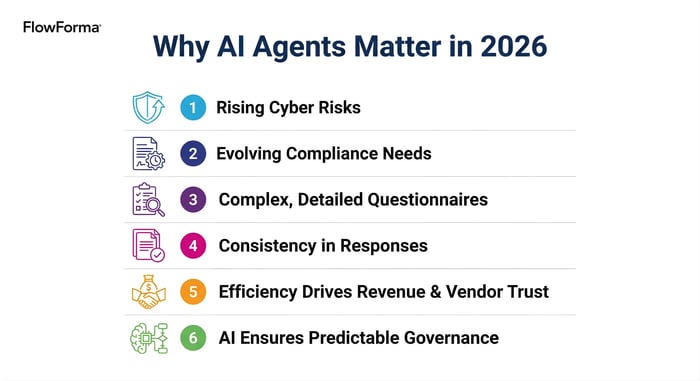
Why AI Agents Matter in 2026
Here are a few reasons AI agents matter for security questionnaires in 2026:
1. Increasing cyber risks
Organizations now operate in an environment where new vulnerabilities emerge daily, and third-party access spans every department. The risk surface continues to grow, yet teams are still expected to produce fast, defensible questionnaire responses.
AI agents help reduce this risk by analyzing security documentation and highlighting high-impact issues before they affect the organization’s security posture.
2. Dynamic and frequent compliance requirements
Frameworks, once reviewed annually, now demand continuous monitoring. Certifications expire more quickly, evidence ages more quickly, and customers expect real-time clarity on controls.
Spreadsheet-driven workflows rarely keep pace. AI security questionnaire tools help organizations adapt by verifying evidence freshness, mapping responses to compliance frameworks, and supporting ongoing compliance without adding more manual effort to already-stretched compliance teams.
3. Questionnaires require technical depth and cross-referencing
Modern questionnaires aren’t simple yes/no forms. They require detailed explanations of security controls, alignment with data protection policies, and supporting evidence.
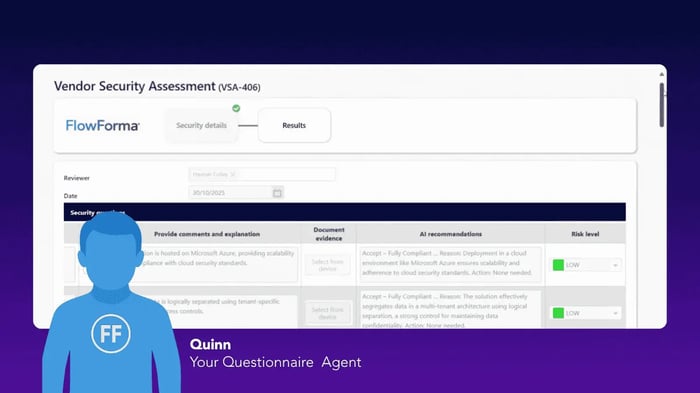
Quinn assisting with security questionnaires
AI agents like FlowAssure’s Quinn use natural language processing to interpret complex questions and compare content across entire questionnaires. This level of analysis would take hours for human reviewers—AI shortens it to minutes while preserving human oversight.
4. Need for consistency across questionnaire responses
As organizations take on more enterprise customers, inconsistent answers become a significant risk. One outdated explanation buried in a PDF can lead to additional scrutiny, delays, or escalations.
AI tools ensure reliability by referencing an internal knowledge base and a centralized content library, ensuring questionnaire responses remain aligned with approved language and current security policies.
5. Efficiency impacts revenue and vendor relationships
Slow response times stall deals, impact procurement approvals, and frustrate stakeholders on both sides of the table. Security teams often juggle incident handling, risk assessments, and vendor checks simultaneously.
AI frees time spent on repetitive tasks like evidence matching and reformulating long explanations, helping teams maintain momentum without compromising accuracy.
6. AI supports a more predictable governance model
Organizations want tools that operate within existing systems while reinforcing compliance processes.
AI agents deployed within Microsoft 365 or similar environments help maintain access controls, preserve audit logs, and support regulatory compliance without introducing new operational complexity. This makes AI not only a productivity tool but a governance asset.
Revolutionizing Security Questionnaire Automation with AI Agents
-1.webp?width=700&height=382&name=Infographic%20showing%205%20ways%20in%20which%20AI%20revolutionizes%20security%20questionnaire%20automation%20(1)-1.webp)
How AI revolutionizes security questionnaire automation
Here are a few ways in which AI agents are revolutionizing security questionnaire automation:
1. Moving beyond traditional, text-heavy review methods
Security questionnaires used to rely entirely on human interpretation — reading long answers, scanning attachments, and validating statements against policies. This manual approach slows down the entire security review process and increases the chance of errors across questionnaire responses.
AI agents change this dynamic by understanding unstructured content, analyzing supporting evidence, and streamlining reviews without compromising human oversight.
2. AI agents bring contextual intelligence to complex questions
Modern questionnaires often require detailed explanations around security controls, security practices, and data management.
AI agents like FlowAssure’s Quinn apply natural language processing to interpret questions, extract relevant information from security documentation, and highlight answers that may be contradictory or incomplete.
3. Automated response generation improves accuracy and efficiency
Rewriting the same explanations repeatedly is a major source of time-consuming work for security teams. AI agents help automate questionnaire responses by drawing from approved language, referencing internal knowledge bases, and generating context-aware answers that reflect current policies and configurations.
This consistency reduces risk and ensures teams aren’t providing outdated or mismatched content.
4. Multi-agent architectures deliver deeper, more reliable analysis
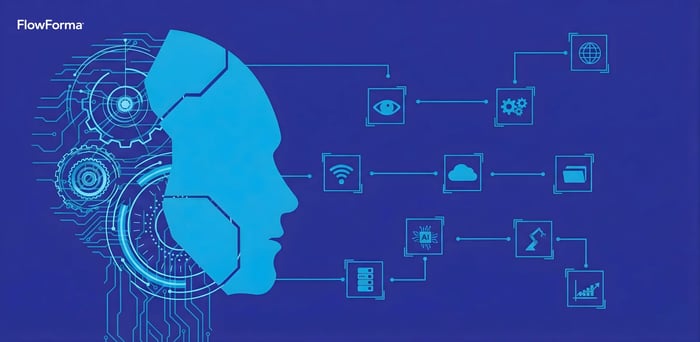
Multi-intelligence AI models assign delivers reliable analysis
A single AI model cannot effectively evaluate penetration tests, interpret policies, and validate evidence at equal depth.
Multi-agent AI systems assign clear responsibilities — one agent for analyzing technical reports, another for reviewing policies, another for summarizing risk. This layered approach strengthens reliability and provides higher-quality insights across complex security questionnaires.
5. AI integrates seamlessly into existing security and compliance workflows
AI automation is most effective when it fits into established processes rather than creating new ones.
Modern AI security questionnaire tools integrate with existing systems, support collaborative review, and enable different stakeholders — legal, procurement, compliance teams, and security engineers — to work from a unified source of truth.
This minimizes friction and allows organizations complete security questionnaires without slowing down business operations.
Advanced AI Technologies Powering Security Solutions
Here are a few AI technologies that help security solutions:
1. Natural language processing for complex content
NLP enables AI to read entire questionnaires and long-form security documentation. It identifies vague descriptions, missing details, or areas requiring clarification. This is essential for accurate questionnaire responses.
2. Machine learning for long-term improvement
Machine learning enhances risk detection by learning from historical questionnaire responses and past assessments. It helps security teams identify trends, repeated issues, and emerging risks over time.
3. Document intelligence for evidence validation
Security assessments depend on evidence such as certifications, policies, and audit results. Document intelligence extracts actionable insights—control applicability, exceptions, remediation notes—without manual parsing.
4. Governance and audit capabilities
Security questionnaire tools must support compliance integrity with full audit logs, access controls, and a secure environment. FlowAssure’s tenant-based Microsoft 365 architecture ensures that sensitive data never leaves the customer’s existing systems.
Introducing FlowAssure: The Leading AI Agent for Security Questionnaire
FlowAssure is FlowForma’s dedicated vendor risk management and security questionnaire automation platform, powered by four specialized AI agents — Quinn, Penn, Sam, and Iris.
Each agent is built to handle a distinct part of the security questionnaire process, from completeness checks to penetration test analysis, policy validation, and risk reporting.
This multi-agent architecture makes FlowAssure uniquely capable among leading AI agents for security questionnaires, providing deeper analysis, stronger accuracy, and faster review cycles than generic AI tools.
FlowAssure - FlowForma’s vendor risk management tool
FlowAssure is designed for teams managing complex questionnaires, especially in regulated industries (like insurance or healthcare) where enterprise customers expect complete, consistent, and verifiable questionnaire responses.
FlowAssure’s Key Features
Let us take a look at the tool’s key features:
1. AI-powered vendor risk assessment
FlowAssure automates the review of security questionnaires by reading questionnaire responses, identifying incomplete answers, and surfacing ambiguities or contradictions.
It speeds up vendor risk management by reducing repetitive tasks through AI agents and pre-defined vendor attributes.
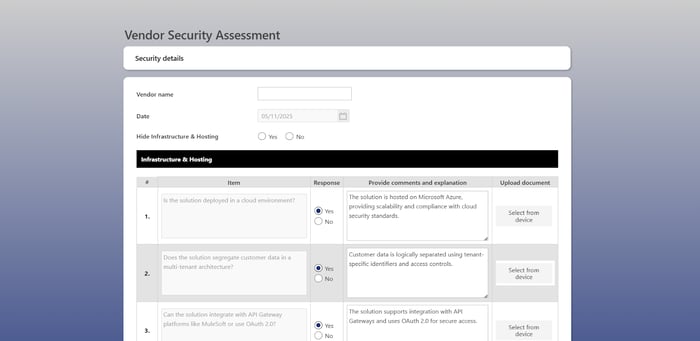
FlowAssure automates end-to-end vendor risk reviews.
The platform interprets long forms, validates claims against security documentation, and produces structured findings that guide reviewers through the security review process.
2. Multi-agent intelligence for deep security analysis

FlowAssure’s AI Agents
FlowAssure uses four specialized AI agents to handle complex security questionnaires:
- Quinn — Completeness and Consistency Review
Quinn reviews entire questionnaires, identifies missing or vague answers, detects contradictions, and flags unsupported claims. This reduces the time spent scanning pages of text for inconsistencies and improves overall accuracy.
- Penn — Penetration Test Intelligence
Penn reads penetration test summaries, interprets severity ratings, identifies remediation gaps, and summarizes technical findings into clear insights for non-technical stakeholders. This is critical for organizations evaluating vendors with varying levels of maturity.
- Sam — Policy and Evidence Validation
Sam validates compliance documents such as policies, SOC2 Type 2 report, DPIAs, and security controls to ensure they support vendor claims.
- Iris — Risk Summary and Reporting
Iris analyzes ISO reports, validates controls, and provides actionable insights to help compliance and security teams assess and manage vendor security risks. It also produces audit-ready summaries combining findings from all agents.
3. Automated risk scoring and intelligent routing
FlowAssure evaluates questionnaire responses and vendor evidence to assign risk scores. This enables teams to prioritize reviews, escalate high-risk findings, and maintain control without getting buried in detail. Risk routing ensures the right stakeholder—security, legal, procurement—reviews each issue.
4. Full audit trails and compliance reporting
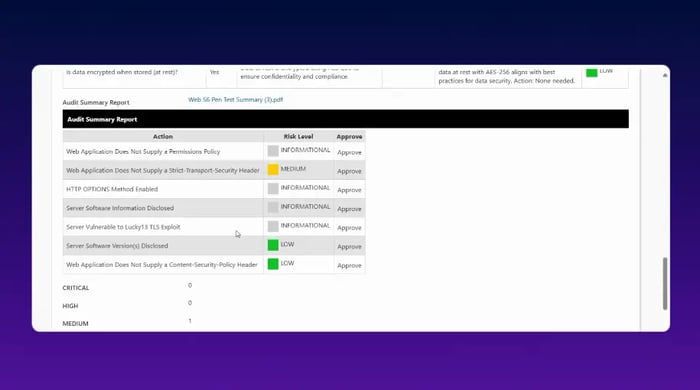
Audit trails generated by FlowAssure
Every action in FlowAssure is recorded in audit logs to support regulatory compliance, internal audit, and external assessments. This includes comments, escalations, documents, and decisions. The ability to demonstrate complete traceability reduces friction for compliance teams preparing for certifications or renewals.
5. Document and evidence review at scale
FlowAssure can read SOC 2 Type 1 and Type 2 reports, ISO 27001 certifications, penetration test attachments, DPAs, and security policies. The AI agents extract relevant information, including control applicability, remediation notes, exceptions, etc.
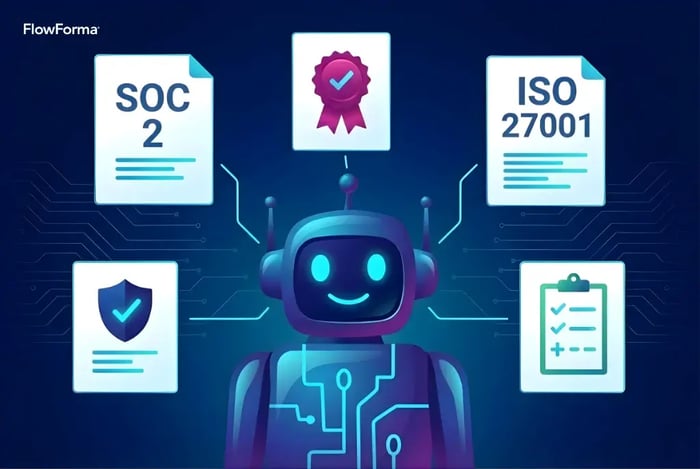
FlowAssure’s ability to read documents and evidence is a key differentiator from other AI tools
This improves the organization’s security posture by ensuring each assessment is backed by verifiable evidence rather than generic claims. FlowAssure’s ability to read evidence is a key differentiator from other AI tools that only summarize text.
Why FlowAssure Is the Smartest Path Forward for Security Questionnaire Automation
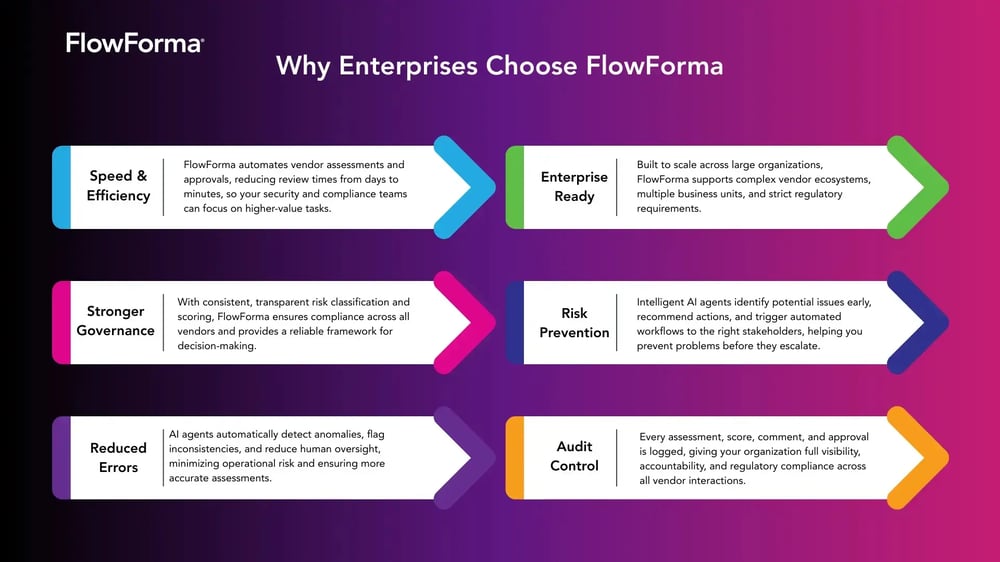
Why enterprises choose FlowAssure
Security questionnaires will only continue to grow in volume, complexity, and scrutiny. Teams can no longer afford slow, inconsistent, or manually driven processes that depend on scattered documentation and repetitive review cycles.
AI agents have become essential for improving accuracy, reducing review fatigue, and strengthening an organization’s overall security posture.
FlowAssure stands out for its four specialized AI agents that deliver deeper analysis, evidence-based insights, and structured outputs. It gives security and compliance teams a governed, scalable, and dependable foundation for every assessment.
For organizations evaluating leading AI agents for security questionnaires, FlowAssure offers a future-ready approach that enhances accuracy, improves operational efficiency, and supports stronger risk management.
Book a personalized demo to see FlowAssure in action.
FAQs
1. Why are organizations turning to leading AI agents for security questionnaire automation?
Organizations handle more security questionnaires each year, and manual review is too time-consuming for compliance teams and security teams.
Leading AI agents for security questionnaire workflows reduce repetitive tasks, support human oversight, and produce accurate responses through evidence-aware automation, thereby strengthening the organization's security posture.
2. What makes FlowAssure different from other AI security questionnaire providers?
Most AI security questionnaire providers focus on summaries. FlowAssure goes deeper—its specialized AI agents evaluate evidence, support vendor risk assessment, and automate questionnaire responses while operating inside Microsoft 365.
This approach improves security assessments, accelerates reviews, and strengthens access controls in regulated industries.
3. How does FlowAssure support compliance teams in regulated industries?
FlowAssure strengthens vendor risk management by validating evidence, supporting compliance frameworks, and ensuring that the questionnaire automation process aligns with regulatory requirements.
By operating within existing systems and maintaining full audit logs, compliance teams can maintain strong governance while completing security questionnaires faster and more reliably.
4. What should organizations keep in mind when evaluating AI tools for security questionnaires?
When evaluating AI tools, focus on whether they produce accurate responses, support security questionnaire automation, and handle complex security questionnaires with evidence validation.
Assess how the tool manages security documentation, enables human oversight, and protects data using strong access controls. Prioritize platforms that strengthen security posture and fit into existing systems without adding risk.