The UK is the third-largest AI market in the world, trailing only behind the US and China. Valued at $92bn (£72.3bn) in 2024, the UK’s AI sector is the largest in Europe, underscoring its central role in global innovation.
As the healthcare sector increasingly embraces generative AI technologies, the potential to improve patient outcomes, efficiency and cost-effectiveness grows exponentially.
But with this growth comes the need to address key challenges, data privacy, ethical concerns and AI integration.
This article explores the current trends, benefits and ethical considerations of generative AI in healthcare and how solutions like FlowForma are helping organisations harness its power securely and efficiently.
An Introduction to Generative AI
Generative AI refers to artificial intelligence systems that create new content or structured outputs, such as text, images, audio, or code, based on patterns learned from existing data.
Built on advanced machine learning architectures, including large language models (LLMs) and diffusion models, these systems are trained on a mix of real-world, licensed, and synthetic data. They can summarise information, identify patterns, generate insights, and support decision-making across a wide range of applications, with options to maintain data privacy and security through responsible deployment practices.
What does generative AI mean in the context of healthcare settings?
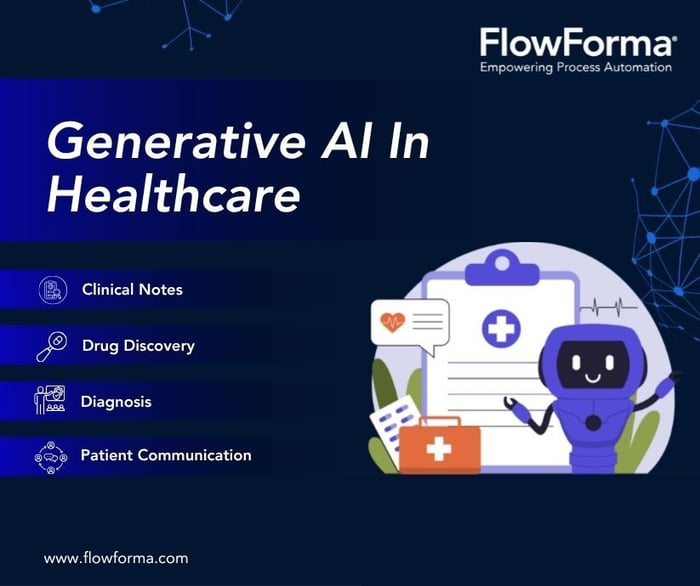 Generative AI applications in healthcare, from diagnosis to communication.
In a healthcare context, generative AI helps healthcare professionals streamline clinical and administrative processes while enhancing patient care.
Key applications include:
- Drafting discharge summaries, visit notes and referral letters
- Normalising electronic health records (EHRs)
- Automating administrative tasks like appointment scheduling or insurance claims
- Extracting key data from unstructured medical data
To name a few.
In addition, generative AI solutions also support clinical practice by identifying potential risk factors within patient datasets, assisting in clinical trial design and recruitment, generating personalised care recommendations, and improving health literacy through clear, patient-friendly explanations.
4 Current Trends in Generative AI for Healthcare [2026]
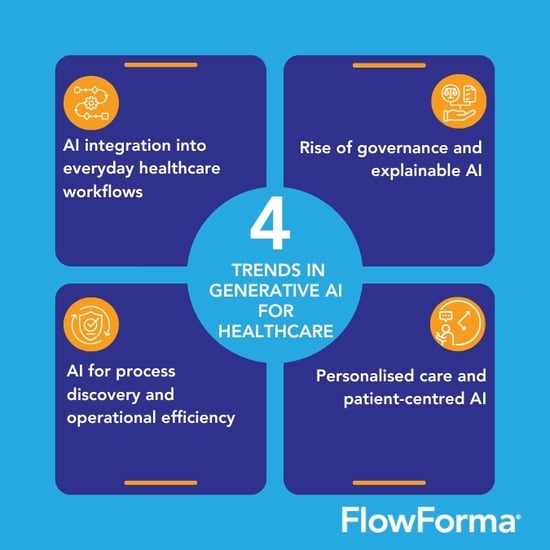 Trends in gen AI for healthcare
The NHS and private healthcare providers are moving beyond pilot projects towards system-wide AI integration. The following five trends show how organisations are using generative AI to deliver measurable improvements while maintaining governance and safety.
The NHS and private healthcare providers are moving beyond pilot projects towards system-wide AI integration. The following four trends show how organisations are using generative AI to deliver measurable improvements while maintaining governance and safety.
1. Integrating AI into everyday workflows
Healthcare organisations are increasingly embedding AI tools within their existing IT systems rather than developing isolated pilots.
FlowForma’s cloud-native, Microsoft 365-aligned platform enables healthcare teams to incorporate AI-generated insights, such as summarised case data or predictive indicators, directly into automated workflows.
Each action is securely logged to ensure compliance with UK GDPR, the Data Protection Act 2018 and the NHS Data Security and Protection Toolkit (DSPT).

Example of a simple patient onboarding workflow
2. Governance and explainable AI take priority
As AI adoption grows, regulators are placing greater emphasis on transparency and accountability. The EU AI Act and the UK AI Assurance Framework classify healthcare AI systems as ‘high risk’, requiring full auditability and explainability.
FlowForma meets these demands through its AI Copilot and Agentic Automation features, which record every AI-driven decision, configuration and modification. This visibility enables clinical governance and IT teams to confirm that AI systems operate safely and in line with policy.
3. AI for process discovery and operational efficiency
Process improvement teams are now using AI to analyse documents, policies and meeting transcripts to uncover opportunities for automation.
FlowForma’s Discovery Agent converts these insights directly into workflow drafts, enabling hospitals to digitise complex processes—from incident management to patient onboarding—without manual mapping or coding.

FlowForma process Discovery Agent
This approach supports the NHS's ambition for ‘digital by default’ operations, empowering staff to accelerate automation in-house while IT teams retain oversight.
4. Personalised care and patient-centred AI
Generative AI is advancing precision medicine by analysing patient histories, genomic data and behavioural patterns to tailor treatments.
A leading UK example is the collaboration between Aston University and Lee Mount Healthcare, which developed an AI-powered smart care home for dementia patients. The system streamlines administration and enables real-time health monitoring.
FlowForma strengthens such innovation by providing the automation layer that governs these processes. Healthcare professionals can build workflows that automatically schedule tests, share results and generate follow-up actions, ensuring every personalised care plan is delivered safely and consistently.
Here’s an example of building a patient onboarding workflow using the AI Copilot:
Top Use Cases of Generative AI For Healthcare Organisations
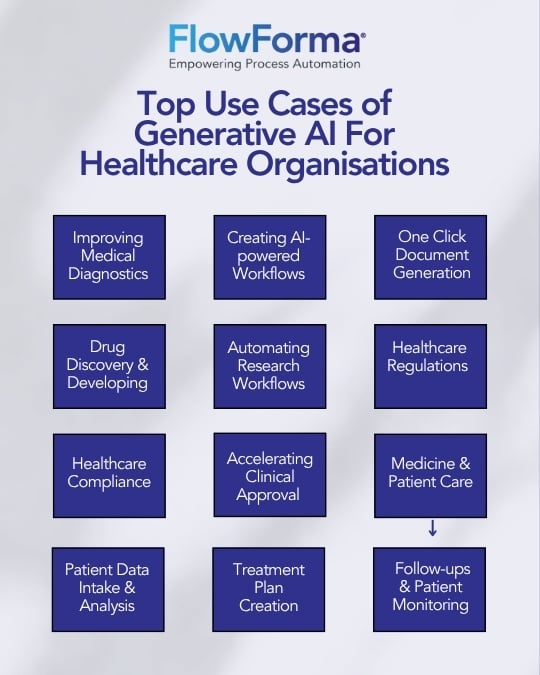 Top use cases of generative AI in healthcare
Let’s walk through the top generative AI use cases in healthcare, including enhancing medical diagnostics, accelerating drug discovery, improving research processes, etc.
Improving medical diagnostics
Diagnostics can be slow, error-prone and fragmented. AI analyses MRIs, X-rays and lab data in real time and feeds that data into workflows that automatically notify the right clinician or trigger follow-up tests.
-
Creating AI-powered healthcare workflows
AI automates diagnostic processes by extracting relevant data from imaging systems, patient records and test results.
Tools like FlowForma enable healthcare teams to design AI-powered workflows that route diagnostic data, update patient records and trigger actions automatically. Manual data entry becomes history and timely intervention becomes the norm.
With the AI Copilot, users can build their preferred workflow (patient scheduling workflow, for instance) using logic, rules and conditions—which they can review before finalising.
-
One-click document generation with AI
With FlowForma’s AI-driven document generation, diagnostic reports and medical records are created and updated automatically.
Once a diagnosis is made, referral letters, discharge notes and summaries are generated with accurate, up-to-date data, reducing errors, ensuring regulatory compliance and improving consistency across clinical records.
Drug discovery and development
Generative AI is revolutionising the pharmaceutical industry by enabling faster drug discovery through data analysis and predictive modelling.
-
Automating research workflows
Pharmaceutical research produces massive volumes of experimental and clinical data that require careful validation and documentation. Generative AI is accelerating discovery by analysing these datasets and predicting molecular interactions faster than traditional methods.
FlowForma complements this innovation by streamlining the operational workflows that support research. The platform’s no-code, AI-powered automation helps teams manage data validation, testing approvals and research documentation with greater accuracy and efficiency, while reducing manual administration.
This way, researchers can easily design automated pipelines that capture laboratory results, initiate quality reviews and generate concise summaries for supervisors.
Healthcare regulations and compliance
-
AI to enhance healthcare regulatory compliance
Pharmaceutical companies must adhere to strict regulatory standards. FlowForma’s AI-driven workflows enable companies to automate regulatory compliance workflows and documentation, ensuring that all necessary approvals, tests and records are properly filed.
The platform automatically generates detailed audit trails at every stage of a process, recording who performed, reviewed, or modified each action. This built-in transparency supports continuous compliance and makes it easier for organisations to demonstrate readiness during CQC inspections, NHS DSPT assessments and internal quality audits.
In addition, FlowForma also supports a broad spectrum of regulatory and operational compliance needs, including:
- Data protection and information governance (GDPR, DPA 2018, DSPT; consent management, audit logs, encrypted storage)
- Cybersecurity compliance (NHS Cyber Standards, NCSC guidance; vulnerability scanning, network monitoring, staff training)
- Clinical governance and patient safety (CQC, NHS Clinical Governance, NICE; digital incident reporting, clinical audits, AI dashboards)
- Vendor risk assessment (FlowAssure automates vendor security assessments, analysing questionnaires, pen tests, ISO and SOC2 Type II reports to ensure third-party compliance)
- Financial and procurement compliance (NHS Financial Manual, Public Contracts Regulations; e-procurement, expense tracking, audit trails)
- Workforce compliance and training (Employment checks, Care Certificate, mandatory training; credential verification, e-learning tracking)
- Clinical coding and data quality (Accurate patient records, NHS Digital Clinical Classifications Service compliance)
-
Accelerating clinical approval processes and workflows
Ensuring clinical safety is critical but often slowed by manual processes and paperwork. Digital process automation can streamline these workflows, track safety checks and generate reports efficiently. This not only ensures compliance but also generates regulatory documents efficiently.
Take Blackpool Teaching Hospitals NHS Foundation Trust, for instance. Critical processes such as clinical safety checks, that once relied on paper, were automated.
Another huge benefit of FlowForma Process Automation is the simplicity around user permissions. We can be confident that we are adhering to information governance rules that make sure only appropriate users can access certain sets of data.”
- Martyn McKechnie
Head of Digital Identity and System Administration, Blackpool Teaching Hospitals NHS Foundation Trust
|
The result was faster completion, reduced administrative burden and improved compliance, showing how automation can strengthen clinical safety across healthcare settings.
Personalised medicine and patient care
Generative AI is helping healthcare providers personalise treatment plans by analysing patient data, including genetic information, medical history and lifestyle factors.
-
Automating patient data intake and analysis
The first step in personalised medicine is the collection and analysis of patient data. In such settings, no-code platforms help design and automate workflows that gather patient information from various sources, such as intake forms, genetic testing and medical records.
A European hospital used FlowForma’s no-code automation to simplify form-filing for recurring medical tasks, using the platform’s Theatre Notes to capture procedure details.
-
AI-driven treatment plan creation
AI can analyse patient data, clinical history and treatment outcomes to generate personalised insights, helping clinicians identify the most effective interventions. However, translating these insights into actionable treatment plans can be slow and error-prone if done manually.
FlowForma bridges this gap by turning AI-driven recommendations into ready-to-use workflows. Clinicians can enter contextual prompts in the FlowForma Playground (as shown below) or upload forms and diagrams, which the platform transforms into ready-to-use processes.
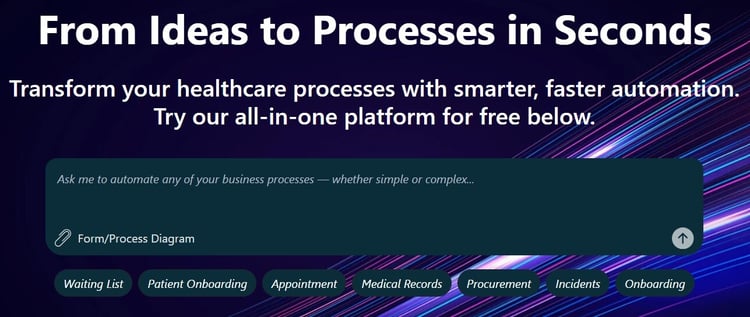 FlowForma playground turning ideas into automated processes in seconds
-
Streamlining follow-ups and patient monitoring
Effective patient care depends not only on creating personalised treatment plans but also on ensuring timely follow-ups and accurate record-keeping. Automating the scheduling of appointments, tests and ongoing monitoring helps ensure that no steps in the care plan are missed.
For example, when you build a patient scheduling process with FlowForma AI Copilot, post-appointment follow-ups can also be automatically managed.
Building and reviewing post-appointment follow-up workflow in FlowForma Copilot
Likewise, keeping patient records automatically updated with the latest treatment and follow-up information gives clinicians a clear, up-to-date view of each patient’s progress, supporting more informed decisions and improved outcomes.
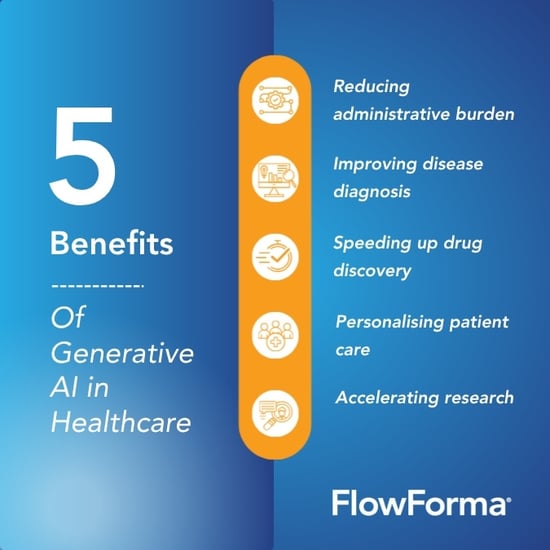
5 Benefits of Generative AI in Healthcare
 Caption: Benefits of gen AI in the healthcare sector
The following are the benefits of generative AI in the healthcare sector:
1. Efficiency and cost savings to reduce administrative burden
Across studies, healthcare leaders rank back-office and documentation wins first—such as scheduling, patient intake, prior authorisation, claims narratives and discharge summaries.
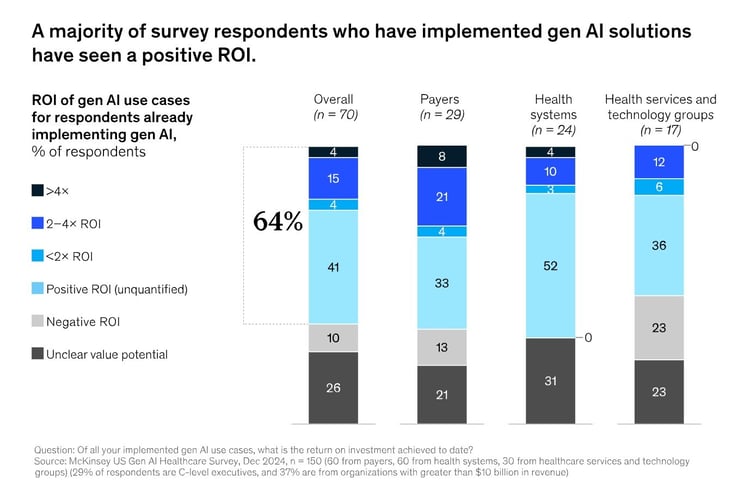
When asked about ROI from generative AI in healthcare, 75% of professionals cited better administrative efficiency, 74% improved clinical productivity and 64% positive ROI, highlighting its impact on efficiency and health outcomes.
 Caption: ROI of generative AI use cases in healthcare (source: McKinsey)
Platforms like FlowForma help healthcare organisations realise these benefits in practice. With transparent, cost-effective pricing, FlowForma enables teams to scale automation across departments.
Such transparency helps leaders plan digital transformation confidently and maximise ROI from generative AI.
2. Enhancing disease diagnosis
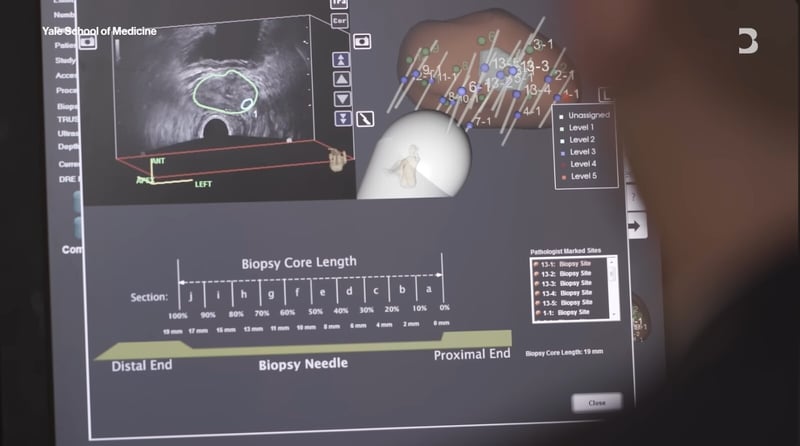
Gen AI is transforming diagnostics through deep learning models that now match or even surpass human accuracy. For example, doctors have developed an AI tool capable of predicting which prostate cancer patients will respond best to a life-saving drug.
This implies how generative artificial intelligence can help healthcare professionals improve patient safety and diagnostic accuracy.
3. Accelerating drug discovery
AI is reshaping drug development by predicting compound behaviour, generating synthetic data and simulating molecular interactions at scale—reducing both time and cost. Several recent examples highlight its growing impact:
While generative AI drives scientific breakthroughs, FlowForma provides the administrative backbone that supports these initiatives—automating document submissions, managing version control and streamlining inter-departmental approvals with full traceability.
Together, these capabilities make drug discovery not only faster and smarter, but also more compliant and well-governed.
4. Personalising patient care
Gen AI enables personalised medicine by analysing genetic, lifestyle and clinical data to tailor treatments, identifying the most effective therapies for each patient while reducing adverse reactions. It can also predict how patients will respond to different interventions, allowing clinicians to fine-tune treatment strategies.
This precision approach helps healthcare professionals enhance patient education, health literacy and patient outcomes, while optimising resource use across health systems.
5. Accelerating research and drug-development time
Through synthetic data generation and data utility enhancement, generative AI technologies enable safe modelling of clinical trials, especially in rare disease research, where local data is limited.
 Using AI to detect hidden abnormalities in heart scans
Projects such as the use of AI tools to identify hidden cardiovascular abnormalities invisible to human eyes demonstrate how artificial intelligence accelerates discovery while maintaining trustworthy AI tools for better healthcare services.
In sum, generative AI in healthcare is more than automation. It’s a catalyst for better diagnostics, faster discoveries and safer, more personalised patient care—from identifying potential compounds to optimising development pathways.
Top Challenges and Ethical Considerations of Using Generative AI in Healthcare
 Challenges of generative AI in healthcare
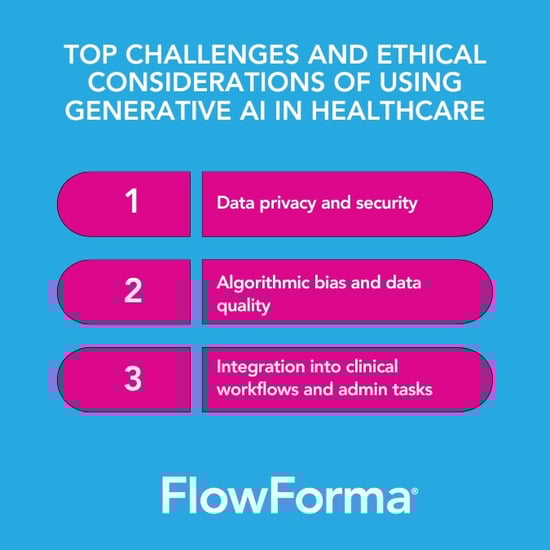
While generative AI technologies hold significant promise for the healthcare sector, their adoption introduces critical ethical and practical challenges for healthcare organisations, regulators and healthcare professionals.
Addressing these responsibly is vital to maintain trust, protect patient safety and improve health outcomes across health systems.
1. Data privacy and security
According to the UK Parliament’s POSTnote 738, many AI models trained on electronic health records risk re-identifying sensitive patient information from training data. These risks extend to LLMs and generative AI systems capable of reproducing details from medical records or image data.
T
o comply with the EU AI Act, healthcare providers must adopt risk mitigation strategies such as anonymisation, secure model training and the use of synthetic data to protect PHI.
FlowForma helps mitigate these risks through robust governance controls, including role-based permissions, data encryption and automated audit trails that ensure compliance with UK GDPR and NHS DSPT standards.
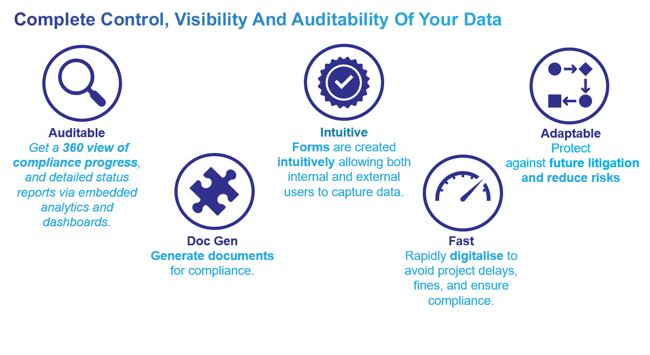 Caption: FlowForma’s compliance modules
All data is securely stored within the organisation’s own SharePoint tenancy, giving healthcare providers full ownership and control over sensitive information.
2. Algorithmic bias and data quality
The European Parliament study (2022) highlights that AI systems trained on non-representative or low-quality medical data can perpetuate bias. This is particularly concerning where local data from underrepresented populations is lacking.
Ensuring diverse, high-quality training data is essential to create trustworthy AI tools that improve fairness in clinical practice and support equitable access to universal health coverage.
3. Integration into clinical workflows and administrative tasks
Fewer than one in three healthcare organisations have successfully embedded AI technologies into routine clinical workflows. Poor digital infrastructure, limited health literacy and cultural resistance contribute to this slow uptake.
FlowForma addresses these challenges through its no-code design, enabling both clinical and administrative teams to automate processes without relying heavily on IT resources. At the same time, IT departments retain complete oversight and governance, ensuring a balance between agility, control and compliance.
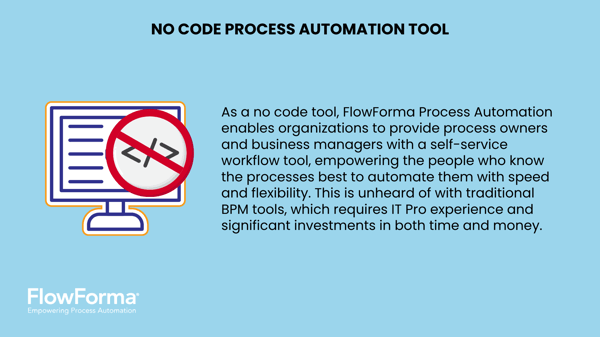 FlowForma’s no-code approach
This approach helps healthcare organisations integrate AI safely into everyday operations while reducing administrative burdens and improving staff confidence in using new technologies.
How FlowForma's AI Innovations Are Transforming Healthcare
FlowForma is an AI-powered business process automation platform designed to help healthcare organisations optimise care delivery, enhance patient safety and achieve measurable improvements in operational efficiency and health outcomes. Building on this foundation, its AI suite brings practical, secure intelligence to every stage of healthcare automation, as explained below:
1. AI Copilot: Compliant healthcare workflows in seconds
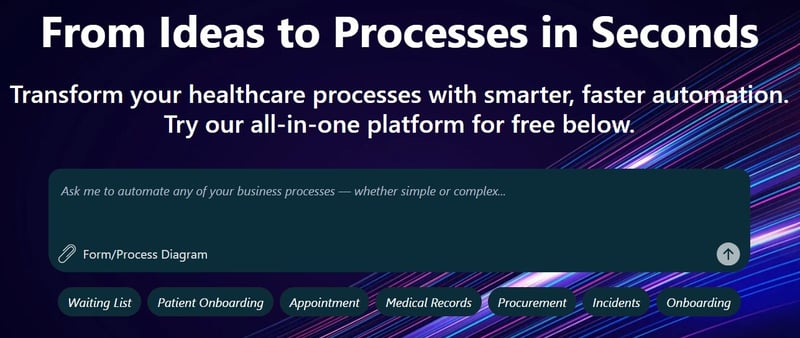 FlowForma AI Copilot
FlowForma Copilot turns a written prompt, image, or form into a working healthcare process in moments, helping healthcare teams and NHS organisations improve cost savings with optimal workflow. It automatically applies governance, defines permissions and records every AI action for audit.
|
Ready to transform your NHS workflows? Just enter a prompt or upload forms/diagrams to the FlowForma playground and watch it build compliant, audit-ready processes instantly. Give it a try for free.
|
Healthcare teams can design compliant workflows—such as approvals, discharge summaries, or claims routing—reducing the imperative of coding skills and IT dependency. This speeds up deployment, reduces cost and lowers administrative burden.
2. AI Summarise: Saving time on documentation
AI Summarise condenses long reports, referrals or clinical notes into short, structured briefs. It helps clinicians and administrators extract the right data from electronic health records (EHRs) quickly, improving decision-making while maintaining visibility of the original source.
The result: faster reviews, fewer delays and consistent documentation quality across departments.
3. Discovery Agent: Build processes from conversations
FlowForma process Discovery Agent
Capture workflows directly from meetings and daily work in minutes. The Discovery Agent spots bottlenecks, missing steps and compliance risks, turning audits into continuous optimisation that improves efficiency and patient outcomes.
4. Agentic Automation: Safe autonomy
Automatically execute defined steps within approved limits. Assign reviewers, send alerts, update records and validate data with full traceability—helping hospitals handle high volumes safely and efficiently.
5. Smart Assistants: Support staff and compliance
Guide users through complex forms in real time, flag missing information and suggest next actions. Smart Assistants reduce training needs, support health literacy and free clinical and admin teams for direct patient care.
FlowForma’s AI capabilities give healthcare organisations the confidence to adopt generative AI technologies responsibly. They secure sensitive patient information, comply with NHS and EU data frameworks and simplify the path from insight to action.
6. FlowAssure: Automated vendor risk management
FlowAssure automates third-party risk assessments for medical device suppliers, pharmaceutical vendors and IT service providers. AI agents review security questionnaires, analyse pen tests and evaluate ISO and SOC2 Type II certifications—flagging risks and routing approvals automatically.
This ensures vendor compliance with NHS cybersecurity standards whilst reducing manual oversight and accelerating procurement.
The outcome is clear: trusted automation that improves efficiency, strengthens compliance and supports better patient outcomes across the healthcare system.
Drive Patient Outcomes and Operational Performance With FlowForma
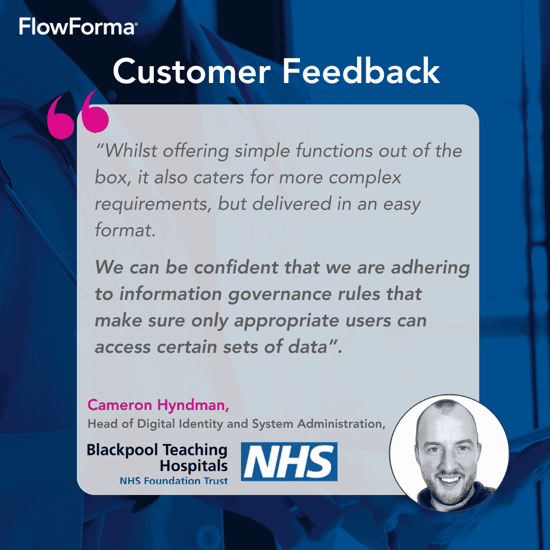 NHS testimonial
FlowForma empowers NHS organisations to digitise and optimise complex healthcare workflows without coding. From streamlining patient referrals to automating clinical audits and compliance reporting, its no-code platform enables teams to deliver faster, safer and more efficient care processes.
Here's how:
- Protects patient data and ensures compliance: Built on Microsoft 365, FlowForma uses encryption, audit trails and role-based access, replacing manual workflows to reduce breach risks and secure medical records in line with the EU AI Act, GDPR and NHS DSPT.
- Offers a cost-effective path to AI adoption: Transparent, process-based pricing, enabling healthcare leaders to scale automation without hidden costs.
- Keeps sensitive information secure: Documents are automatically classified, shared per policy and include validation and approval steps to maintain accountability and controlle access.
- Improves AI reliability and trustworthiness: FlowForma Copilot provides explainable, traceable automation where every AI-driven action is logged and auditable, supporting professional judgement and safe adoption.
- Improves healthcare efficiency: Automating routine administrative tasks frees clinicians for direct patient care, enhancing speed, consistency and outcomes without compromising safety or governance.
Ready to unlock the greater potentials of generative AI in healthcare? Explore FlowForma and its AI-powered innovations for healthcare in action.
.png)