How McKinley Irvin Cut About 90 Minutes From Every Payment Approval
A 120-person family law firm across six offices replaced a seven-step, seven-person email chain with a flow inside SharePoint — and found that the harder win was cultural: people asking to move more processes over.
Every department is now engaged in replacing paper-based processes with best practice processes.
The Challenge
McKinley Irvin is one of the largest divorce and family law firms in the US Northwest with 120 people working across six offices in Washington State and Oregon. The firm has always been progressive in its outlook, leveraging the latest technologies to make processes more efficient in a notoriously paper-intensive business. A period of fast growth and a new recruitment drive has only increased the appetite for change.
“It’s all about freeing up the ‘brain time’ of our paralegals and attorneys, letting them focus on the complex nature of law, rather than day-to-day tasks that can be so time-consuming,” said Dustin Ray, Business Process Analyst. Ray was brought in to advance the company’s digital transformation strategy. He began looking for an automation platform that could support office-type processes and replace manual tasks with something more efficient and cost-effective.
The company already had Microsoft SharePoint®, the document-sharing platform, as part of an Office 365® deployment but was barely using it. With previous experience of InfoPath®, Microsoft’s legacy electronic forms application, Ray had an idea that a modern alternative that was compatible with SharePoint would be a good fit for the firm. He came across FlowForma Process Automation and was immediately impressed.
“
It’s all about freeing up the ‘brain time’ of our paralegals and attorneys, letting them focus on the complex nature of law, rather than day-to-day tasks that can be so time-consuming.
Dustin Ray, Business Process Analyst, McKinley Irvin
The Solution
Having decided on FlowForma Process Automation, McKinley Irvin bought the 250-seat license plan and Dustin Ray undertook the training. While he found the software intuitive and easy to use, one-to-one training webinars were an invaluable part of his learning curve. FlowForma instructors shared their screens and took him through the finer points of the application.
Before long, Ray was building and managing his own online processes. He had identified two internal processes that were ripe for automation. The first was a straightforward turnkey solution, a better way of managing client funds that McKinley Irvin spends on their behalf. Historically, it had been a seven-step manual process with seven people involved in emailing each other notifications. The second was for new employee onboarding, much needed as the company was growing fast.
There are diverse roles within the firm, broadly categorized as either legal or administrative. Each job has distinct IT and application needs. “The software people use will be radically different depending on the part of the company they work in. The legal configuration can also vary across the two states we operate out of,” explained Ray.
Important regulatory requirements are also addressed – something that Ray identified from the outset as critical. FlowForma Process Automation ‘flows’ provide an auditable record of exchanges that is much harder to achieve with a disparate collection of emails. The fact that it occurs inside SharePoint, part of a “trusted Microsoft application”, has helped mitigate risk.
“
The software people use will be radically different depending on the part of the company they work in. The legal configuration can also vary across the two states we operate out of.
Dustin Ray, Business Process Analyst, McKinley Irvin
The Outcome
By starting to automate the large amounts of document generation that take place in a legal practice, FlowForma BPM is providing McKinley Irvin with new efficiencies. Crucially, for Dustin Ray, it liberates employees from process drudgery. “By enabling our people to focus on the legal questions at hand, not on typing documents, we’re seeing cost savings and efficiencies,” he said.
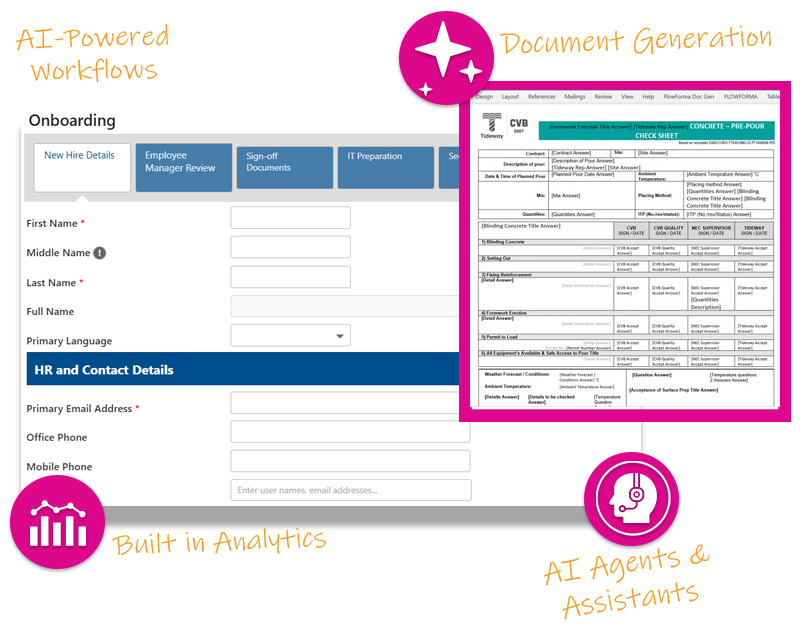
Benefits for the first two projects have helped make a solid business case for FlowForma Process Automation. The payment flow accesses SharePoint lists in a seamless approval process that saves around one-and-a-half hours per request, according to Ray. The onboarding process saves several hours around each new hire, because all the fields are taken care of in different templates, where only the relevant configuration is displayed to the user.
The big win has been the way FlowForma Process Automation keeps processes moving. “Anyone who works in an office can attest that an email inbox is not where you want your critical requests to lay,” said Ray.
The no-code environment, easy set-up, and rich features have made a big impression on Dustin Ray. What he didn’t anticipate, however, is how warmly it would be received by the wider practice. “Employees talk about FlowForma Process Automation in a very positive way and are looking to move more processes over to it. I’ve been involved with a lot of change management projects and it’s not often you see that willingness to adopt new processes,” he said. “What we’re looking for now, slowly but surely, is to have FlowForma Process Automation take on the role of document generation across the firm with potentially dozens of flows. There is a huge appetite for it.”
He also spoke highly of the FlowForma team and the support that has been provided. “They have been fantastic. We’re a few time zones apart but they are great about making themselves available,” he said.
“
I’ve been involved with a lot of change management projects and it’s not often you see that willingness to adopt new processes.
Dustin Ray, Business Process Analyst, McKinley Irvin
Case Study Feedback
Dustin Ray
Business Process Analyst, McKinley Irvin
“
It had a robust set of features and required no coding skills, so that was an advantage. For an analyst role like mine, I needed something that would be relatively easy to step into where I could start learning immediately.
Having a one-stop shop that we can go to for a heads-up on a process, where we can see instantly if any action needs to be taken, has been indispensable.