
How a Canadian Oil & Gas Firm Scaled Without Adding Headcount
A change of ownership across ten Canadian offices triggered a process review, and the choice was stark: hire more people, or automate. Four workflows are live across operations, engineering, quality, HR and finance — each one designed by the team that uses it.
4
workflows live: non-compliance reporting, HR, performance, invoice support
3
more in the pipeline: field service, accounts payable, preventive maintenance
5
functions on one platform — operations, engineering, QA, HR, finance
10
offices across Canada served by the same processes
- Sector
- Oil, gas and energy services
- Organization
- Canadian oil and gas services company — custom-manufacturing of wellhead and frac products
- Trigger
- A transition in ownership prompted a review to find efficiencies for the next phase of growth
- Replaced
- Manual processes running on Excel and email, neither scalable nor efficient
- Approach
- A pilot process first, with stakeholders designing their own workflows
The pain points and the benefits
The Processes
- Non-Compliance Reporting
- HR Onboarding
- Performance Management Tool
- Invoice Support Repository
The Pain Points
- Resources wasted on time-consuming tasks
- Manual processes undermine business scalability
- Large systems make digital transformation difficult
The Benefits
- Easy-to-use, scalable, cost-efficient
- Integrates with existing Microsoft investments
- Encourages stakeholders to be change leaders
- Non-function specific but consistent look and feel
The Next Steps
- New oil and gas process automation workflows are in the pipeline for Field Service Job Tracking, Accounts Payable Processing, and Preventive Maintenance Tracking.
The Challenge
Our clients provide equipment, field services, and custom engineering to oil and gas companies in Canada, with ten offices across the region. A transition in ownership prompted a process review to identify efficiencies that could drive the next phase of growth.
Manual processes involving Excel and email were neither scalable nor efficient. The option was to hire more people or look to technology to reduce human error and provide a platform for growth. The second option won out. Finding a solution that could automate processes and free up people’s time was the priority.
“Adding technology is more cost-effective than adding people,” said the Chief Financial Officer. “And hours spent on manual activities and searching for data is not the best use of our employees’ time, so we were looking to add value by freeing them up to do things that would be more useful to the business.”
Adding technology is more cost-effective than adding people.
The Solution
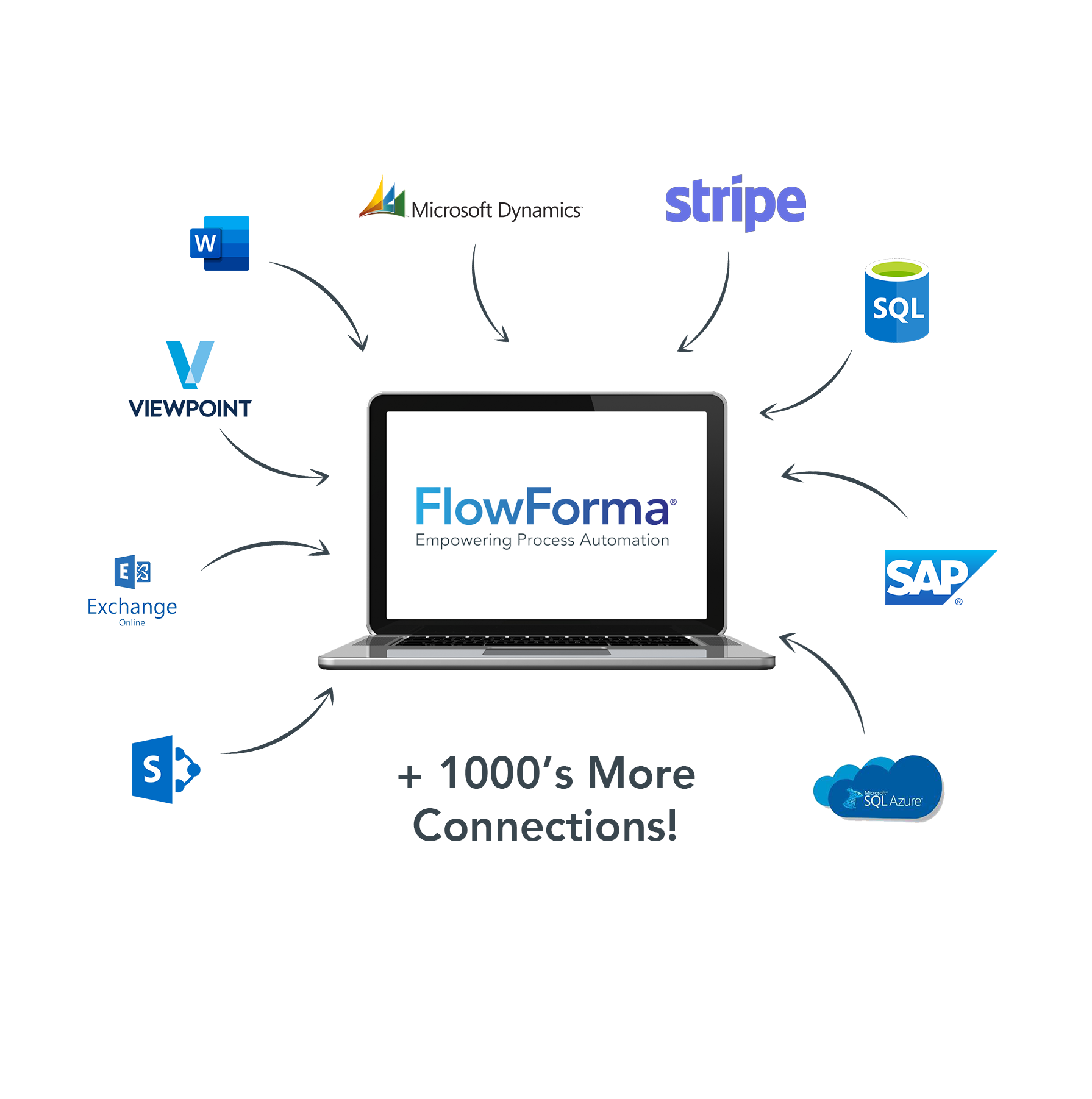
FlowForma Process Automation was chosen because it ticked crucial boxes for this organization: it’s an easy-to-use “no code” solution; it fit within the existing environment, principally Microsoft 365; and it has a strong value proposition as a cloud-hosted subscription service that can easily scale.
The CFO mentions how intuitive FlowForma is to use. Little or no training is required, which he considers important for any technology investment because the effectiveness of a solution is always determined by the willingness of employees to adopt it.
Seamless integration with the Microsoft cloud suite, including Power BI for data analytics, was another benefit and helped make more use of existing software licenses. Perhaps the biggest win, however, was having a highly automated solution that could grow with the restructured business. Once stakeholders were familiar with FlowForma Process Automation, new processes could quickly be developed, as and where needed, at speed.
To get to this point the process champion started with a simple pilot process. He included stakeholders early in the design process to help make the business case; asked for their feedback and took it onboard. It was a well-received Non-Compliance Reporting process for the Quality Assurance (QA) team, which was followed by a HR Onboarding/Offboarding process and then a Performance Management Tool.
The company was soon ready to step up and transition to more sophisticated processes. By now it was understood that using FlowForma Process Automation was not just about replicating old ways of doing things, it was about reinventing processes and doing them better. An Invoice Support Repository for EDI Automation was built in FlowForma Process Automation that typified this new confidence.
There was process improvement and redesign happening at the same time. It’s a good place to be and something that we always plan for now.
The Outcome
The organization has achieved its goal of process improvement through digitization, replacing time-consuming manual processes with automated workflows. Digitization has also contributed to culture change, empowering business owners across different divisions to stamp their authority on process improvements in a positive way.
The new workflows have already delivered tangible business benefits, not all of them expected. In the case of Compliance Reporting, the QA team knew it would be more efficient than assembling information manually in Excel, but its built-in traceability has proved to be a huge time saver when it comes to doing audits.
The HR flow is an example of another FlowForma benefit, where processes are not just digitized, they are rethought and improved. “There was process improvement and redesign happening at the same time,” commented our client. “It’s a good place to be and something that we always plan for now.”
For the EDI Automation flow, FlowForma Process Automation functions as an intermediary in a large-scale digital transformation project, solving a problem for the firm – finding a way to upload invoices from the ERP system to share with customers – without having to invest in expensive new software.
What our client likes most about FlowForma Process Automation is that it’s not function-specific. “It’s highly flexible and cross-functional. It’s used across operations, engineering, Quality Assurance, HR, and finance, but it doesn’t feel like going to totally different systems. It always has a similar look and it’s always very usable.”
It’s used across operations, engineering, Quality Assurance, HR, and finance, but it doesn’t feel like going to totally different systems.
Case Study Feedback
Chief Financial Officer
Canadian oil & gas services company
We’re going to push other people to get involved and use the new processes because it’s going to make all their working lives better. And because they designed them, they are invested in making sure they are adopted.
FlowForma helped us fill in deficiencies without having to invest in a lot of extra infrastructure or implement something new that everyone would have to learn. You don’t have to build the whole process; you can digitize part of it to make things easier.


Inspired by our AI process automation success stories?
Write your own success story today. Take your first steps by speaking with our team of AI process automation experts.