Teams in financial services, healthcare, technology, and other regulated industries often start their compliance journey with Vanta. It helps organizations maintain compliance with frameworks like SOC 2, ISO 27001, HIPAA, and GDPR.
As businesses scale, however, many face rising costs, a steep learning curve, and workflows that don’t align with their actual compliance processes or internal controls. This leads buyers to explore Vanta alternatives that offer stronger workflow automation, deeper risk assessment capabilities, and more flexible third-party risk management.
In this guide, we will:
- Explore the top 10 Vanta competitors to consider in 2026
- Explain why organizations switch and what each tool does well
- Highlight why FlowAssure stands out with AI Agents, in-built compliance controls, and audit readiness
Key Takeaways
- Vanta’s limitations — expanding pricing, rigid workflows, and limited flexibility — push teams toward Vanta alternatives with deeper compliance automation.
- Leading competitors include Drata and Sprinto, which offer SOC 2 alignment and continuous monitoring. Secureframe and OneTrust also stand out for helping teams manage multiple compliance frameworks and broader regulatory requirements.
- FlowAssure stands out as the best alternative to Vanta for organizations seeking compliance automation, vendor risk management, and Microsoft 365 data residency in a single system.
|
Overview of the Top Vanta Competitors in 2026
If you are looking for simple SOC 2 or ISO compliance automation, then Drata and Sprinto are good choices.
If you want support for multiple compliance frameworks and governance workflows, then Secureframe and OneTrust are solid tools. If your primary need is third-party risk management and monitoring external vendors, UpGuard is a good fit.
However, if you want AI Agents for vendor assessments and compliance automation, FlowAssure offers the broadest value as an alternative to Vanta.
Here is a simple view of how the top compliance tools compare:
|
Tool
|
Best For
|
Key Features
|
Pricing
|
|
FlowAssure
|
Compliance-heavy orgs needing workflow automation
|
AI Agents for vendor risk and compliance management, audit readiness, and Microsoft 365 security
|
Transparent, process-based
|
|
Drata
|
Fast SOC 2 readiness
|
Continuous monitoring, automated evidence collection
|
Custom
|
|
Secureframe
|
Multi-framework compliance
|
Policy management, vendor risk workflows
|
Custom
|
|
Sprinto
|
SaaS & cloud-native teams
|
Controls automation, HRIS/SSO mapping
|
Tiered
|
|
SafeBase
|
Customer-facing security reviews
|
Trust center, security posture sharing
|
Custom
|
|
Hyperproof
|
Audit & risk management
|
Risk registers, audit management
|
Enterprise
|
|
OneTrust
|
Governance, risk & compliance
|
Privacy workflows, regulatory compliance workflows
|
Tiered
|
|
UpGuard
|
Third-party security assessments
|
External scanning, security questionnaires
|
Custom
|
|
AuditBoard
|
Internal audit & SOX
|
Audit workflows, evidence collection
|
Enterprise
|
|
Scytale
|
SMEs adopting SOC 2/ISO
|
Templates, evidence automation
|
Custom
|
Table showing the key features, pricing, and core focus of key Vanta alternatives
10 Top Vanta Alternatives in 2026
Now, let us explore each tool, its features, pros, and cons in detail:
1. FlowAssure
FlowForma’s FlowAssure is an AI-powered vendor risk management and compliance platform that helps organizations assess third-party security risks with greater accuracy and speed.
FlowAssure - FlowForma’s vendor risk management tool
FlowAssure helps organizations maintain data residency, strengthen governance, and ensure regulatory alignment across multiple frameworks. It is especially valuable for companies in healthcare, financial services, and other regulated sectors that require consistent, audit-ready vendor assessments.
Key Features of FlowAssure
Let us now expand on the key features that make FlowAssure a standout tool:
1. AI-powered vendor risk assessment
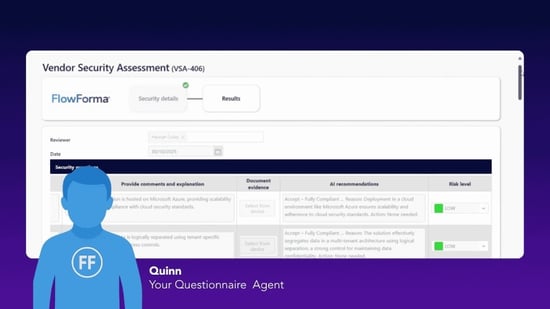 FlowAssure automates end-to-end vendor risk reviews.
FlowAssure automates the heavy lifting in vendor assessments by reviewing questionnaires, validating responses, and highlighting incomplete or ambiguous information.
It helps compliance teams identify security risks faster and ensures assessments follow a consistent, repeatable standard.
This makes it easier for organizations to maintain compliance readiness across SOC 2, ISO 27001, and GDPR.
2. AI Agents for deep security and compliance analysis
FlowAssure uses multiple AI agents to analyze complex vendor documentation, including SOC 2 reports, ISO 27001 certificates, penetration test summaries, security questionnaires, and data processing agreements.

FlowAssure’s AI Agents
- Quinn – Completeness & Consistency Review: Detects missing answers, vague responses, contradictions, and unsupported claims across vendor submissions. Quinn acts as the “first line of intelligence,” helping compliance teams quickly pinpoint risks and ensure regulatory alignment before beginning deeper reviews.
- Penn – Penetration Test Intelligence: Penn specializes in interpreting penetration test reports. It extracts key findings, identifies severity levels, highlights remediation gaps, and summarizes complex security testing results into digestible insights.
- Sam – Policy & Evidence Validation: Sam validates compliance documents such as policies, ISO evidence, DPIAs, and security controls to ensure they support vendor claims.
- Iris – Risk Summary & Reporting: Iris analyzes ISO reports, validates controls, and provides actionable insights to help compliance and security teams assess and manage vendor security risks. It also produces audit-ready summaries combining findings from all agents.
Together, these agents accelerate vendor assessments, improve accuracy, and help organizations ensure regulatory alignment.
3. Automated risk scoring & intelligent routing
FlowAssure assigns risk scores based on vendor responses, documentation quality, and detected gaps. High-risk findings are automatically routed to the appropriate reviewer—compliance, security, procurement, or legal—ensuring faster closure and fewer bottlenecks.
This supports scalable third-party risk management across growing vendor ecosystems.
4. Audit trails & compliance reporting
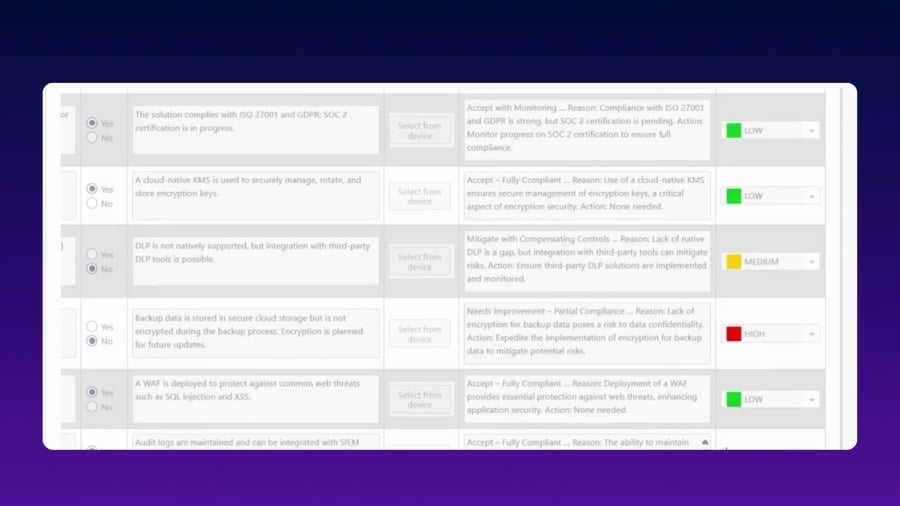
FlowAssure’s compliance module
FlowAssure records every action, comment, escalation, and decision in a complete audit trail.
Teams can generate reports instantly for internal audit, external assessments, or leadership reviews. This improves transparency, supports compliance monitoring, and ensures the organization can demonstrate due diligence during audits.
5. Document & evidence review capabilities
FlowAssure analyzes vendor-submitted documents, including SOC 2 reports, ISO certificates, security policies, DPAs, and penetration test attachments.
It extracts relevant details (scope, control applicability, remediation status, sub-processor information, and exceptions), helping compliance teams quickly understand a vendor’s security posture without manually parsing long documents. This improves speed, accuracy, and clarity during third-party assessments.
FlowAssure’s Pros
- AI-powered vendor risk assessments
- Pen-test agents, questionnaire agents, and AI agents to review SOC Type II and ISO reports
- Automated risk scoring and routing
- Complete audit trails and reporting
- Ideal for compliance-heavy industries
FlowAssure’s Cons
- Best for Microsoft 365 organizations
FlowForma Success Stories
Here are a few real-world examples to understand how FlowForma helps compliance-heavy organizations:
💡Case Study in Focus: How Aon Automated Financial Services & Risk Management Workflows
Aon adopted FlowForma to replace spreadsheet-driven processes that created gaps in documentation and increased organizational risk. FlowForma’s workflow automation helped compliance teams standardize regulatory and audit processes. The platform supported internal audit and security teams with consistent evidence trails, improving audit readiness and reducing delays.
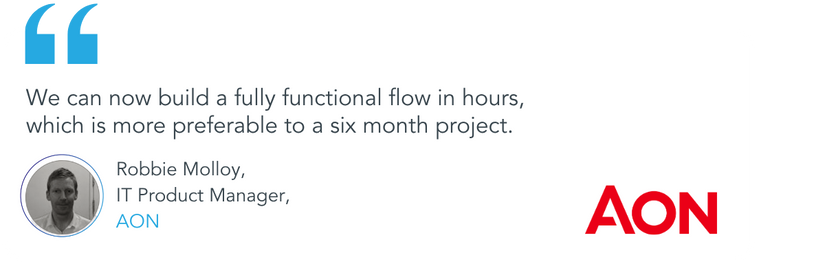 How Aon Brought About Digital Transformation through FlowForma
By keeping all workflows within Microsoft 365, Aon strengthened its security posture and achieved better collaboration across departments.
💡Case Study in Focus: How Blackpool Teaching Hospitals NHS Streamlined Healthcare Governance
Blackpool Teaching Hospitals NHS needed to streamline complex security, onboarding, and clinical governance workflows. Manual documentation made compliance monitoring difficult, especially for recurring audits.
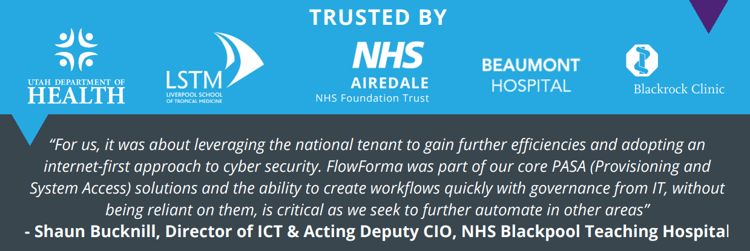
Customer testimonial for FlowForma
FlowForma automated compliance documentation and clinical safety checks, while allowing teams to work within familiar Microsoft systems. This improved accountability, reduced administrative workload, and strengthened regulatory compliance across the Trust.
2. Drata
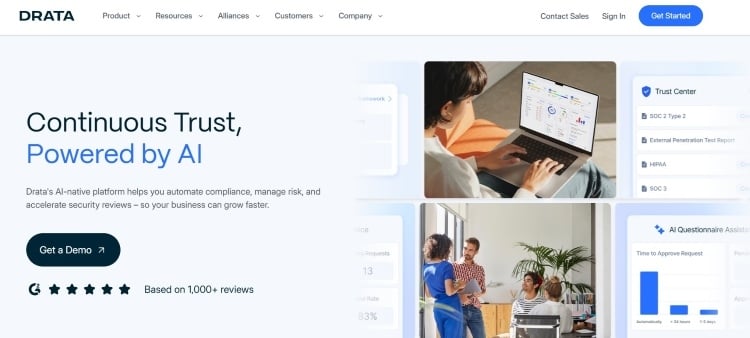
Drata Homepage
Drata is a compliance automation platform designed for companies seeking fast SOC 2 or ISO 27001 alignment. It centralizes continuous monitoring, automated evidence collection, and security questionnaires to help teams maintain compliance with minimal manual work.
Drata’s Key Features
- Continuous monitoring with real-time alerts
- Automated evidence collection across systems
- Cloud services and developer tool integrations
- Built-in security questionnaires
- Risk assessments to support compliance teams
Drata’s Pros
- Quick SOC 2 alignment
- Good customer support
- Clean and intuitive interface
Drata’s Cons
- Limited workflow automation
- Not ideal for multi-team compliance programs
3. Secureframe
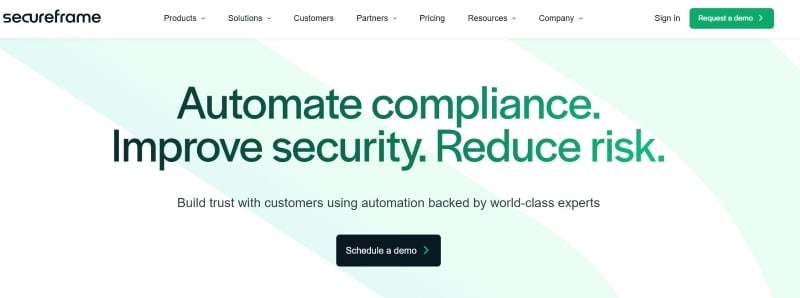
Secureframe homepage
Secureframe helps organizations manage multiple compliance frameworks by providing policy libraries, evidence workflows, and third-party risk assessments in a single platform.
It is well-suited for teams that need structure across SOC, ISO, HIPAA, and privacy frameworks, with continuous compliance monitoring and vendor workflow capabilities. Compliance teams value Secureframe’s templates, though larger programs may need more customization.
Secureframe’s Key Features
- Multi-framework compliance templates
- Automated vendor assessments
- Evidence collection workflows
- Policy templates and training modules
- Compliance monitoring dashboards
Secureframe’s Pros
- Supports complex compliance programs
- Strong vendor workflows
- Helpful onboarding and customer support
Secureframe’s Cons
- Higher cost with additional frameworks
- Complex interface for small teams
4. Sprinto
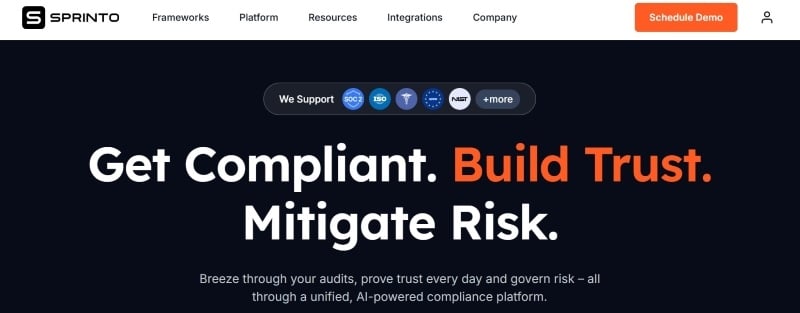
Sprinto’s homepage
Sprinto is built for cloud-native companies that want simple, guided compliance workflows without heavy configuration. It automates controls, evidence collection, and continuous compliance monitoring, making it a good fit for startups seeking fast SOC 2 or ISO readiness.
Sprinto’s Key Features
- Pre-mapped automated controls
- Continuous compliance monitoring
- HRIS/SSO and cloud provider integrations
- Evidence collection automation
- Risk assessments for small compliance teams
Sprinto’s Pros
- Easy implementation
- Simple, beginner-friendly UI
- Good for small teams
Sprinto’s Cons
- Limited audit readiness features
- Not ideal for large compliance programs
5. SafeBase
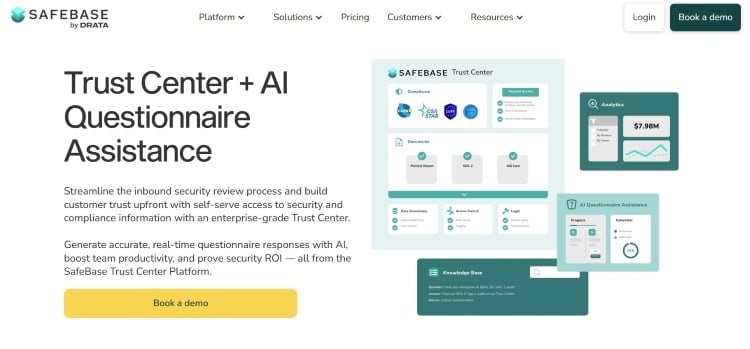
SafeBase Homepage
SafeBase is a trust management platform that helps companies present their security posture, streamline customer-facing security reviews, and reduce repetitive questionnaire cycles. It is favored by sales teams and security teams that need a shareable trust center to speed up deal cycles and improve transparency.
SafeBase’s Key Features
- Public or gated trust center
- Automated security questionnaires
- NDA and access management
- Customer insights for sales and security teams
SafeBase’s Pros
- Reduces friction in security reviews
- Sales-friendly and easy to deploy
- Integrations for platforms such as Slack, Jira, Salesforce, and Teams
SafeBase’s Cons
- Not a full compliance management platform
6. Hyperproof
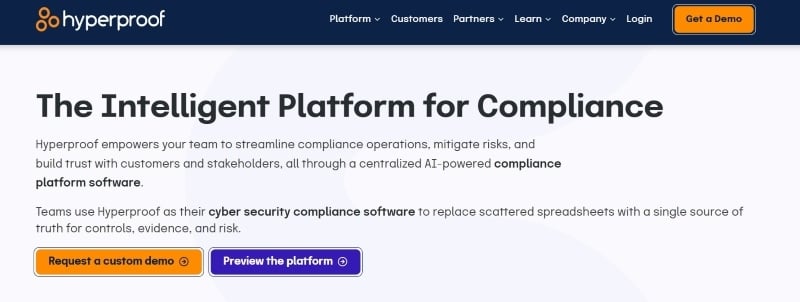
Caption: Hyperproof homepage
Hyperproof supports mature risk and compliance programs by centralizing risk registers, audit workflows, and evidence repositories. It is used by enterprises that have structured internal audit cycles, multiple control owners, and recurring compliance tasks across the business.
Hyperproof’s Key Features
- Risk assessments and risk registers
- Audit management workflows
- Evidence collection and control testing
- Compliance monitoring dashboards
- Issue tracking and remediation management
Hyperproof’s Pros
- Strong internal audit support
- Useful risk management capabilities
- Comprehensive controls tracking
Hyperproof’s Cons
- Expensive for small teams
- Steeper learning curve
7. OneTrust
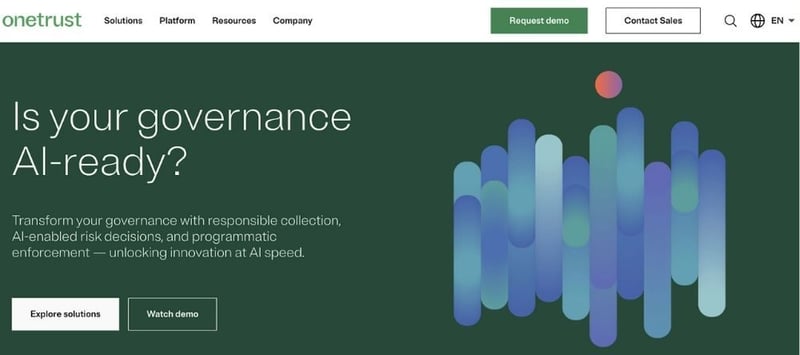
OneTrust Homepage
OneTrust is an enterprise platform for privacy, governance, and regulatory compliance. It supports organizations that need to manage data governance, consent, privacy programs, and complex security requirements across departments. With integrated GRC modules, OneTrust is designed for teams handling large, enterprise-scale compliance programs.
OneTrust’s Key Features
- Governance, risk, and compliance workflows
- Privacy management modules
- Vendor assessments and risk scoring
- Security policies and asset tracking
- Automated workflows and dashboards
OneTrust’s Pros
- Supports multiple frameworks
- Offers reporting and dashboard capabilities
- Provides reliable data governance and privacy
OneTrust’s Cons
8. UpGuard

UpGuard’s Homepage
UpGuard focuses on third-party risk management, external scanning, and continuous monitoring of vendor security posture. It is useful for organizations that rely on many external partners and need to identify vulnerabilities or attack-surface risks quickly.
UpGuard’s Key Features
- Security questionnaires and vendor assessments
- Vendor risk scoring
- Continuous monitoring
- Attack surface analysis
- External security posture insights
UpGuard’s Pros
- Supports vendor assessments
- Real-time insights and alerts
- Offers external monitoring capabilities
UpGuard’s Cons
- Not suited for internal compliance workflows
- Limited workflow automation for compliance tasks
9. AuditBoard
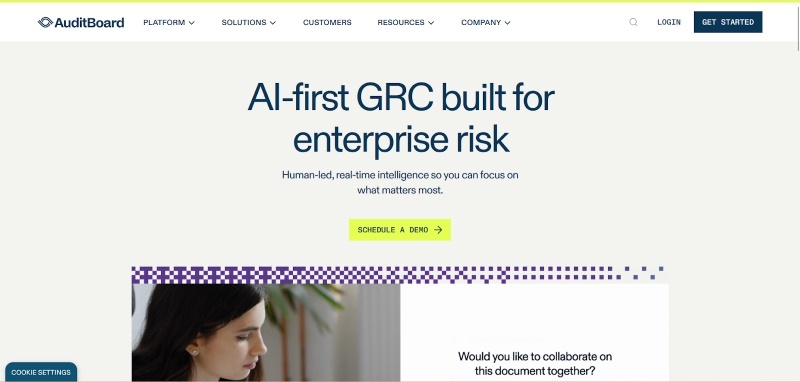
AuditBoard Homepage
AuditBoard is designed for internal audit teams that manage SOX, operational audits, risk assessments, and audit readiness. It centralizes audit processes with built-in workflows, issue tracking, and documentation repositories, helping large organizations streamline governance activities across departments.
AuditBoard’s Key Features
- Internal audit workflows
- AI-powered governance, risk assessments and control mapping
- Issue tracking
- Evidence collection
- Compliance programs dashboard
AuditBoard’s Pros
- Ideal for audit-heavy teams
- Strong documentation and mapping tools
- Well-structured workflows
AuditBoard’s Cons
- Enterprise pricing
- Not ideal for SMBs
10. Scytale

Caption: Scytale homepage
Scytale is designed for SMEs seeking guided SOC 2, ISO 27001, and GDPR workflows. It provides a simple interface, helpful templates, and automation for evidence collection—ideal for smaller organizations that want predictable compliance workflows without complex configuration.
Scytale’s Key Features
- Evidence collection automation
- Security questionnaires
- SOC/ISO templates for easy workflow creation
- Compliance tasks dashboard
Scytale’s Pros
- Good entry point for compliance teams
- Affordable for small businesses
- Clean, intuitive UI
Scytale’s Cons
- Limited for large organizations
- Not ideal for broad workflow automation
Why FlowAssure Is the Best Vanta Alternative
Your ideal Vanta alternative depends on your compliance requirements and workflow needs.
- Drata and Sprinto are best for SOC 2 automation
- Secureframe and OneTrust support complex multi-framework compliance
- UpGuard excels in external vendor security reviews
- AuditBoard suits internal audit teams.
While Vanta offers compliance automation and basic security workflows, FlowAssure goes further by automating vendor assessments, incident reporting, policy sign-offs, access reviews, audit management, and risk assessments — all powered by AI.
Here’s a quick look at why it emerges as the best alternative to Vanta:
FlowAssure vs. Vanta
|
Area
|
FlowAssure
|
Vanta
|
|
Core Purpose
|
AI-powered vendor risk management and compliance assessment platform
|
Compliance automation for SOC 2, ISO 27001, HIPAA, and basic security workflows
|
|
AI Capabilities
|
Specialized AI agents for security questionnaire and penetration test analysis, control validation, and risk summaries
|
Limited AI used for basic automation and evidence collection
|
|
Vendor Risk Management
|
Advanced vendor assessments, AI-driven document review, automated follow-ups, structured risk scoring
|
Basic vendor questionnaires; limited depth in document analysis
|
|
Audit Readiness
|
Complete audit trails, validation logs, risk summaries, and actionable remediation insights
|
Strong external audit preparation, but less flexible for multi-team review processes
|
|
Assessment Depth
|
Reviews SOC 2, ISO, policies, DPAs, pen tests, questionnaires, and flags gaps with high accuracy
|
Primarily focused on SOC 2 and ISO evidence collection, with less contextual analysis
|
|
Deployment Environment
|
Operates fully inside Microsoft 365, supporting governance, security measures, and data residency requirements
|
Hosted outside customer tenancy with less control over governance
|
|
Best For
|
Organizations needing deep vendor assessments and strong third-party risk management (healthcare, financial institutions, insurance, public sector)
|
Startups and SaaS companies primarily needing certification readiness
|
Side-by-Side Comparison of FlowAssure and Vanta across key features
Streamline Compliance Management With FlowAssure

Why enterprises choose FlowAssure
FlowAssure is a strong fit for organizations seeking a scalable vendor risk assessment automation tool along with audit-ready documentation and Microsoft 365 governance.
Its AI agents and no-code design help teams reduce manual work and manage complex processes with confidence. Book a FlowAssure demo to see the tool in action.
FAQs
1. What features should I look for in a Vanta alternative?
The best Vanta competitors provide a host of features to streamline compliance. Key features to look for in alternative compliance automation tools include:
- Intelligent risk assessments to help teams identify and manage security risks
- Integrated governance, risk, and compliance (GRC) capabilities for stronger control over compliance programs
- Seamless integrations with Microsoft 365, cloud services, identity tools, and existing systems
- Robust security measures, including encryption, access controls, and incident management workflows
- Pre-built templates and workflows for SOC 2, ISO 27001, GDPR, and internal processes to help organizations ensure regulatory alignment
2. Is FlowAssure a good alternative to Vanta for multi-team compliance needs?
Yes. FlowAssure is a strong alternative to Vanta for organizations that need broader workflow automation beyond SOC 2 or ISO checklists.
It supports vendor assessments, audit workflows, risk management, and cross-department collaboration inside Microsoft 365.
3. How does FlowAssure help reduce manual compliance tasks?
FlowAssure uses specialized AI agents — Quinn, Penn, Sam, and Iris — to automatically analyze vendor questionnaires, penetration tests, ISO evidence, policies, and security documents. These agents highlight gaps, inconsistencies, and unsupported claims, allowing compliance teams to avoid time-consuming manual reviews.
The platform also automates risk scoring, routes high-risk findings to the appropriate team, and generates audit-ready summaries that strengthen internal controls.







![10 Best OneTrust Competitors For Compliance Management [2026]](https://www.flowforma.com/hubfs/Onetrust-competitors%20%281%29.webp)