“To err is human,” but at enterprise scale, even small mistakes can add up quickly.
For every 10,000 entries, automated systems typically make just one to four errors, while human-managed processes can produce 100 to 400.
That gap, up to a hundredfold, underscores the need for smarter, structured workflows in modern business.
As organizations grow, minor inefficiencies can ripple across teams and operations. Manual handoffs, scattered tools, and inconsistent execution slow decisions and reduce visibility. Enterprise process management provides a structured framework that improves accuracy, transparency, and alignment with business goals.
This thesis was echoed in our recent CIO roundtable, which brought together senior leaders from the insurance, education, healthcare, and construction industries. Of the participants surveyed before the event, 75% cited data inaccuracy as their biggest concern. This underscores the critical importance of data in today’s digital age and reaffirms that effective process management is central to modern enterprise success.
In this blog, I will be discussing the topic in more detail, outlining how enterprise process management works, its key benefits, challenges, and features that enhance effectiveness. I'll also explore how AI-powered process automation platforms like FlowForma enable organizations to transform well-defined workflows into measurable operational impact.
Key Takeaways
- Enterprise process management provides the structure needed to run complex, cross-functional workflows consistently as organisations scale.
- Without process management, automation efforts fragment quickly, increasing operational risk, visibility gaps, and long-term complexity.
- Mature enterprise process management balances speed with governance, allowing faster change while maintaining standards, approvals, and auditability.
- High-impact industries adopt enterprise process management to handle volume, regulation, and variability without sacrificing quality or control.
- Platforms like FlowForma show how AI-assisted, no-code process management helps enterprises move from defined workflows to measurable operational outcomes.
|
What Is Enterprise Process Management?
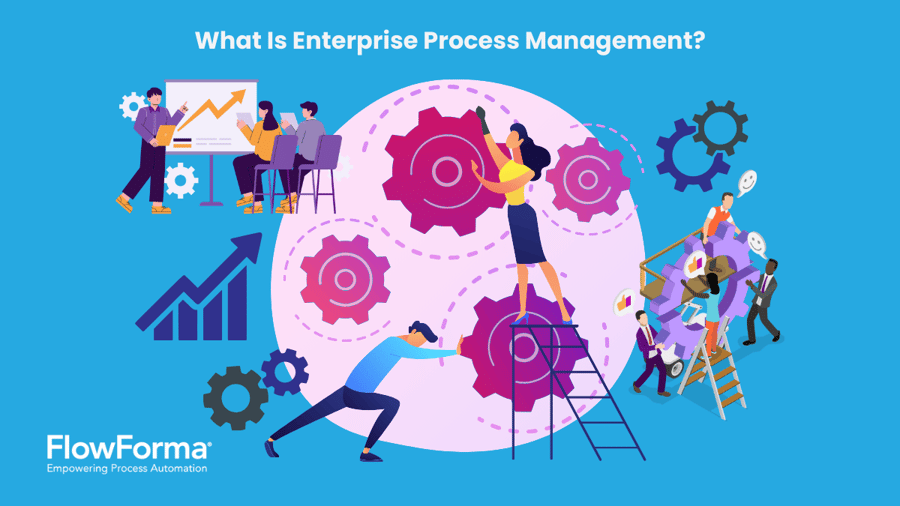
What is enterprise process management?
Process management, also known as business process management (BPM), is a structured approach to defining how business processes are designed, executed, automated, and continuously monitored across the enterprise.
It takes a holistic view of end-to-end processes spanning multiple business units, enabling organizations to maintain consistency, enforce governance, and ensure processes remain aligned with organizational goals as complexity and scale increase.
A traditional onboarding process involves multiple tasks, such as account setup, equipment allocation, training, and approvals, often managed via email and spreadsheets. Process management software streamlines these into a single workflow, automating handoffs, tracking progress, and ensuring consistent, on-time completion.
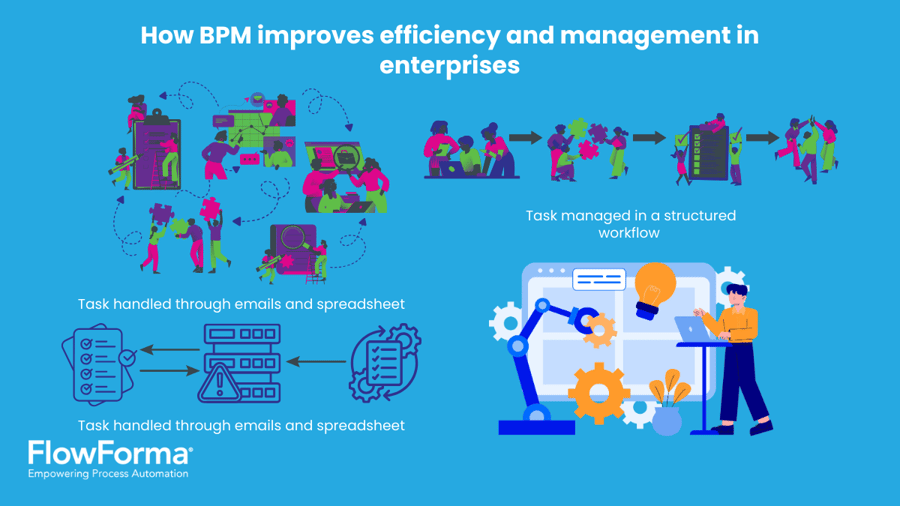
How BPM improves efficiency and management in enterprises
Is business process automation (BPA) different from BPM?
Business process automation (BPA) and business process management (BPM) are related but not the same. BPA focuses on automating specific tasks to reduce manual effort, speed up execution, and limit errors. It improves efficiency within existing processes, often without rethinking how those processes are designed or connected.
BPM takes a broader, end-to-end view of how work flows across people, systems, and data. It covers process design, optimisation, automation, monitoring, and continuous improvement.
Automation supports BPM, but the primary aim is to align processes with business outcomes and keep them adaptable as requirements change. Here’s a quick overview of the key differences between BPA and BPM:
|
Aspect
|
BPA
|
BPM
|
|
Scope
|
Automates specific tasks or steps
|
Manages and improves end-to-end processes
|
|
Primary goal
|
Efficiency and cost reduction
|
Business alignment, optimisation and agility
|
|
Approach
|
Tactical and execution-focused
|
Strategic and lifecycle-driven
|
|
Role of automation
|
Central objective
|
One component of a wider discipline
|
Difference between Business Process Automation (BPA) & Business Process Management (BPM)
Why Process Management Is Important For Enterprises In 2026 & Beyond
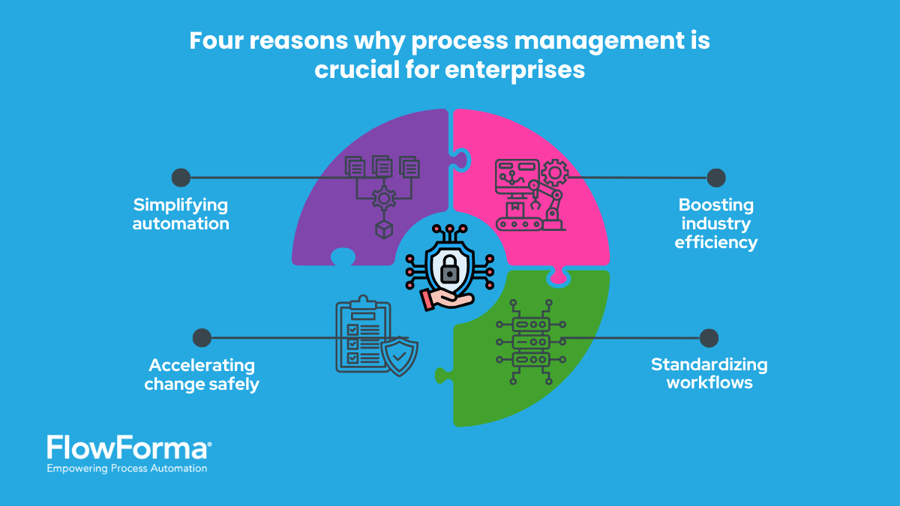 Four reasons why process management is crucial for enterprises
As enterprises scale automation across teams and functions, the focus shifts from automating individual workflows to maintaining control, consistency, and adaptability at scale.
Process management provides the structure and governance needed to deliver efficiency without fragmentation, risk, or long-term complexity, which is why it plays a critical role in enterprise automation strategies today.
In this podcast with Everyday MBA podcast hosted by Kevin Craine, we explore the key considerations that organizations must consider to kick-start their process automation journey and the technologies that are a must have to automate and improve processes.
Let’s explore some strategies:
1. Reducing complexity as automation scales
ARIS’s analyst report found that 80% of enterprises with mature automation practices are expected to pivot to consolidated platforms by 2029 to orchestrate processes and enable end-to-end agentic automation.
As automation expands, disconnected tools and workflows limit visibility and increase operational overhead.
2. Enabling faster change without increasing risk
The same ARIS report also found that 80% of automation platforms are expected to offer AI-assisted development by 2027, reducing development effort and enabling greater participation from business users.
With structured process management, enterprises can accelerate change while enforcing standards, approvals, and auditability.
3. Delivering measurable efficiency in high-impact industries
Industries with high volume, complexity, and regulation see the greatest returns from process management. Across manufacturing, financial services, and healthcare, automation has eliminated billions of working hours, automated around 25% of banking activities, and streamlined core clinical and administrative workflows.
These outcomes demonstrate how managed processes drive efficiency without compromising compliance or quality.
4. Standardizing critical enterprise workflows across regulated industries
Regulated industries rely on repeatable, compliant processes to reduce risk and ensure quality. By standardizing workflows, enterprise process management ensures tasks run consistently, transparently, and at scale. Organizations gain stronger compliance, smoother operations, and fewer errors throughout their processes.
Case Study: Downer Engineering Managing Risk In Construction
Focus: Enterprise-wide compliance, risk management, and governance through digital process automation.
🧩 Context & Compliance Challenges
Downer New Zealand is a large infrastructure, engineering and construction services provider with 30,000+ employees across 120 locations. Prior to automation, key compliance and risk-related issues included:
- Paper-based and manual processes that were slow, error-prone, and difficult to audit.
- Siloed information across sites, hindering enterprise visibility and consistent governance.
- Complex workflows—like Permit to Dig—required multiple handoffs to manage regulatory risk (e.g., utility strikes) and compliance.
These challenges increased organizational risk by making compliance activities less visible, slower, and more error prone.
🛠 Digital Transformation for Stronger Compliance
Downer adopted FlowForma Process Automation to address compliance and risk management at scale. Key elements included:
🔁 Integrated Compliance Workflows
- Digital permit systems replaced paper for high-risk activities like Permit to Dig. The digital form integrates with GIS mapping tools, ensuring accurate risk data is captured and reviewed before field work begins.
- Compliance signals (approvals, risk flagging, inputs from multiple stakeholders) were embedded into workflows, reducing manual steps and potential errors.
📱 Mobile Access and Real-Time Control
- Workflows are accessible via mobile devices, enabling frontline teams to complete tasks accurately and in context—improving real-time compliance and risk mitigation.
- Permissions and process controls were built into the flows, ensuring appropriate review and sign-off stages that align with compliance requirements.
📊 Centralized Data & Audit Trails
- Automation created a single digital source of truth for process data, improving transparency across the enterprise.
- Workflow data is structured and stored centrally – enabling better reporting, analysis, audit prep, and governance oversight.
🎯 Strategic Outcomes
By scaling FlowForma across 23 automated processes, Downer achieved:
- Reduced compliance risk through standardized, governed processes.
- Improved data integrity and operational transparency, which support proactive risk management.
- Empowered teams with tools that enforce process discipline while minimizing dependence on manual controls.
Hear from Cameron Hyndman, National Digital Engineering Lead, Downer on their journey to process excellence in this webinar recording below.
|
6 Core Features to Look for in Enterprise Process Management Software
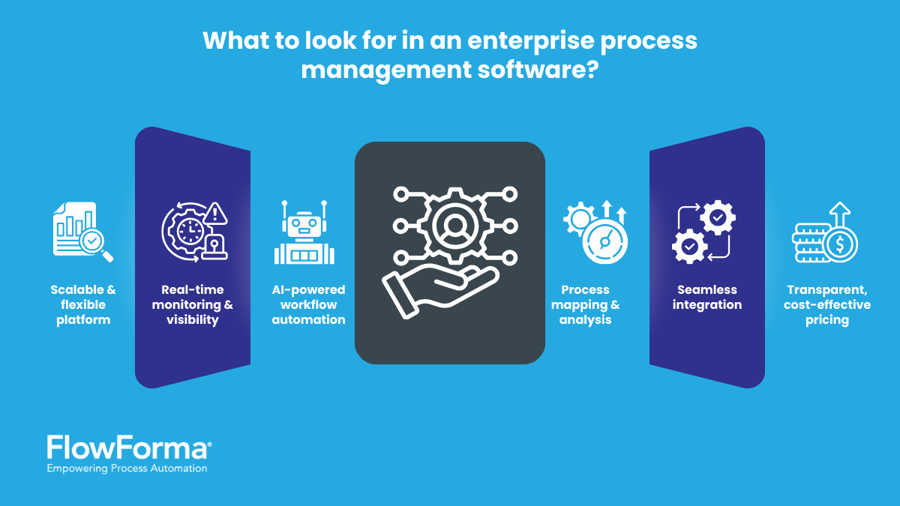
What to look for in an enterprise process management software?
Selecting the right enterprise business process management software requires a strong focus on execution, scalability, and consistent day-to-day process control across the organization.
The following features are essential:
1. Platform scalability and flexibility
As business operations grow, processes must support higher volumes, increased complexity, and new business units. An enterprise-ready BPM platform should scale without constant redesigns or system constraints, while remaining flexible enough to adapt to evolving requirements.
2. Real-time process monitoring and visibility
The BPM software should provide real-time insights into process performance, bottlenecks, and outcomes, enabling faster intervention, informed decision-making, and continuous operational improvement.
3. Enterprise-grade AI and automation for workflow optimization
Built-in automation and AI-driven capabilities should reduce repetitive work, minimize human error, and improve consistency, productivity, and efficiency across enterprise workflows.
4. Process mapping and analysis capabilities
The process management software should support process mapping and modeling to visualize current workflows, identify inefficiencies, and guide structured process optimization initiatives.
5. Integration capabilities
Strong integration capabilities ensure processes remain connected end to end, reduce data silos, and enable automation across the broader technology ecosystem.
6. Cost-effective and transparent pricing models
Pricing should be predictable, scalable, and aligned with business usage. Transparent, process-based pricing enables organizations to expand automation initiatives with confidence, without hidden costs or licensing complexity.
Top 5 Benefits of Enterprise Process Management Systems
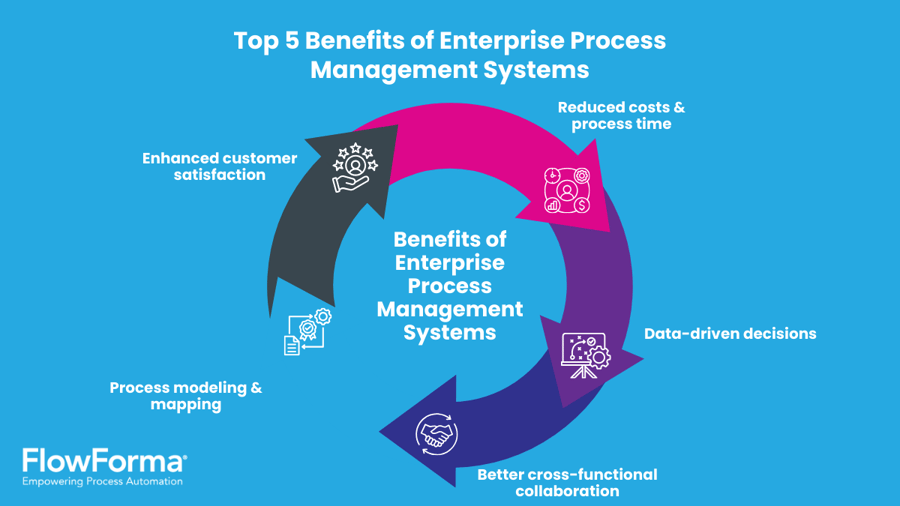
Benefits of process management for enterprises
When implementing enterprise process management at scale, the focus shifts from individual processes to delivering measurable value across teams, workflows, and organizational goals.
1. Improved customer satisfaction
By streamlining customer-facing processes, such as employee onboarding, support workflows, and customer relationship management, enterprise process management directly contributes to higher customer satisfaction.
2. Cost reduction through process optimization
Replacing manual, paper-based workflows with automated processes reduces inefficiencies, rework, and delays.
Grant Thornton, a professional services firm, moved job appraisals, client acceptance, and data access requests away from paper forms, spreadsheets, and email. These processes involved multiple reviewers, high volumes, and strict compliance requirements.
.png?width=800&height=562&name=Customer%20feedback%20for%20FlowForma%20William%20McCann%20(1).png)
Customer feedback for FlowForma
This led to a 60% reduction in process time while improving visibility, reducing manual effort, and lowering operational risk. Read the full case study here.
3. Data-driven decision making
Real-time analytics and process monitoring provide actionable insights, helping organizations manage processes proactively and make informed decisions that improve operational outcomes.
4. Stronger cross-functional collaboration
Enterprise process management breaks down organizational silos by standardizing workflows, improving cross-functional collaboration, and enabling teams to work more effectively across departments. In essence it makes cross-department jobs easier for everyone via streamlined workflows.
We presented on this very subject recently and the video belows shows why
5. Process modeling and mapping
By supporting detailed process modeling and process mapping, enterprise process management helps organizations align processes with strategic objectives, drive continuous improvement, and accelerate time to business value.
The 8 Common Challenges in Process Management for Enterprises (+ Fixes)
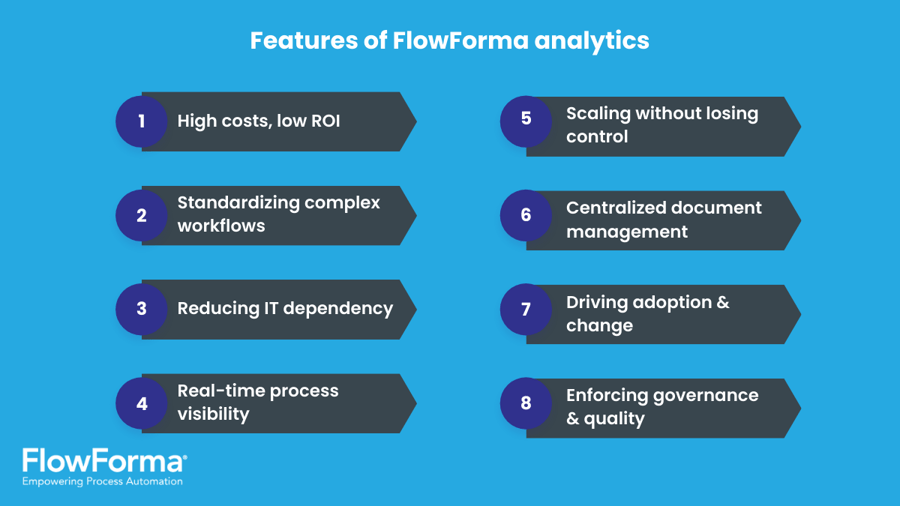
8 process management challenges for enterprises
Enterprise process challenges rarely exist in isolation. They compound as organizations scale, making it harder to maintain control, visibility, and momentum.
Here are the top challenges in enterprise process management and their fixes:
1. Costs that outpace process value
Traditional EPM platforms are expensive, with hefty upfront licensing fees, per-user fees, and hidden costs that escalate as organisations add more processes, users, or business units. Many companies end up paying for capacity they don’t yet use, making it hard to justify investment before automation shows measurable results.
The fix: With transparent, per-process pricing, FlowForma enables teams to start with the most critical workflows, demonstrate measurable impact early, and expand automation across the organisation in a controlled, cost-effective way.
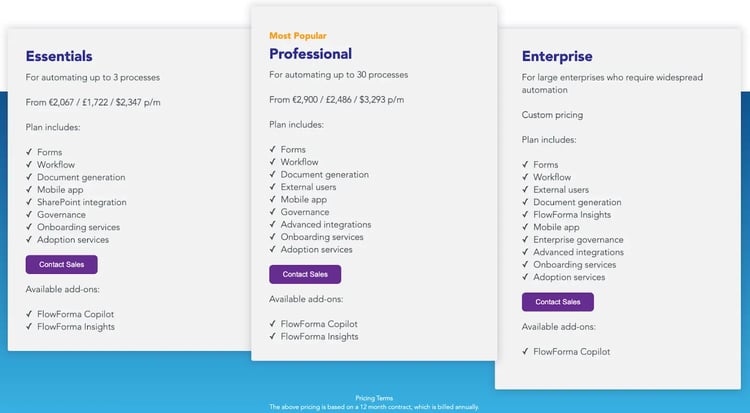 FlowForma’s pricing plans
Enterprise users can, thus, ensure process management scales without unexpected or runaway expenses.
2. Managing complex processes across multiple business units
Enterprises often operate with fragmented workflows that vary by department, region or function, creating inconsistency and duplication.
The fix: Standardizing core workflows (such as onboarding, feedback collection, incident management, renewals, etc.) with AI across the organisation while allowing controlled variations can eliminate duplication and ensure consistency.
For instance, users can create a supplier onboarding process with the FlowForma AI Copilot in just a few steps. Watch this demo video to learn how.
Creating a supplier onboarding process with FlowForma AI Copilot
3. Dependence on IT for process changes
When process updates require coding or system changes, business agility slows, and IT backlogs grow.
The fix: No-code enterprise process automation tools enable you to build, modify, and deploy workflows independently, without mandating any coding skills or heavy reliance on the IT team.
4. Lack of real-time visibility into process performance
Without timely insight, enterprises struggle with delayed decisions and unmanaged risk.
The fix: Implement real-time monitoring and reporting to gain instant visibility into processes, enabling faster decision-making, proactive risk management, and ongoing operational improvement.
Using AI-powered insights and analytics, FlowForma enables users to detect bottlenecks, analyze trends, and flag performance issues to enhance workflow efficiency. Users can also create dynamic dashboards to track processes and trends in real-time.
5. Scaling processes without losing control
Processes that rely on manual steps or disconnected tools break under volume and complexity.
The fix: Adopt scalable, flexible systems that handle growing volumes and complexity while maintaining clear oversight and control over every process.
Learn about FlowForma Governance Hub
6. Fragmented document and content handling
Paper-based forms and scattered documents slow execution and introduce errors.
The fix: Centralize document management and automate content workflows to reduce errors, speed execution, and ensure consistency.
7. Resistance to change and low adoption
Complex tools often fail because employees avoid using them.
The fix: Intuitive, user-friendly tools and training that encourage adoption and make new processes easy to follow.
For instance, FlowForma’s drag-and-drop workflow builder, simple form design, and clear process guidance make it easy for employees to use from day one, minimizing resistance to change and ensuring smooth enterprise-wide adoption.
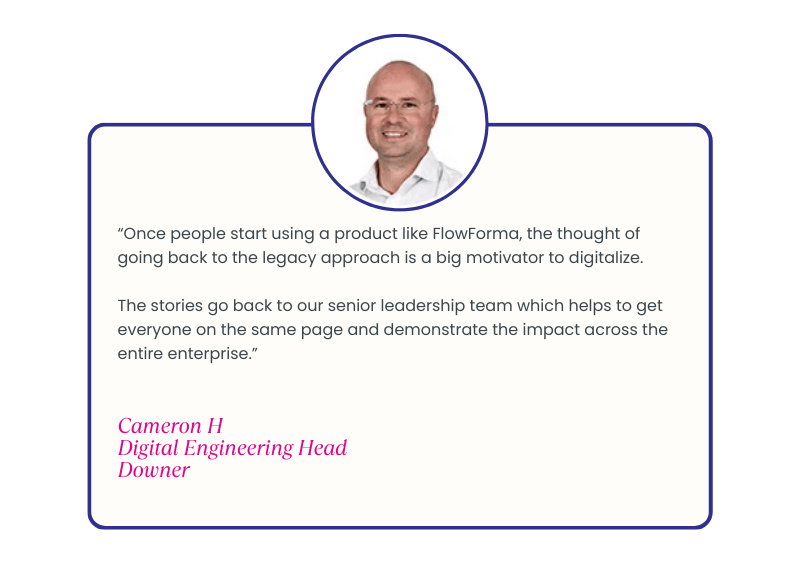
What users say about FlowForma adoption
8. Inconsistent governance and quality standards
Enforcing quality and compliance across processes is difficult without embedded controls.
The fix: Embed compliance controls and standardized workflows to enforce quality, maintain governance, and reduce operational risk.
Why Choose FlowForma for Your Enterprise Process Management Needs
FlowForma modernizes enterprise process management by combining automation, intelligence, and governance in a single platform. Large organizations use it to standardize operations, reduce cycle times, and realize measurable ROI within weeks.
Enterprise teams can design, deploy, and continuously improve processes without constant IT intervention. This shortens delivery timelines while ensuring processes remain consistent across departments and regions.
Key features include:
1. Enterprise-grade AI-powered process automation
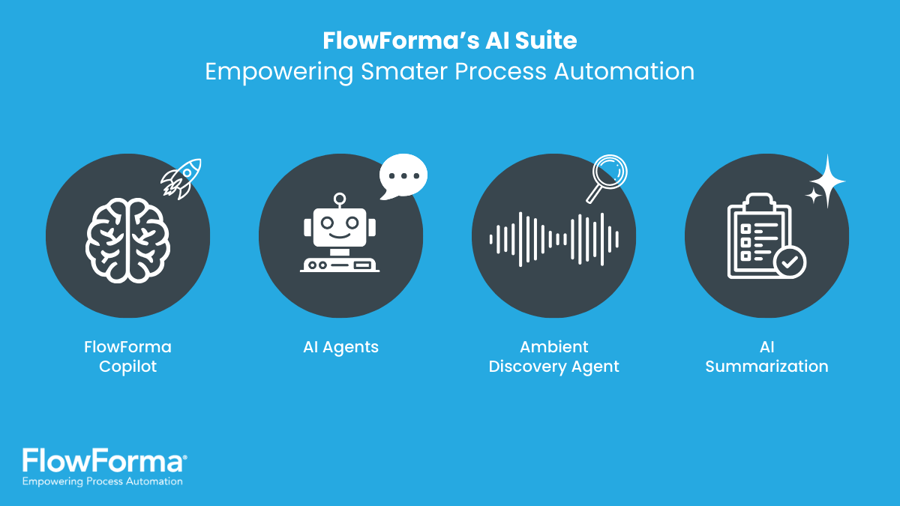
FlowForma’s AI suite
AI accelerates the development and optimization of enterprise processes. Workflows are created in minutes from simple descriptions, with suggested approval paths, policy-aware routing, and multilingual support suited to global operations.
To support enterprise-wide consistency, control, and scalability, FlowForma applies AI directly across the process lifecycle. Here’s how:
|
AI feature
|
What it does
|
Enterprise process management impact
|
|
AI Copilot
|
Creates workflows from natural language
|
Rapid process prototyping, speed up process automation
|
|
AI Agent Rule
|
Extracts and validates document data
|
Automates compliant, document-heavy enterprise processes
|
|
AI Summarization
|
Summarizes process activity and decisions
|
Improves oversight of complex, cross-team workflows
|
|
AI Discovery Agent
|
Captures processes from conversations and content
|
Accelerates identification and prioritization of automation opportunities
|
|
Smart Assistants
|
Guides users and enables natural language actions
|
Drives adoption while enforcing enterprise standards
|
|
AI Insights & Analytics
|
Flags bottlenecks and performance trends
|
Enables continuous optimization and SLA management
|
FlowForma AI capabilities for enterprise process management
2. Enterprise-grade no-code process management with built-in governance
FlowForma allows business teams to model and automate enterprise processes without code, while IT retains full control over governance, access, integrations, and standards. As a result, delivery cycles are shortened, automation backlogs are reduced, and consistency is maintained across departments.
Watch this 2-minute demo video of the FlowForma platform
3. Intuitive drag-and-drop workflow builder and optimization
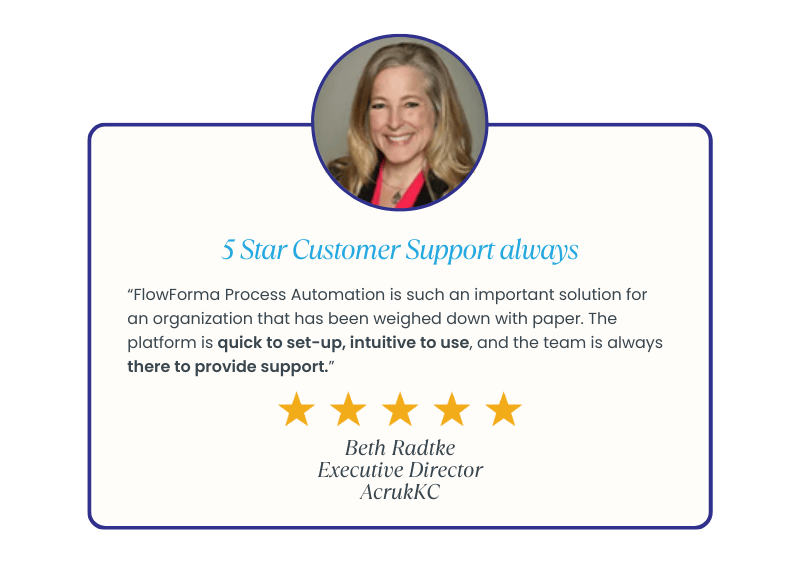
Customer testimonial on FlowForma’s intuitive workflow automation
FlowForma’s intuitive drag-and-drop workflow builder makes designing and optimizing processes simple and efficient.
Users can visually map out workflows, configure approvals, escalations, and automated actions without coding, while built-in optimization tools help streamline tasks, reduce bottlenecks, and ensure processes run smoothly from start to finish.
4. Embedded compliance, auditability, and risk control
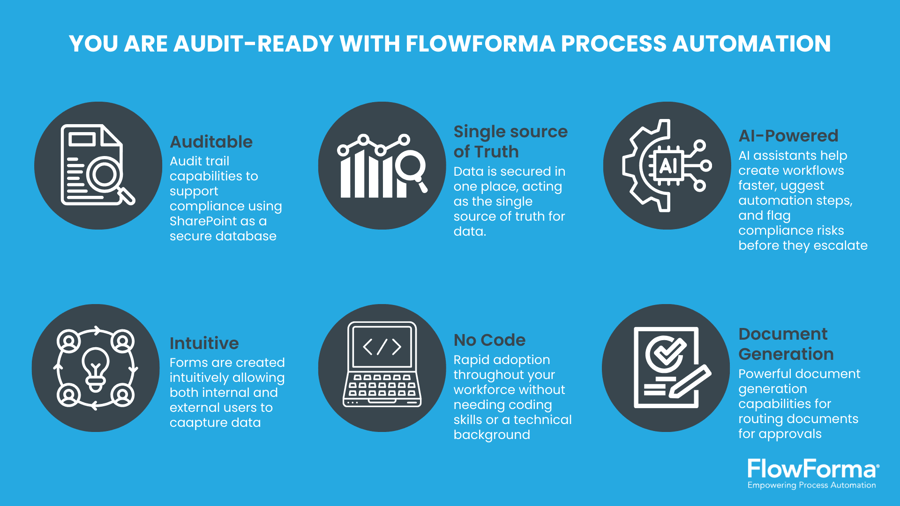
FlowForma’s compliance modules
Every action, decision, and document is automatically recorded, creating complete audit trails that help organizations meet regulatory and industry standards such as HIPAA, SOC 2, and ISO 27001.
The built-in oversight also enhances compliance, strengthens governance, and reduces operational risk.
5. Seamless integration supporting continuous optimization
Native integrations with SharePoint and Microsoft 365, along with over 1,000 application connectors, allow organizations to work seamlessly with existing systems while avoiding data silos.
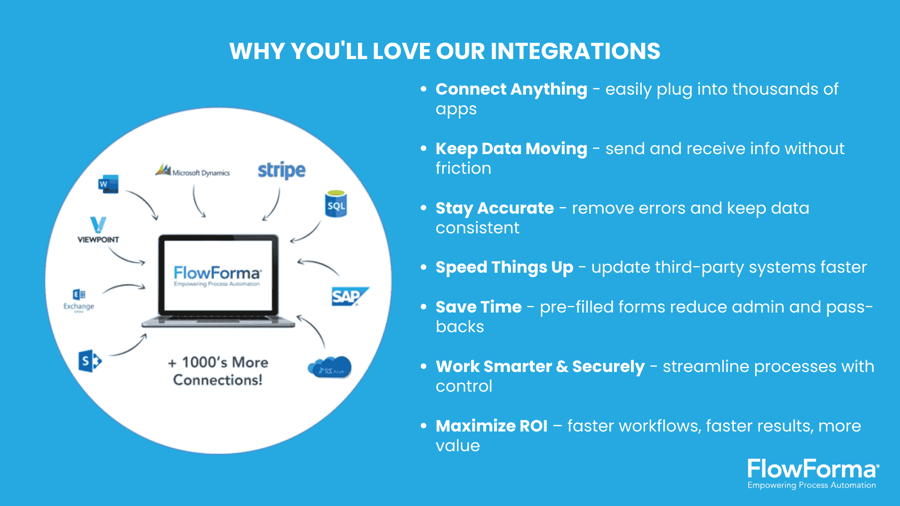
Benefits of FlowForma’s vast integration options
In addition, FlowForma brings together forms, workflows, analytics, document automation, and AI in one cohesive environment, reducing reliance on fragmented tools.
The platform also offers the following advanced workflow optimization capabilities that further strengthen process execution:
- Dynamic form builder simplifies data collection by applying conditional logic, validation rules, smart fields, and built-in error checks.
- Intelligent workflow builder enables teams to design both simple and complex workflows with approvals, escalations, and audit-ready tracking.
- Document automation streamlines the creation of contracts, invoices, and reports using consistent templates, version control, and compliance tracking.
Automated workflows in FlowForma track tasks, deadlines, and documentation, ensuring organizations stay compliant and maintain governance standards.
FlowForma supports digital transformation with a clear, process-based pricing model that scales as needs evolve while preserving control and governance.
See how it brings structure and efficiency to complex workflow management—book a demo today.
Streamline, Govern, and Scale Enterprise Processes with FlowForma
Why FlowForma is a preferred process automation platform for enterprises
As enterprises scale, fragmented workflows, manual processes, and inconsistent governance slow decision-making and increase risk. FlowForma solves these challenges with a no-code, AI-powered enterprise process management platform that centralizes workflows, enforces quality standards, and enables scalable, compliant automation.
Teams can streamline enterprise business process management, optimize enterprise content management processes, and improve efficiency—all while maintaining control and reducing operational risk.
Curious to see how FlowForma works? Take a 7-day free tour of the platform with all-in-one access (AI Agents, forms, workflows & document generation).
FAQs
1. Why is enterprise process management critical for scaling without chaos?
Enterprise process management standardizes and governs business processes as organizations grow. It ensures consistent execution, clear ownership, and process alignment across teams, preventing fragmentation while supporting scale, agility, and operational control.
2. How does enterprise process management reduce IT dependency?
Configurable process management software allows business teams to design, modify, and manage processes independently of IT. By doing so, development backlogs shrink, change accelerates, and IT can focus on higher-value initiatives.
3. How does enterprise process management support the enterprise risk management process?
Enterprise process management strengthens the enterprise risk management process by embedding controls, approvals, and audit trails directly into day-to-day workflows. Risks are identified and managed at the process level rather than after the fact.
4. How does FlowForma support enterprise process management without overloading IT?
With no-code tools, business teams can build and adapt workflows while IT retains governance, security, and oversight. As a result, IT backlogs are reduced without sacrificing control, and processes maintain consistent standards, permissions, and audit requirements even as automation scales.
5. Can FlowForma handle complex, document-heavy enterprise processes?
FlowForma handles workflows with documents, approvals, and strict compliance requirements. AI agents extract and validate data, enforce rules automatically, and generate full audit trails, making it ideal for regulated, high-volume enterprise processes without custom development.
6. What role does enterprise process management play in the enterprise change management process?
Enterprise process management provides a controlled way to introduce, test, and scale change across the organization. Instead of informal updates or ad hoc rollouts, changes are versioned, approved, and monitored through structured workflows.