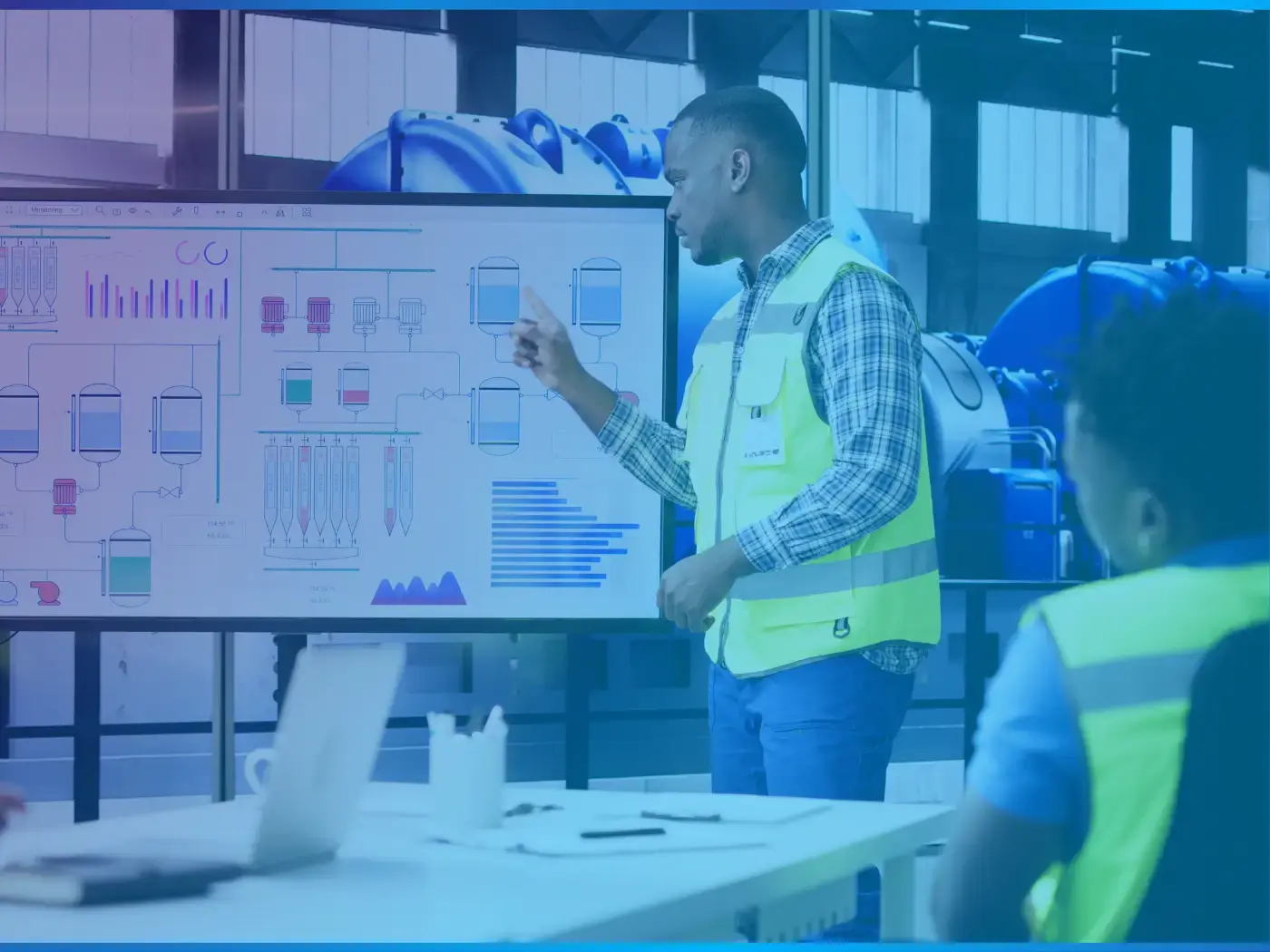
In 2026, automation in the oil and gas industry has firmly moved from the point solution automation phase to enterprise orchestration.
According to EY (2026), 50% of organizations are already running enterprise-wide transformation programmes. This statistic is also backed up from data from our own customer base, where 60% of customers are using our process automation platform for enterprise-wide automation.
| Category |
Description |
Percentage (%) |
| Operational Processes |
Companies using some form of operational processes |
84 |
| Finance / Accounting / Legal |
Companies using finance, accounting, or legal processes |
43 |
| Onboarding & Stakeholder Processes |
Companies using onboarding (employee, supplier, customer) processes |
27 |
| Compliance / Safety / Risk |
Companies using compliance, safety, or risk assessment processes |
21 |
| Enterprise-wide (Multiple Processes) |
Companies using multiple process types across the enterprise |
60 |
Processes automated by category vs complete enterprise-wide automation
Despite the shift to enterprise automation, from working with some of the leading oil and gas organizations including Dresser Natural Gas, Aberdeen Radiation Protection Services and Navajo Energy Transition Company across upstream, midstream and downstream operations, we know there is still a huge amount of automation to be undertaken, and a lot of associated pain exists.
So where is automation in the oil and gas industry heading, what are the challenges and the opportunities?
In this article, I will address these questions and introduce tangible and real-world use cases to inspire your own automation journey.
What is Oil and Gas Automation?
Oil and gas automation refers to the use of advanced technology, software, and machinery to streamline and optimize operations within the oil and gas industry.
Two types of automation
Physical automation
Physical automation relates to the automation of tasks in exploration, drilling, production, refining, and transportation. The types of technologies used in this area include SCADA, IoT, robotics, predictive maintenance to enhance safety by reducing manual intervention in hazardous environments, and improve accuracy in data collection and analysis.
Process and Workflow Automation
The key focus of process automation in the oil and gas industry is the integration of technologies that streamline forms, approvals, and workflows. Automation can spans operational areas, compliance, finance, and health and safety.
Both forms of automation in aim to increase efficiency, reduce costs, minimize risks, and enhance productivity across the entire supply chain.
Key Oil and Gas Worklows To Automate
Automating HSE Processes
By further automating health and safety processes, companies can significantly improve risk management, compliance, operational efficiency, and overall safety of their employees and contractors.
Some health & safety processes automated by our customers include:
|

"Incident rates have been reduced, and the EHS team’s administration time on SBO was cut by 25%. The number of SBOs input increased by 45% from 2022 to 2023, and statistics show a direct correlation between SBOs and a reduction in incident rates. EHS observation data has increased by 40% since converting to FlowForma."
Anthony Condon, Digital Manager, Hegarty
|
Automating Operational Processes
Operational processes are usually the first ones to be prioritized for our customers in the oil and gas industry, processes that have been top of the list include:
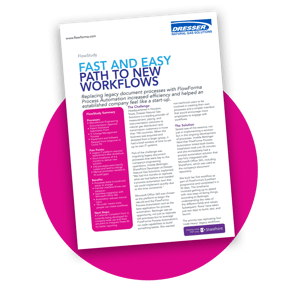
In this webinar recording, one of FlowForma's customers, Dresser Natural Gas Solutions describe their journey to automating key operational processes. Watch the video to learn more about their automation journey or you read the complete case study.
Dresser Natural Gas Solutions share their process automation journey
Key Results: FlowForma In Oil and Gas
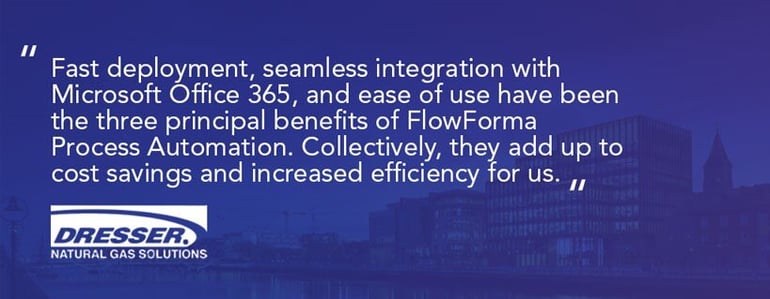
"Fast deployment, seamless integration with Microsfoft Office 365, and ease of use have been three principal benefits of FlowForma. Collectively, they add up to cost savings and inceased efficiency" - Imelda Bettinger, SharePoint Developer, Dresser Natural Gas Solutions
1. Manufacturing Engineering Documentation & Approval Workflows
Operational problem:
- Engineering change processes required documentation, approvals, and tracking.
- Legacy workflows were slow, difficult to modify, and partially supplemented with manual notebooks.
- Changes could take months to implement due to reliance on centrally controlled, coded systems.
FlowForma operational solution:
- Digitized four core manufacturing engineering workflows.
- Created structured forms, approval routing, and automated task assignments.
- Integrated with SharePoint lists and lookup tables for standardized data capture.
Operational impact:
- Eliminated manual paper tracking and duplicate recordkeeping.
- Reduced administrative workload (e.g., document controller saved ~15% of time).
- Improved speed of approvals and process completion.
- Enabled reuse of workflows across divisions with minor modifications.
2. Customer Complaint Management Workflow
Operational problem:
- Existing complaint management system lacked flexibility, reporting, and scalability.
- Complaint tracking was fragmented across divisions.
FlowForma operational solution:
- Built a centralized, structured customer complaint submission and approval process.
- Automated routing based on business unit, product, and responsible teams.
- Integrated with Power BI for automated reporting.
Operational impact:
- Enabled real-time complaint tracking across divisions.
- Improved visibility into complaint status, ownership, and resolution time.
- Automated reporting replaced manual Excel report compilation that previously took weeks.
- Enabled scalable rollout across multiple business units.
3. IT Change Management and Audit Compliance Workflow
Operational problem:
- IT changes required structured approvals and audit tracking, especially for financial and system-impacting changes.
- Prior systems lacked robust audit-ready documentation and reporting.
FlowForma operational solution:
- Created a structured IT change management workflow capturing:
- Change details
- Impacted systems
- Approval chains based on risk and system type
- Full audit trail
Operational impact:
- Improved audit readiness through centralized, traceable records.
- Enabled automated reporting for auditors via Power BI.
- Eliminated scattered documentation and manual compliance tracking.
|
Key Trends of Oil and Gas Automation
Demand for Operational Efficiency
We recently held an oil and gas automation focus group with C Levels across the United States and Europe, a key trend among the participants was a need for their organizations to become smarter, improve efficiency, and solve the fundamental problems that stand in the way of better bottom-line performance. They want better visibility and transparency of operations and have processes followed and standardized.
One participant indicated "I would like to learn how to use real time data to improve operational efficiency. How to gather, showcase, and apply data to make better decisions. My sector is labor intensive – we are always delivering a tailored service. Key aspects for us to take advantage of oil and gas automation, are how we gather information, whether it is correct, and its visibility to make better decisions. We want to standardize processes without losing business agility".
Another stated "We have tonnes of paper processes. Operational excellence and digitalization are key for us. We want to streamline workflows, get workers to collect data, and leverage technology to improve operational excellence and save time."
Oil and gas automation is proven to help organizations automate tasks so that the processes are standardized and that the information collected is validated to ultimately improve productivity by processes running much smoother and also freeing up staff to work on more value-adding tasks.
Business processes automated through products like FlowForma run much faster and can be easily analyzed within the tool for continuous improvements. Our clients benefit from fewer mistakes and the associated costs of rework.
A significant portion of failures and errors in standard tasks within Oil & Gas can be attributed to human error – 60-80%. By standardizing processes and validating the data along with audit trails, this statistic can be drastically reduced.
Read the Dresser Natural Gas Case Study
The Role of AI in Oil and Gas Automation
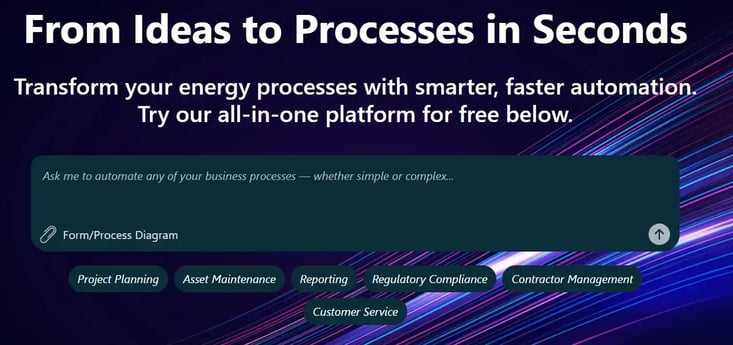
AI has been naturally embedded into workflow automation platforms in order to speed up automation, improve data and secure compliance. At the IT level, AI is now helping process builders build out their workflows with simple text or voice prompts. At FlowForma, we developed a Copilot for the oil and gas industry that does actually this. Using a simple text prompt, users can build out any workflow. For the purpose of demonstration, we have pre-baked prompts to test including project planning, reporting, contractor management, compliance and asset maintenance.
Build processes with AI Copilot
The interactive demo below provides a real-world and guided journey to showcase how a regulatory compiance process can be built with FlowForma Copilot.
Data Accuracy Requirement
As per the conversations in our recent roundtable, data is a trending topic. Attendees want to empower staff to collect data, seamlessly validate this data, and report on it in real-time for decision-making and continuous improvement.
Data accuracy is critical for the oil and gas sector especially related to health & safety, compliance, sustainability, and maintenance.
Below is an example of a dashboard pulled from the built-in analytics feature of the FlowForma Process automation platform. Oil and gas companies can rapidly create dashboards based on the data collected in their processes to:
-
continuously pinpoint areas for process improvement
-
instantly identify bottlenecks and risks
-
deliver actionable insights for better decision-making
In the webinar recording below, you'll see my colleague Robert Kane, our Solutions Team lead at FlowForma. The video will show how process automation can provide a 360 degree view into every process within your organization.
How data insights can support oil and gas automation
Ever Increasing Regulation
 Increasing regulation is a challenging trend in the oil and gas industry, impacting nearly every area of the operations and the entire supply chain. Climate change mitigation is ever-increasing, along with stakeholder pressure associated with sustainability reporting. Health and safety monitoring and reporting can be a time-consuming yet highly important task for oil and gas focus.
These increases in regulation along with many more in CSR and exploration etc. present challenges for the sector, but they should also be observed as opportunities for innovation and achieving competitive advantage.
Challenges in Automating the Oil and Gas Industry
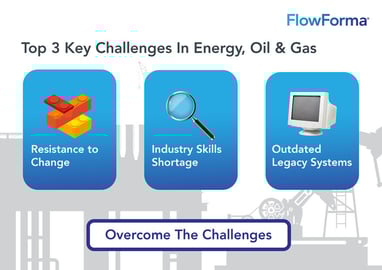 Skilled Labour
Research indicates that skilled labor is one of the key challenges hindering the digital transformation of the oil and gas industry, but this doesn't need to be the case. With the rising trend of no code process automation tools, IT teams, business professionals, or a fusion of both are empowered to digitalize processes at speed.
FlowForma customers tell us that they are digitalizing 4 to 10 times faster with our intuitive process automation tool than with competing products.
Resistance to Change
As with any change, there will be some resistance to change regarding oil and gas automation. Luckily this can be overcome with the correct approach to the introduction of the automation software and how employees are offered training and access to the platform.
For example, one customer recently told us they were very concerned about adoption, and had a lot of staff who had been working the same way for 20+ years with a number of these not having daily access to laptops, to address this challenge the customer utilized QR codes on the machinery to empower staff to quickly scan the QR code to access the processes they needed to update, it was a huge success.
The same customer had a unique outcome in that the digitalization of their processes across multiple sites created a competitive streak across sites, with sites competing against each other - which they could do so much easier by monitoring the dashboards on their DPA platform.
Legacy Systems
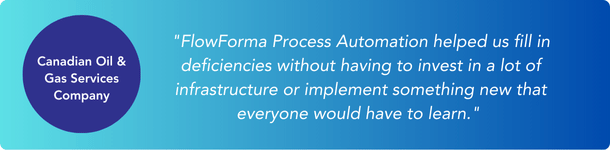
Many companies are still challenged with legacy systems, but this needn't be a blocker. Automation software has helped many companies accelerate digitalization by pulling or pushing data to and from legacy systems. Oil and gas automation tools come with ready-to-go integrations into Finance, HR, and ERP systems, etc.
Read the associated case study
How Essar Oil Automated Onboarding And More in Oil & Gas with FlowForma
Essar Stanlow, is the second largest refinery in the UK, supplies 16% of UK’s road fuel and around 800 people, 500 contractors and 5000 people in local industries that they support.
When they came to us, they were looking to address key business process challenges including:
- Removing paperwork and forms that can be error prone
- Lack of transparency and governance
- Poor process visibility
- Reporting was difficult
In order to tackle the challenges, we worked with the Essar team on a robust strategy and process automation platform roll out plan.
We got them onboarded quickly through our SureStart onboarding process, created a team of 12 Superusers, and appointed an internal evangelist to drive the project forward.
We automated around 30, for processes such as:
- Employee onboarding
- Civil department work requests
- Waste transferal process
- Health referral process
Key results the project achieved:
- At least 5-10 times faster processes
- Better governance with full traceability
- Continuous improvements
- Better reporting
- Drive its digital transformation agenda
‘’I can confidently build a process within an hour using FlowForma Process Automation.’’
Robert Macknay, Data & Engineering Manager, Essar Oil
In Conclusion
 Oil and gas automation is no longer just a trend but a necessity for companies aiming to improve efficiency, ensure data accuracy, and comply with increasing regulations. Despite the challenges of disconnected sites, skilled labor shortages, and resistance to change, the benefits of automation are clear.
By automating processes, oil and gas companies can standardize operations, reduce errors, and make data-driven decisions in real time. This transformation not only enhances productivity and safety but also positions the oil and gas industry to meet the demands of a rapidly evolving industry.
Embracing automation tools like FlowForma can help overcome legacy system limitations and drive faster digitalization, ultimately leading to a more competitive and sustainable future for the oil and gas sector.
We have experts on hand to support you in overcoming any of the above challenges, simply book a demonstration or trial with our team today both come with one-to-one expert support.