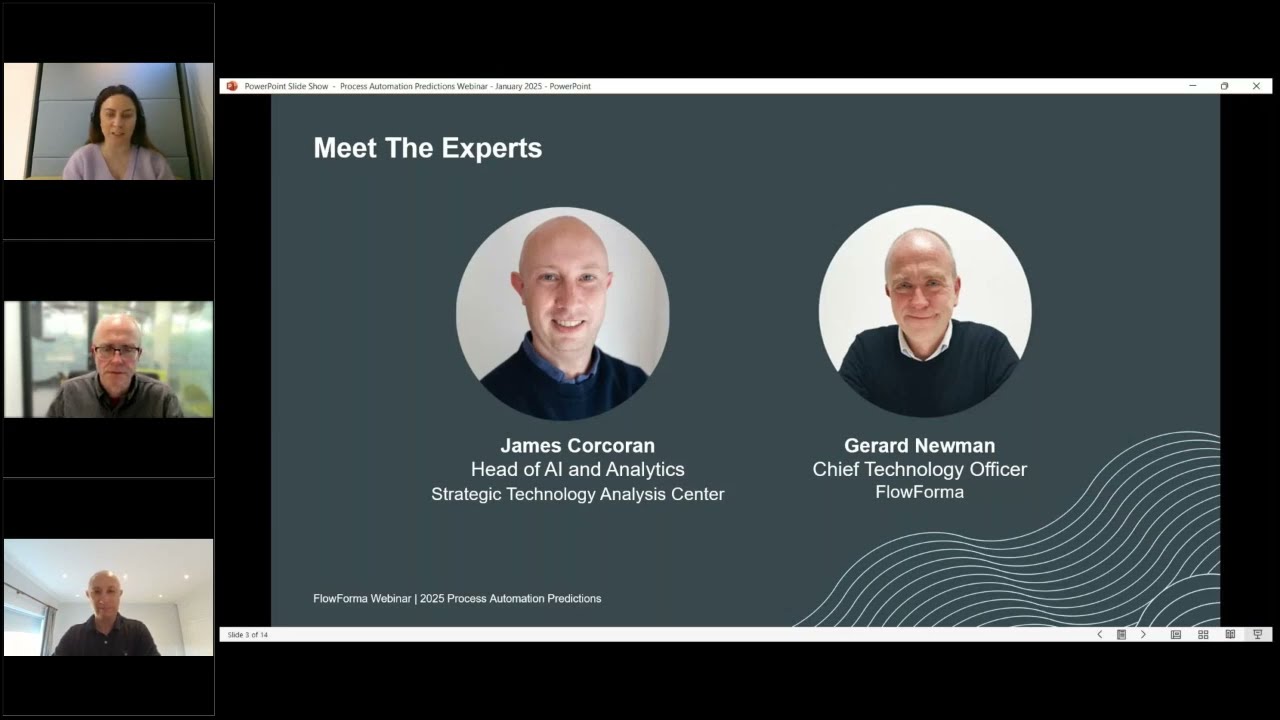
Who spoke on this webinar?
James Corcoran, head of AI and analytics at STAC, and Gerard Newman, CTO of FlowForma. Niamh Lordan, FlowForma's head of marketing, hosted.
What were the five predictions for 2025?
AI moves into core business operations; automation success depends on balancing AI innovation with proven tools; agentic AI becomes a major focus; AI accelerates citizen development; and organizations must show a clear return on investment from AI.
Is it too early for fully AI-automated processes?
Gerard's view was that 2025 was a bit early for completely automated processes running on generative AI. He expected organizations to layer AI into their existing automation platforms instead, with a human in the loop, starting with decisions that have clear data, parameters and rules.
How should organizations measure the ROI of AI?
James suggested starting with high-value use cases rather than a solution looking for a problem. Expected efficiency gains are easier to quantify than costs at the start of a project, so early ROI is most likely to come from productivity gains in areas like customer success and back-office process automation.
Can AI tools like Copilot help with wider adoption of process automation?
Yes. They help teams understand and document processes without starting from a blank page, and make it quicker to experiment. In FlowForma Copilot you can describe a process in chat, or load in a drawing or diagram, and build a working process from it.
Can FlowForma Copilot use your own organization's data?
FlowForma Copilot keeps its conversations focused on process automation to give more relevant answers. Gerard explained that you can give generative AI some of your own data to tailor answers, and techniques such as retrieval-augmented generation (RAG) can make it more specific to your business.