


On-demand webinar60 minutesConstruction

The race to digitalize construction: how Bouygues Energies & Services builds a digital-first workforce

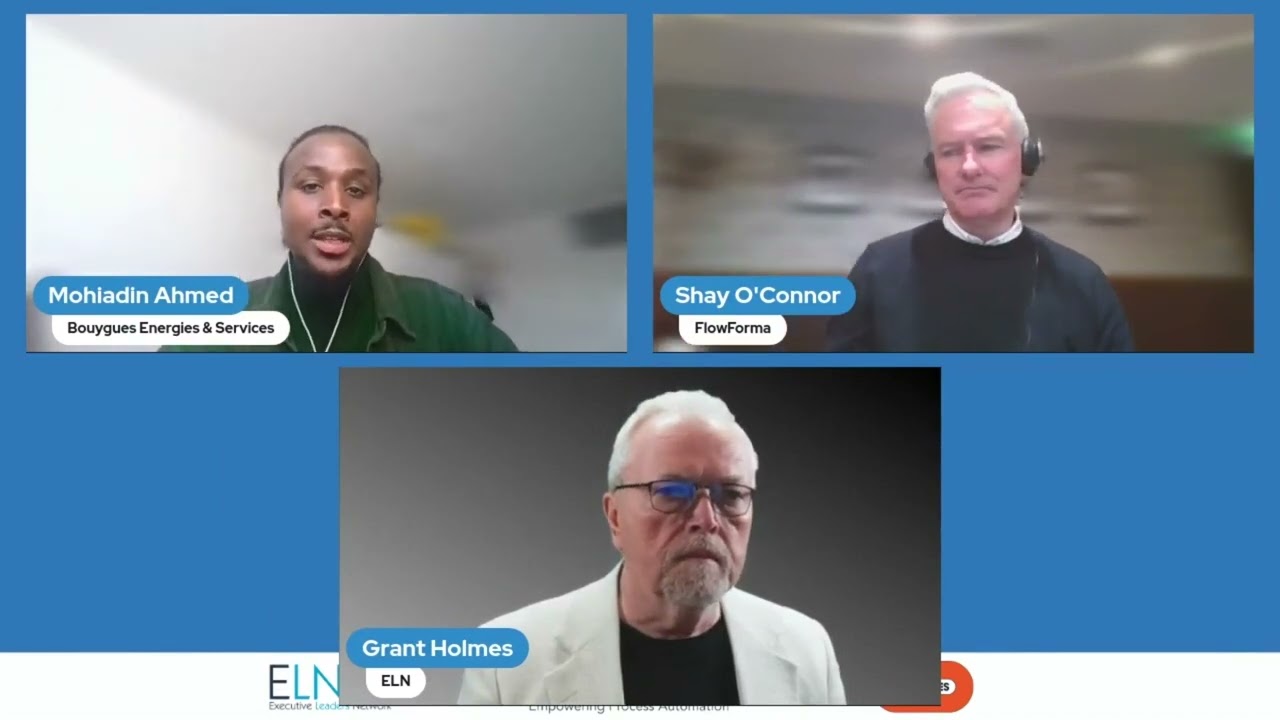
Mohiadin Ahmed of Bouygues Energies & Services and Shay O'Connor of FlowForma on using data to make better decisions, getting stakeholders on board, and digitizing processes such as stock management without code. Hosted by the Executive Leaders Network.

What does the Bouygues Energies & Services webinar cover?

The Race to Digitalize Construction is a 60-minute on-demand webinar from FlowForma, the no-code process automation platform native to Microsoft 365, hosted by the Executive Leaders Network. Mohiadin Ahmed explains how Bouygues Energies & Services uses data and no-code processes to build a digital-first workforce. Read the case study.

6 hoursto build a usable process in FlowForma
24 hoursto build the same process in Power Apps
18 monthsof learning before that Power Platform build
4 stepsto log stock: open, scan, enter, submit

What Bouygues needed, and how its stock process works

The criteria Bouygues set for a process automation tool, and the four steps that replaced a paper stock log in a basement storeroom.

4x

faster to build than in Power Apps

What Bouygues looked for in a process automation tool

  • Easy to use, without hours of learning
  • A simple interface for builders and end users
  • Works on phone, tablet and laptop, including offline
  • A partner that understands its needs
“You can't manage what you don't measure.”Mohiadin Ahmed, Bouygues Energies & Services

From the session, 30:17 to 33:00

4

steps to log stock, even offline

How the stock management process works

  • Open the FlowForma app and scan the part's barcode
  • Part name, number and stock level fill in automatically
  • Enter how many items you've taken and submit
  • Syncs when back online; alerts when stock runs low

From the session, 42:37 to 45:40

Inspired by Bouygues Energies & Services?

Book a demo with our process experts and see how your site and office teams can build their own processes, without code, and work offline on site.

  • A demo built around one of your processes
  • Stock management, order forms or vehicle checks
  • Advice on adoption, stakeholder buy-in and rollout
  • No cost and no obligation

Working in construction? See FlowForma for construction

Pick a time that suits you

00:02

Welcome from ELN

Watch this part

Grant (ELN)00:02

Hello and welcome to the Executive Leaders Network webinar, brought to you in collaboration with FlowForma. ELN offers a broad spectrum of online and in-person events for senior executives across industries. Today we're thrilled to partner with FlowForma on a webinar about the digitization of construction and the importance of empowering a digital-first workforce in a fiercely competitive market.

Grant (ELN)01:36

Over the next hour, our expert speakers will explore how adopting data-driven decision-making can enhance project performance, mitigate budget overruns and enable rapid business growth. We'll also look at how technology can streamline operations, increase resilience and give you a competitive edge, particularly in the face of material cost increases and supply chain disruptions. Post your questions in the chat, and we'll get to as many as we can in the live Q&A at the end.

02:56

Meet the speakers

Watch this part

Grant (ELN)02:56

Joining us today are Shay O'Connor from FlowForma and our guest speaker, who'll share his insights, experiences and best practices since partnering with FlowForma. Shay has more than 25 years in the technology sector and an acute understanding of the construction industry and the challenges facing companies looking to digitize.

Grant (ELN)03:30

Mo was an engineering graduate trainee at Bouygues, completing four placements before joining the digital transformation team, where he led projects such as the rollout of Office 365 to 4,000 users and the digitization of critical processes. He believes in finding solutions that offer the easiest implementation and fastest adoption, especially in today's rapidly changing business environment. Shay and Mo, over to you.

04:15

What FlowForma does

Watch this part

Shay O'Connor04:15

Thanks, Grant. I'm Shay O'Connor, head of solutions at FlowForma. FlowForma is a digital process automation platform. That means you can turn manual processes and groups of tasks into a digitized format, all without any coding. It lets you work at pace, and it's a knowledge transfer: all you need to know is your process.

Shay O'Connor05:06

We're a worldwide organization, with customers from New Zealand to the West Coast of the States, and in construction we see the same problems globally: stretched staffing, materials and timelines, and tight margins. FlowForma has been effective here because it gives you a percentage of time back and makes you a percentage more efficient. Every percentage counts. Get 10% or 15% back and you can do more with your time.

06:12

Three ways companies digitize

Watch this part

Shay O'Connor06:12

Organizations facing the digitization question tend to fall into three categories. Some buy a package off the shelf and do whatever it tells them, which usually leaves chunky gaps, maybe 30% difference between how you work and how the product works. Others prefer to code everything with their own team of developers, which carries an overhead, and a risk if you lose people.

Shay O'Connor07:12

The third category is where we come in: empowering an organization to create its own processes in a no-code environment. You tell the system your steps and your rules, and it creates the digital forms for you. When I first met Mo a couple of years ago, that was a big factor. It was the 'don't give me a fish, teach me how to fish' scenario. They wanted to get their hands dirty, control their own destiny and do things their own way.

08:52

Why Bouygues wanted control

Watch this part

Mohiadin Ahmed08:52

Absolutely. Where we're trying to take it is to give the power to the process owners, the people developing or managing processes in the business. We tried other solutions, such as the Office 365 suite, and we even did a time study comparing how long it would take to develop something in Power Apps and the Power Platform versus FlowForma. The difference was so drastic that it made sense to partner with you, and we're already seeing the benefits.

Mohiadin Ahmed09:58

For me it's important that people can pick it up quickly. You show someone once, they do it themselves a few times, and the cogs start to turn. Then they can transfer that knowledge to someone else, and someone else again.

Shay O'Connor10:22

One of the big mind shifts is that you're working slightly differently. Once a process is digitized it's repeatable. It's not a hunch or 'what we normally do here'; it's set, though still adaptable. When you have thousands of employees and contributors to align, the easiest way is a consistent approach, and that knowledge transfer of 'this is our optimal way of doing it'. And it's not one process; it's two, three, four, five.

11:41

Why data matters

Watch this part

Grant (ELN)11:41

Mo, how important is data within your organization?

Mohiadin Ahmed11:53

As with most organizations, data is gold. It helps us make better decisions, understand our clients, their needs and trends, and tailor our services to them. I read a quote once: the goal is to turn data into information, and information into insights. Good data gives us the knowledge to make informed decisions that aren't based on assumptions, whether that's how long something takes, what keeps breaking down or what material is being ordered. That leads to less wasted resource. You can't manage what you don't measure.

13:24

Using CAFM data to make decisions

Watch this part

Grant (ELN)13:24

How is your organization using that data to inform better decision-making?

Mohiadin Ahmed13:29

A massive data pool for us is our CAFM system, where we log our jobs, work orders, purchase orders, planned maintenance and job times, and manage most day-to-day operations. If one site gets 30 to 50 call-outs a day, we capture what the issue is, which machine is being fixed and what's broken, and compare that with other sites. We build trends: the most common faults, how long jobs take to rectify, and what's holding a job up, whether it's waiting for materials or a subcontractor.

Mohiadin Ahmed14:44

With that we make better decisions: stocking the right materials rather than leaving dead stock in the warehouse, upskilling staff or hiring more technically proficient engineers when we're calling out subcontractors too often, or replacing equipment altogether. We also capture sensor data from the machines to build a more effective, predictive maintenance plan. If 12 sites replaced the same item on the same machine over the last year, you look at the next 12 sites now.

Mohiadin Ahmed16:07

Another example is tenders and bids. We can look at historical data from all our sites, the packages we offered, what they cost, the materials and services we provided, and create a more tailored and accurate bid.

16:36

First steps: process first

Watch this part

Grant (ELN)16:36

Shay, what are the first steps to becoming a data-centric organization?

Shay O'Connor16:48

We always say process first. Work out what questions you want answered and work back from there. Take materials: with a proper procurement process in place, you know who wants what and when. One of our clients avoided a hefty procurement penalty because their requisition process was that effective. Choose a process that will have an impact.

Shay O'Connor17:37

Then adoption is massive, because it's a new way of working. Include the business. They'll give feedback and point out nuances you assumed, you adjust, and they get buy-in and ownership. The first process matters most because it's their entry point. Once they feel ownership, you expand to the second, third, fourth and fifth.

Shay O'Connor18:39

I ask people whether they see themselves digitized in three to five years. They all say yes. So when are you going to start? Those digitizing now will have three to five years of data and will make decisions based on history. When's the best time to plant a tree? Twenty years ago. The second best time is today.

19:23

Engaging process owners

Watch this part

Grant (ELN)19:23

How do you identify process owners across the business and get them to engage?

Shay O'Connor19:35

It's an ownership thing, and you need senior support. With senior support it's a lot easier; without it you're fighting a very tough battle. Then include the business: pick a site or an area with someone supportive who sees the difference it will make, put the first process in, get feedback and adjust, so people feel part of it rather than having it forced on them. When people see it saves them time, everybody buys in.

Shay O'Connor20:42

We hear this all the time: 'I spend three hours on a Friday putting together a report for my customer, and now the data is real time, I click a button and it's there.' One customer told me a digitized health and safety process saves one of his people 10 hours a week, but he only tells management five, or they'll ask what he was doing with those 10 hours.

21:36

Bouygues Energies & Services

Watch this part

Grant (ELN)21:36

Let's move into the case study. Mo, tell us about Bouygues Energies & Services.

Mohiadin Ahmed21:50

Bouygues is mainly known for construction. It's a household name in France, a family business started by Francis Bouygues in the 1950s. Projects our North American audience may know include the Port of Miami Tunnel and Brickell City Centre in Miami, and we have sister companies in Canada, including one in Vancouver.

Mohiadin Ahmed22:58

The entity I work for is Bouygues Energies & Services. Our bread and butter is facilities management: hard FM, the management of physical assets, and soft FM, the services people perform, such as custodial and security. We also work in highways and local government, on street lighting and smart motorways, smart cities, EV charge points, and an energy division that designs, installs and commissions solar PV farms.

Mohiadin Ahmed24:43

I'm a digital change manager. My background is mechanical engineering, but the graduate scheme let me move into the digital transformation team. We look at how technology can aid our transformation, but for me it's about bringing people along on that journey. The technology is digital, but the people who use it every day are human. Show them what's in it for them, and you sustain outcomes for longer and reach a higher level of adoption in a much shorter time.

25:47

Why it was time to digitize

Watch this part

Grant (ELN)25:47

What motivated you to digitize your processes, and what told you it was time for a change?

Mohiadin Ahmed25:59

Our CEO, David Carr, likes to get involved, and one of his things is making employees' lives easier. That was our first motivator: simplifying mundane, manual, paper-based processes, taking people from three hours on a Friday to five minutes, and from passing a document around 100 people to clicking a button. Construction is often seen as old school and behind the curve, so we also wanted to become an industry leader in digitalization.

Mohiadin Ahmed27:09

What made me take this on was a workshop with our operational staff to understand their pain points. A colleague at one of our hospital sites in Edinburgh shared an idea: can't we automate this process? It was fairly simple. He just didn't want to send emails. Around the room I could hear 'we've always done it this way', but his idea was simple. My manager at the time researched and found FlowForma, and we decided to turn that small idea, from a colleague 500 miles away, into a much wider process automation and digitalization project.

Shay O'Connor28:45

The big thing is senior support. It's one of the cornerstones, because everybody falls into line. The biggest frustration we see in construction is people who want to improve efficiency but don't have that support, and 'we've always done it this way'. The thing is, there's no downside to digitization. We don't know of any company that started digitizing and went back to manual. With senior support you can easily get it done in half the time.

30:06

What Bouygues looked for in a tool

Watch this part

Grant (ELN)30:06

Mo, what did you look for in a process automation tool?

Mohiadin Ahmed30:17

First and foremost, something easy to use that didn't need hours of learning to build a basic process. On the comparison with Office 365 someone asked about: a colleague at a site in the middle of England was very familiar with the Power Platform, but it took him 18 months of learning, because although it's called low-code he had to learn JSON and basic coding principles. Then it took him another 24 hours to build his process in Power Apps and Power Automate.

Mohiadin Ahmed31:21

When we built that same process at the start of our SureStart with FlowForma, it took six hours to build something usable, about four times faster, after one- and two-day training sessions. He was comfortable with it straight away, and others pick it up quickly too.

Mohiadin Ahmed32:01

Second, the UX and UI had to be simple, so neither builders nor end users get frustrated. Third, it had to work on phones, tablets and laptops, and offline, because many of our sites have no signal and people work in basements; it resyncs when you're back online. Finally, we wanted a company that understood our needs, would work with us and let us lean on its experience. A lot of processes are in people's heads, not on a Visio diagram, so we worked with the team to build them, find the pitfalls and improve them before digitizing.

33:56

No-code versus coding

Watch this part

Shay O'Connor33:56

The old way is to document the process in swim lanes, get agreement, then build it, and only then do you see the gaps and go back and forth. There's a place for that, but for a huge percentage of processes you can build the process as you refine it, and FlowForma documents it automatically. Full disclosure, I used to be a programmer, the protector of my black box. Now there's full visibility.

Shay O'Connor35:16

Your colleague did a great job over that 18 months, but when we showed him FlowForma he was blown away. Because he was a business person first, he didn't try to protect the code. He wanted better business results at scale. It's about removing the need for specialist skills so you can work at pace, while keeping control: someone has an idea, builds it in a sandbox, and experts review it. And because the forms, including on mobile, are created automatically, there's consistency. Learn the first one and you've learned the model.

36:56

Getting stakeholder buy-in

Watch this part

Grant (ELN)36:56

Do you have any advice on getting buy-in from stakeholders?

Mohiadin Ahmed37:13

Engage them as early as possible. In change management a person goes through awareness, desire, knowledge, ability and reinforcement, so give people time to digest and prepare. Involve them early and they build a personal attachment and want it to succeed. Speak their language: for a senior stakeholder, what's in it for them is the bottom line; for the person doing the work, it's how much time they get back. Once they see an MVP, they buy in.

Mohiadin Ahmed39:12

We're working on a process for our assurance and compliance team. From the outset I involved the director and the five authorizing engineers she relies on, and kept them informed every step of the way. When I demoed the end product, they asked how to get it going straight away. Now they're telling sites it goes live on the 27th. It's their process; they're the ones who will live with it.

40:15

Consistency and small wins

Watch this part

Shay O'Connor40:15

Mo hit the nail on the head with desire. Once stakeholders want to improve, you're in a great place, and you remove the big-bang requirement. You bring it in in stages and suddenly you've gone from one process to 20 or 40 without anyone noticing. Stakeholders love the hard benefits: visibility of data and consistency.

Shay O'Connor41:08

One client's biggest frustration was inconsistent outputs: customers got reports that didn't look the same week to week or site to site. With a process behind it you get consistent data, terminology and output, more professionalism, happier staff and happier customers. Small things help too, like QR codes on equipment that open the right form on a mobile device, so staff don't have to carry forms around.

42:16

Digitizing stock management

Watch this part

Grant (ELN)42:16

Mo, tell us about the processes Bouygues Energies & Services has digitized and the benefits you've seen.

Mohiadin Ahmed42:37

One of the main ones is stock management. We had an unmanned storeroom with no internet access, hidden in a basement, and engineers relied on a paper system, writing down what stock they took. Nobody wants to do that every time, so we had discrepancies and shortages. Someone would arrive to do a job without the part they needed, which could mean a penalty against our KPIs. The client raised it in the yearly review, and the site team reached out: 'This is my problem, and I need something quick.'

Mohiadin Ahmed44:15

We developed and refined the process in FlowForma. Now, before an engineer takes stock, he scans a barcode with his device, which fills in the part name, part number and current stock level. The only manual thing is how many items they've taken. When they're back on Wi-Fi or data, it synchronizes. Open the app, scan, enter the quantity, submit: that's it. Combined with an automated alert when stock falls below a set level, the site team can order proactively, so there are fewer shortages, fewer financial penalties and better service for our clients.

45:48

Order forms, vehicle checks and more

Watch this part

Mohiadin Ahmed45:48

We're also digitizing order forms for our mobile team, our internal subcontractor of engineers in vans who support sites around the country, particularly on gas safety. Orders came in by email on a Word document and went to the wrong person. Now you enter the work order number, it pulls the job specification and who's assigned, you say what you need, it goes to the right people and you get a document with every detail from submission to approval. Vehicle checks, and procurement's single works agreements, are next, and once one person saw the benefit, requests started coming in. Even a sister company asked to borrow some licenses.

47:31

Benefits and digital appetite

Watch this part

Mohiadin Ahmed47:31

The benefits are mainly financial, which appeases everyone from the operational person on the ground up to the CEO. People also get time back to focus on added-value tasks instead of sifting through paper. And there's digital appetite: people see the value and the wheels are turning.

Mohiadin Ahmed48:25

Our CEO walked past one day and asked what I was working on. When I mentioned the stock management process, he said other sites have the same issue and asked me to offer it to them. Then he took it further: as more sites use it, we build a database of the common items used from stockrooms, reduce dead stock, and let sites see each other's stock lists. If a part is five miles away, it's quicker to send an engineer to collect it and scan it out than to wait two or three days for a supplier. And changes are quick to make in the app.

50:18

Processes that educate users

Watch this part

Shay O'Connor50:18

A Six Sigma person at one organization said a by-product of digitizing was educating users on the process. They could see a materials request goes through five or six steps before the goods arrive, so instead of chasing, they can see it's at step four and has been checked. That reduces queries, and it helps new people too: the process tells them what to do and when. They just do their step.

52:05

What's next for Bouygues

Watch this part

Grant (ELN)52:05

Mo, what's next on the agenda for Bouygues Energies & Services?

Mohiadin Ahmed52:12

From a process automation perspective, we'll keep capturing and digitizing business processes that reach as many people as possible. From a data perspective, we want to become more data mature and make more data-informed decisions that add value for our employees and clients. We walk before we run and don't try to fix everything at once. It's about finding the quick wins and best value, and encouraging our employees to become data-aware and comfortable capturing data in a structured way.

53:46

Q&A: the tech stack

Watch this part

Grant (ELN)53:46

Let's get to some questions. Mo, did FlowForma shrink your tech stack, and what does the stack look like now?

Mohiadin Ahmed54:13

Previously we used an array of applications and languages to develop anything. We still use the Office 365 tools, and our CAFM system, Maximo, where you can develop and code things to capture information. With FlowForma we rely on that less, because the time and cost for our internal information systems team to develop something in Maximo is too great. We use FlowForma for quick wins. It hasn't reduced the stack drastically, but enough that people now come to us rather than other departments.

55:14

Q&A: time to outcomes and strategy

Watch this part

Grant (ELN)55:14

Shay, how quickly do construction companies onboard and start seeing business outcomes?

Shay O'Connor55:24

The quick answer is immediately, but really it's within a few weeks if you know your first process. Get the first one right, and don't pick an overly complicated one. Pick one users understand, because it's all about their buy-in. And you don't always know at the start which process will have the most impact, so digitizing a lot matters. Some will surprise you.

Grant (ELN)56:26

Does FlowForma allow strategic objectives and initiatives to be rolled out through the platform?

Shay O'Connor56:33

A lot of organizations use FlowForma as a blanket over existing systems. It talks to them, so it's straightforward to pull data from different systems and get everyone on the same wavelength. One of the most common HR examples is performance appraisals, where there are objectives straight away and full visibility of how people are progressing.

57:20

Q&A: external partners

Watch this part

Grant (ELN)57:20

Mo, can external partners and clients collaborate as well, and how engaged can they be?

Mohiadin Ahmed57:30

Absolutely. They can access the forms and input the information they need to. It depends on how you set up your process. For example, once part one of a form is completed, it can be emailed to the external client with a message you create. They click the link, fill in their part and submit, and the next person in the journey is notified.

Shay O'Connor58:13

Exactly. They're part of the process, and they only see their step. In a five-step process, they might only see step two.

58:30

Summary and close

Watch this part

Grant (ELN)58:30

Thank you, gentlemen. A quick summary: don't be afraid of change, and be a champion. Unlock the benefits of citizen development by empowering your workforce. Start with the obvious and launch quickly. Focus on adoption rates. Digitize for the outcomes you really want, and integrate your DPA tool with existing systems. A FlowForma representative will follow up, so you can get free advice from subject experts. Thanks to everyone for attending.

Frequently asked questions

Did FlowForma shrink Bouygues Energies & Services' tech stack?

Not drastically, but enough. Bouygues still uses Office 365 tools and its Maximo CAFM system, but relies on them less for new processes, because developing in Maximo takes too long and costs too much. FlowForma delivers the quick wins.

How quickly do construction companies onboard and see outcomes?

Within a few weeks if you know your first process. Start with one users understand rather than an overly complicated one, get it right, then digitize more, because some processes will surprise you with their impact.

How does FlowForma compare with Power Apps for building processes?

At Bouygues, a process that took 24 hours to build in Power Apps and Power Automate, after 18 months of learning, took six hours to build in FlowForma after one- and two-day training sessions.

Does FlowForma work offline on site?

Yes. Bouygues needed a tool that works on phones, tablets and laptops in basements and sites with no signal. Forms can be filled in offline and synchronize when you're back online.

Can strategic objectives and initiatives be rolled out through FlowForma?

Yes. Many organizations use FlowForma as a layer over existing systems, pulling data from them so everyone works from the same information. Performance appraisals are a common example.

Can external partners and clients take part in a process?

Yes. A step can be emailed to an external client or partner with a link. They fill in their part and submit, and the next person is notified. They only see their own step.

Ready to win the race to digitalize?

Book a tailored demo, or read the full Bouygues Energies & Services case study.