On-demand webinar57 minutesNovember 2020

5 reasons to accelerate your HR digital transformation

HubbubHR and FlowForma on remote work, employee journeys and business continuity, with three HR processes demoed live.

What does the HR digital transformation webinar cover?

5 Reasons To Accelerate Your HR Digital Transformation is a 57-minute on-demand webinar from November 2020. Jacinta Hennessy of HubbubHR and Paul Stone of FlowForma, the no-code process automation platform native to Microsoft 365, explain why remote work, local variation, real-time data, employee journeys and business continuity call for digital HR, then demo three HR processes built without code. See FlowForma for HR.

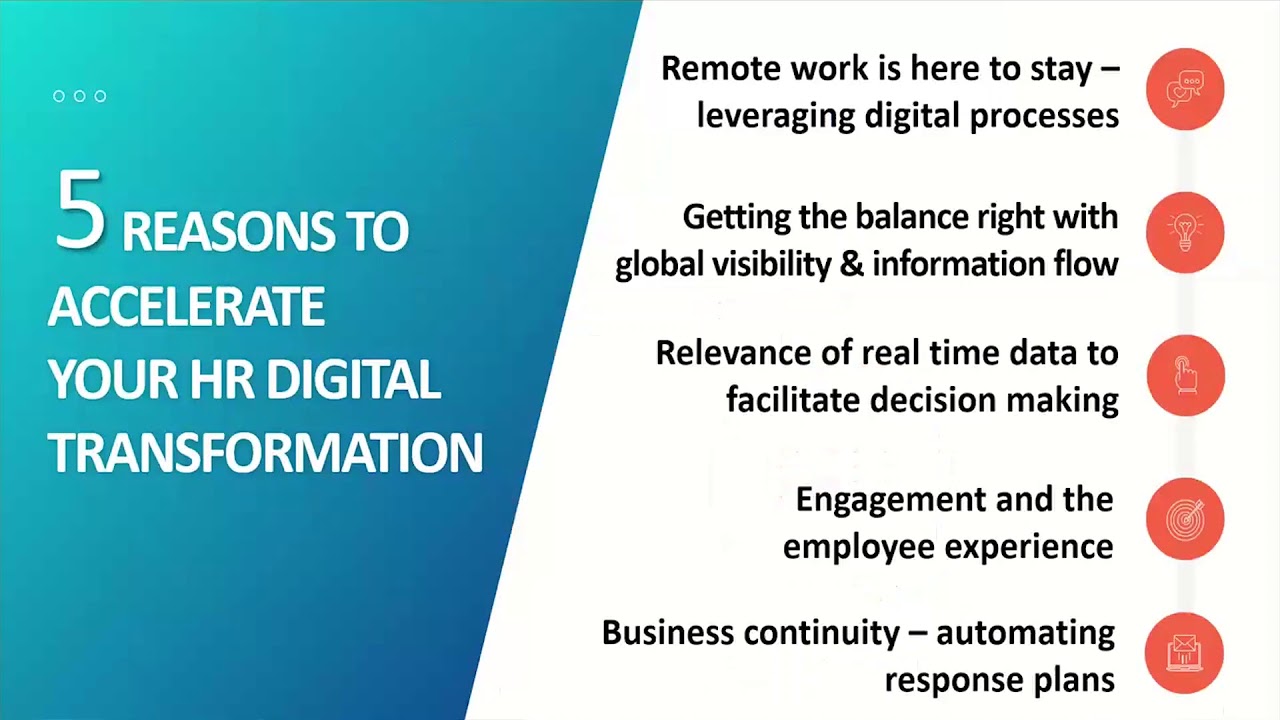
5reasons to accelerate HR digital transformation, from remote work to business continuity
3HR processes demoed live: pre-return to work, a pulse survey and a business continuity plan
2live audience polls on digital skills and what holds digital advancement back

What we asked, and what we built live

The two questions put to the audience, and the three HR processes Paul built in the session.

2

live audience polls

Two questions we asked the audience

  • Does your organization have a plan in place to close its digital automation skills gap?
  • Historically, what has been the main inhibitor preventing your digital advancements?
“You don't need all the answers to start on this journey.”Jacinta Hennessy, HubbubHR

Polls at 05:47 and 37:42

3

HR processes demoed live

Three HR processes, built live

  • A pre-return-to-work process with a safety checklist and signature (40:56)
  • An anonymous NPS pulse survey, with no login needed (45:51)
  • A business continuity plan with parallel task checklists (47:38)
“As an HR person, you don't need specific technical skills.”Paul Stone, FlowForma

Demos from 40:56

Ready to digitize your HR processes?

Book a demo with our process experts and see one of your own HR processes digitized live, from the first form to the updated employee record.

  • A demo built around one of your processes
  • A walkthrough of forms, approvals and anonymous surveys
  • Advice on the first HR process to digitize
  • No cost and no obligation

Want to try it yourself? Start a free trial

Pick a time that suits you

00:00

Welcome

Watch this part

Conor McGrath00:01

Hi everyone, and welcome to today's webinar on five reasons to accelerate your HR digital transformation. I'm Conor McGrath, digital marketing assistant at FlowForma, and I'll be your host. Your lines are muted, but please use the Q&A function to ask questions and we'll take them at the end. The webinar is being recorded and will be shared with you in the coming days.

Conor McGrath01:05

I'm delighted to be joined by Jacinta Hennessy, chief product strategist at HubbubHR, and my FlowForma colleague Paul Stone, product strategist. Welcome, both.

01:05

Meet the speakers: HubbubHR and FlowForma

Watch this part

Jacinta Hennessy01:29

Thanks, Conor. I'm Jacinta Hennessy with HubbubHR. We provide global HRIS systems, including performance, compensation planning and succession, and, through our partnership with FlowForma, workflow. Our HRIS is designed for maximum configurability and adaptability, so it can handle country, regional and local variances. We have full API connectivity to payroll, applicant tracking and other systems, and our highest priority is personalized, attentive service. We leverage the Microsoft stack: we integrate with Power BI and Office 365, and we're hosted on Microsoft Azure.

Paul Stone02:37

I'm Paul Stone, product strategist at FlowForma, which is now integrated with HubbubHR so you can automate processes related to all the employee data you store there. FlowForma combines workflow, the execution of tasks in sequence to achieve a business goal, with document generation, document management and forms. It's adaptable, so you can change processes as business needs change, and it's intuitive to adopt on a desktop or a mobile device. The main message is that it's easy to configure and removes the dependency on IT: it adds workflow to HubbubHR that you can modify yourselves.

04:00

What is digital HR transformation?

Watch this part

Jacinta Hennessy04:00

In our research on digital HR transformation, we knew 2020 would put the spotlight on it, but we were surprised by how many industry experts, analysts and HR leaders agree on its importance, and with what urgency. 2020 has fundamentally changed the way we work, probably forever. Many of us work from home much of the time.

Jacinta Hennessy05:05

To open, a quote from one of my favorite HR analysts, Jason Averbook: the future of work has smashed into this world of now, and we have to start thinking about now in a completely different way. He also said that HR-led digital transformation has never been more vital, and if you haven't revised your people strategy around digitization in 2020, that's a problem. That's a bit of a wake-up call for all of us.

05:41

Poll: closing the digital automation skills gap

Watch this part

Conor McGrath05:47

On to a quick poll: does your organization have a plan in place to close its digital automation skills gap? There are plenty of responses coming in, and it's always interesting to see the challenges our audience is facing.

Jacinta Hennessy06:51

A similar survey found that 28% of respondents' companies had revised their digital people strategy, 48% hadn't yet but knew they needed to, and 15% didn't have a digital people strategy. So there's a lot of work to be done, and we'll share today's results after the session.

06:51

Why 2020 accelerated digital HR

Watch this part

Jacinta Hennessy07:31

Josh Bersin said that everyone agreed the multi-year digital transformation their company was doing was suddenly accelerated to a few weeks: every system, tool and enablement platform has to work now. Paul and I discussed not only the pre-return-to-work process but others, like a company's idea for a remote work request, so they'd know where employees are working, whether from home or from different countries.

Paul Stone08:19

So many companies are coming to us needing to digitize very quickly. Not just processes that existed on paper and email chains, because you can't exchange pieces of paper with people working remotely, but new processes too. Pre-return to work is a perfect example: it wasn't very important in the past and suddenly it's front and center, and it all has to be digitized and accessible from people's laptops at their home desks. The pressure to digitize has increased a lot.

Jacinta Hennessy08:59

It's forcing us to reimagine how we use technology to deliver to our customers differently and to build more business resilience. Deloitte wrote that now is the time to accelerate digital HR: the crisis has fundamentally changed the way we live and work. An IBM survey, COVID-19 and the future of business, found the pandemic had accelerated digital transformation at 59% of companies, and 66% of respondents said they could now complete digital initiatives that previously met resistance. Paul, are you hearing this from customers?

Paul Stone10:29

Very much so. When people are at their desks in their houses, they realize how dependent they were on social interaction, on being able to turn their head and speak to a colleague. Where they might have resisted digitizing in the past as too much change or too much hassle, now they're saying we have to make this work: we can't be productive without a digital way to pass work between each other. It's given people a new sense of urgency, and they're very much up to the challenge.

11:28

The five reasons at a glance

Watch this part

Jacinta Hennessy11:34

These are the five areas we've broken today's webinar into. First, remote work is here to stay, and how to leverage digital HR processes to support it. Second, the balance between global visibility, information flow and local requirements. Third, using data for decision-making, which helps build business resilience. Fourth, engagement and the employee experience, including employee journeys. And fifth, business continuity, where Paul will show a process that supports it.

12:54

Reason 1: remote work is here to stay

Watch this part

Jacinta Hennessy12:54

Josh Bersin noted that if there's anything we've learned from the pandemic, it's that we need systems that can adapt, morph and change to meet our new needs. Agility is everything. We can't predict which jobs people will be in, where, or what travel policies we'll have each week, but we need a tool set that can adapt.

Jacinta Hennessy13:32

Remote work is here to stay, whether in the office, out of it or some hybrid. Google is allowing all workers to work from home until at least the middle of next year. Twitter says employees never have to go back unless they want to. Siemens, with 140,000 employees, is letting people work from home two or three days a week permanently, and Microsoft will let employees work from home permanently if they request it, even relocating internationally if approved. So we're looking at the digital transformation projects needed to support this new way of working.

Paul Stone15:02

Conor and I made a special exception to come into the office for the webinar, but the entire company normally works from home, and very successfully, because people have the tools to communicate with each other and execute processes. It can work: it just takes a little change in procedures to make it happen.

15:52

What managers and employees expect

Watch this part

Jacinta Hennessy15:52

A Boston Consulting Group and Ipsos survey of over 5,000 managers across Europe, the US and China found 89% of managers feel involved in digital transformation at their company, a little lower for employees. Well over 80% of both believe digital transformation will help companies relaunch activities more easily once the crisis is over, and over 80% want to participate. The only lower figure, about 50%, was employees unsure how it will benefit their jobs, which I hope will rise as the idea becomes more familiar.

17:18

Reason 2: global visibility and local needs

Watch this part

Jacinta Hennessy17:18

IBM remarked that adaptability is now a mandatory business competency. A personal story: at my former company, with about 14,000 employees across continents, we embarked on implementing a global ERP, which required solid standardized processes. We were nowhere near that, and I naively took on leading both the ERP implementation for HR and a concurrent global process review.

Jacinta Hennessy18:25

It was an eye-opening experience. We were so focused on standardization that we lost sight of the fact that we were a truly global company, with corporate needs and very valid local needs. Trying to fit them into one global standard was too rigid; there had to be a way to allow for variances. It became apparent that a global HRIS needed to be configurable and adaptable for global, local and community stakeholders, so we set about designing HR software that could do just that, and you'll see how adaptable the workflow is when Paul walks through the processes.

19:28

Reason 3: real-time data for decision-making

Watch this part

Jacinta Hennessy19:28

McKinsey noted that never before has the need for accurate and timely data been greater, and that technology is a core driver of value, not merely a support function. A customer told me recently that having immediate access to data for all their operations and business units was pivotal in helping them make collective decisions. When they started their implementation, her team grumbled that getting their data in order felt boring and administrative. Now they realize how important it is.

Jacinta Hennessy20:57

In my previous role, regional stakeholders told me the monthly reports corporate asked for were exhausting; they just wanted to do their jobs. One of the biggest selling points was that with a globally accessible system, corporate wouldn't have to ask them anymore. They said, where can we sign up?

Jacinta Hennessy21:45

IBM calls this HR 3.0: moving HR systems to the cloud gives leaders the scalability and flexibility to make evidence-based decisions and deploy consistent global self-service HR tools that improve the employee experience. Paul, are customers finding they almost have to do digital HR transformation now?

Paul Stone22:30

Absolutely, everything's accelerated. IBM's point about the cloud is important, because you have to make systems accessible to everybody in their remote locations, and that's very difficult with on-premise systems. We're seeing our own client base accelerate from old on-premise systems into the cloud, and I'm sure that's driven by the current COVID situation.

Jacinta Hennessy23:08

With on-premise you have VPNs and everything that goes with them, whereas the cloud gives you the access you need. The same survey asked managers whether they'd be interested in using digitized ways of working: 83% said yes, and 82% said their employees would too. The interest is most definitely there.

24:20

Reason 4: engagement and the employee experience

Watch this part

Jacinta Hennessy24:20

Reason four, engagement and the employee experience, is one of my favorite topics. Josh Bersin wrote that the employee experience platform market has arrived, and that employee experience solutions go far beyond the traditional functions performed by HR, into almost all employee journeys across HR, IT and other areas.

25:09

Employee journeys: a family change and a promotion

Watch this part

Jacinta Hennessy25:09

We've heard of customer journeys; now attention is turning to employee journeys. Your organization may have salaried and hourly employees, managers, supervisors and contractors, each with different needs for information and approvals. Take a family change journey: an employee has just had a child. They want to review the parental leave policy, request time off, add the new dependent to benefits or insurance, and perhaps update their address after a move. Actions that used to be separate can now be combined into one journey.

Jacinta Hennessy26:39

Paul, we can attach the relevant policies to the workflow, support the time-off request and, once the data changes are submitted, update them back into the employee profile in HubbubHR, all within one process.

Paul Stone27:00

We've seen a big uptake in interest in exactly this employee experience area. People expect it to be easy now: a digital system that tells them what to do, where they fill in a few details, press go, and their requests are passed to the relevant people and updated in the systems automatically. It's becoming the norm, and the current situation is accelerating it.

Jacinta Hennessy27:52

Employees are expecting a consumer-grade experience, a one-stop shop. The same goes for managers. Promoting an employee might mean reviewing salary and job grade, getting approval from senior management and HR, generating a congratulations letter, letting IT know about new system access and sending the new salary to payroll, and the process may differ by country or region. We can give managers live data from the employee profile right within the process, workflow it to the approvers, generate the letter and notify the other stakeholders in sub-steps.

29:45

Onboarding a contractor workforce

Watch this part

Paul Stone29:45

Those processes are getting more complex as the workforce changes. You mentioned contractors: FlowForma has been used a lot to manage contract workforces, because contractor turnover is much higher than permanent staff and the processes are repeated very frequently. Contractors want to work for an easy employer, so onboarding them quickly, with the IT access and equipment they need, makes a big difference, and so does letting them exit quickly and easily.

30:50

Measuring journeys with pulse and NPS surveys

Watch this part

Jacinta Hennessy30:50

Employee journeys bring functional areas like HR, finance, payroll, travel requests and IT access together into one cohesive experience: pull in data from the employee profile, give them the relevant policies, forms and documents, run the approvals, and update their data when it's complete.

Jacinta Hennessy32:24

Not only can we manage these journeys, we can measure their impact and satisfaction. With quick pulse surveys and NPS surveys, we can ask employees straight after a journey how it went and whether we could improve it. That immediate feedback loop lets us iterate and continuously improve, which supports agility and business resilience, because we have our finger on the pulse of what's working.

Paul Stone33:29

I'll show you what a pulse survey looks like. One of the key things is that it's anonymous, so employees can be comfortable supplying information they might not want their boss to see. There's an anonymous forms feature for that.

34:06

Reason 5: business continuity

Watch this part

Jacinta Hennessy34:06

As McKinsey said, we haven't seen the end of this crisis, but the recovery will come, and the CEOs who best prepare their businesses for a more digital future will give their companies the best chance. Paul, you've created business continuity processes that can be adapted on a country basis for local regulations.

Paul Stone34:50

Continuity plans have to be set and reset as circumstances change. I'll cover that in the demonstration.

Jacinta Hennessy35:02

Some analysts categorize this year as a black swan event: unpredictable, beyond what's normally expected and with potentially severe consequences. Josh Bersin believes black swan events are here to stay, and that this may be our new normal. So business continuity planning is vital, and it needs to be flexible, in an agile tool, so we can respond to a crisis both globally and locally.

Jacinta Hennessy36:41

McKinsey wrote that by acting early and being bold and decisive, CEOs can accelerate their digital transformation and reach the next normal sooner. So what if we could automate and integrate our global HR processes while still supporting local needs, with a vendor that helps you define and build the processes, in a system configurable enough to meet your needs today and as they change?

37:36

Poll: the main inhibitor to digital advancement

Watch this part

Conor McGrath37:42

Before the demonstration, a second poll: historically, what has been the main inhibitor preventing your digital advancements? Select as many as apply: budget, lack of time and resources, lack of knowledge of the benefits, or other.

39:08

A tour of HubbubHR

Watch this part

Jacinta Hennessy39:08

Very briefly, this is HubbubHR. The home page or dashboard can include different requests, reminders and employee-friendly information, and there are immediate insights for each module. We have modules for HRIS, performance, compensation planning, compliance, disciplinary actions and grievances, learning and succession, all highly configurable, plus org charts you can modify. And you can jump straight into processes: pulse surveys, start and leave forms, exit surveys, new hire processes, change requests and so forth.

40:56

Demo: a pre-return-to-work process

Watch this part

Paul Stone40:56

What Jacinta showed was the business user portal. I'm in the configuration portal, with a new pre-return-to-work process open. It shows every step: induction and return-to-work safety, HR review, pre-return details and so on, all executed before you reach the business goal, which is returning to work. HR normally initiates it and the employee completes it before arriving back in the office, with approvals and reviews along the way.

Paul Stone41:52

Each step can be assigned to a different person, so the right person always does the work, and the system builds an audit trail in the background, so you can see where any process is at any time, from that business dashboard. The system integrates with HubbubHR, pulling out information about the current user and their employee record, and passes it into the electronic form for the current step.

Paul Stone42:50

I can fill in the fields: I'm based in Canada, my induction is complete. When I say yes, the form is dynamic and asks for more, like the date it was completed and my address. When I submit, the workflow moves on to the next step, which could be assigned to me or someone else, who gets an email notification with a link back into the process.

Paul Stone43:57

This step is a safety protocol checklist: are you aware of the signs and symptoms of COVID-19, and so on. If I answer no, I have to give a reason; it tracks who I am, and I can add a signature, which can be output into a contract or confirmation document and emailed inside or outside the organization. The induction data hasn't disappeared: click on any step to see what was entered there, read-only. When the process completes, the data is saved in HubbubHR and the documents in SharePoint, all tied together.

45:51

Demo: an anonymous NPS pulse survey

Watch this part

Paul Stone45:51

FlowForma normally requires you to be logged in, because it keeps an audit trail, but you can also create forms for anonymous users. You send a link, for example in an email, and they don't need to log in at all. Here's the net promoter score form Jacinta mentioned: a simple question about employee satisfaction, with room for comments, or 100 fields if you need them. It's saved to your central database for analytics, and surveys can be chained, so completing one schedules the next a week later, gradually gauging people's mood and satisfaction.

47:38

Demo: a business continuity plan

Watch this part

Paul Stone47:38

Business continuity is a more complex process. Setting up a continuity plan involves many steps carried out in parallel. Each step sets out a checklist of tasks assigned to different people in the organization, all completed in parallel. For example, obtaining information on COVID-19: I can mark it complete, upload a document as evidence and give the date, work down the list, then confirm the section with my signature, with the date and audit trail stamped automatically. It lets you run something closer to a program of work than a single process.

49:17

Demo: adding a step with no code

Watch this part

Paul Stone49:17

All of these processes are easy to configure and change with our no-code configuration tool. Here's the pre-return-to-work process: the steps, the data items inside them, and business rules that do things like send email notifications. It doesn't require IT skills. To add a new step, I type in a title, HR approval, drag it to the right point in the workflow, and add a question: do you approve? I can capture many types of data, assign steps dynamically, generate documents, send emails, and push and pull information to and from the HubbubHR database, all with no code. There's roughly a two-day training cycle to configure large, complex workflows yourselves.

Paul Stone51:29

When I save and launch the process again, it already has the new step, so you see the impact of your changes straight away, test them and share links for feedback. It's a very dynamic, agile system that lets you respond to changes in your business environment.

52:31

Mobile, and a magical time for HR

Watch this part

Paul Stone52:06

One last thing: there's a mobile interface, with the same workflow and details adapted for touch screens, on Apple and Android devices.

Jacinta Hennessy52:31

Thank you, Paul. It's interesting to see everything from simple processes like an NPS pulse survey with one question, through administrative HR processes, to complex business continuity, all updating and pulling in data and giving users what they need just in time. My favorite quote, from Jason Averbook: I truly think this is a magical time for HR. It is a time to step on the accelerator and to leave behind past practices that we know don't work.

54:13

Q&A: where do I start with digital HR?

Watch this part

Conor McGrath54:13

We're over time, but a couple of questions. One attendee says: I know I need to move to digital HR, but I don't know where to start. Jacinta?

Jacinta Hennessy54:34

The place to start is wherever you're at right now. If your data is in spreadsheets, or in another system that's no longer serving your needs, we can start with that, and look at what your stakeholders need and what processes and programs you need to support. We generally recommend starting with what you need right now and evolving over time. You don't need all the answers to start on this journey; it's just a matter of getting started.

55:05

Q&A: can HR build its own workflows?

Watch this part

Conor McGrath55:05

Paul, can I as an HR person build my own workflows, or do I need to involve IT?

Paul Stone55:20

Absolutely, you can build your own workflows. The system is designed as a no-code solution, which simply means you don't have to be an IT person to use it. I showed how easy it is to add a step, and it's just as easy to create a brand-new workflow yourselves, and FlowForma and HubbubHR will support you in doing that. As an HR person, you don't need specific technical skills.

55:56

Close

Watch this part

Conor McGrath55:56

That's all we have time for, but thanks for your questions; the panel will get back to you. Thanks to Paul and Jacinta for your insights. If you'd like a one-to-one demo to help digitize and streamline your HR processes, reach out to HubbubHR or FlowForma, and a short survey will appear when the broadcast ends. Thanks for attending, and we'll see you at our next webinar.

Frequently asked questions

Who spoke on this webinar?

Jacinta Hennessy, chief product strategist at HubbubHR, and Paul Stone, then product strategist at FlowForma. Conor McGrath of FlowForma hosted the webinar on November 18, 2020.

What are the five reasons to accelerate HR digital transformation?

Remote work is here to stay; global visibility has to be balanced with local needs; real-time data supports decision-making; engagement depends on the employee experience; and business continuity plans need to be agile.

What is an employee journey?

A set of related actions, policies, forms and approvals behind one employee need, such as a family change or a promotion, combined into a single process instead of separate requests.

How does FlowForma work with HubbubHR?

FlowForma adds no-code workflow to HubbubHR. Processes pull employee data from HubbubHR into forms, route each step to the right person with an audit trail, save documents in SharePoint and write changes back to the employee profile.

Can employees respond to surveys anonymously?

Yes. FlowForma's anonymous forms can be sent as a link, so employees can complete pulse or NPS surveys without logging in, and the results are saved for analytics.

Can HR build its own workflows?

Yes. FlowForma is no code, so HR teams can add steps, questions and notifications, or build new workflows, without IT skills.

Ready to accelerate your HR digital transformation?

Book a tailored demo, or start a free trial and build it yourself.