
On-demand webinar33 minutesForrester 2021

Forrester's 2021 digital process survey results

Forrester's Rob Koplowitz walks through the 2021 survey data: why process automation has never been more important, where paper and email processes break, and how teams optimize before they automate.

What does the Forrester 2021 digital process survey webinar cover?

Forrester's 2021 Digital Process Survey Results: Process Automation Has Never Been More Important is a 33-minute on-demand webinar from July 2021. Forrester's Rob Koplowitz shares the survey data on why process work has shifted from cost reduction to digital transformation and customer experience, why paper and Excel-and-email processes broke during the pandemic, and how process mining, low code and pragmatic AI fit in. FlowForma, the no-code process automation platform native to Microsoft 365, shares the replay. Watch the companion session with Forrester's John Bratincevic.

76%plan wide-scale, end-to-end automation (Forrester's 2021 survey, 15:25)
80%have at least some processes with paper dependencies (Forrester's 2021 survey, 17:01)
71%rate customer satisfaction an important measure of process change (Forrester's 2021 survey, 10:26)
48%already use some form of natural language processing (Forrester's 2021 survey, 29:29)

Two findings from the 2021 survey

Where process optimization is headed, and the platforms organizations already use to get there.

32%

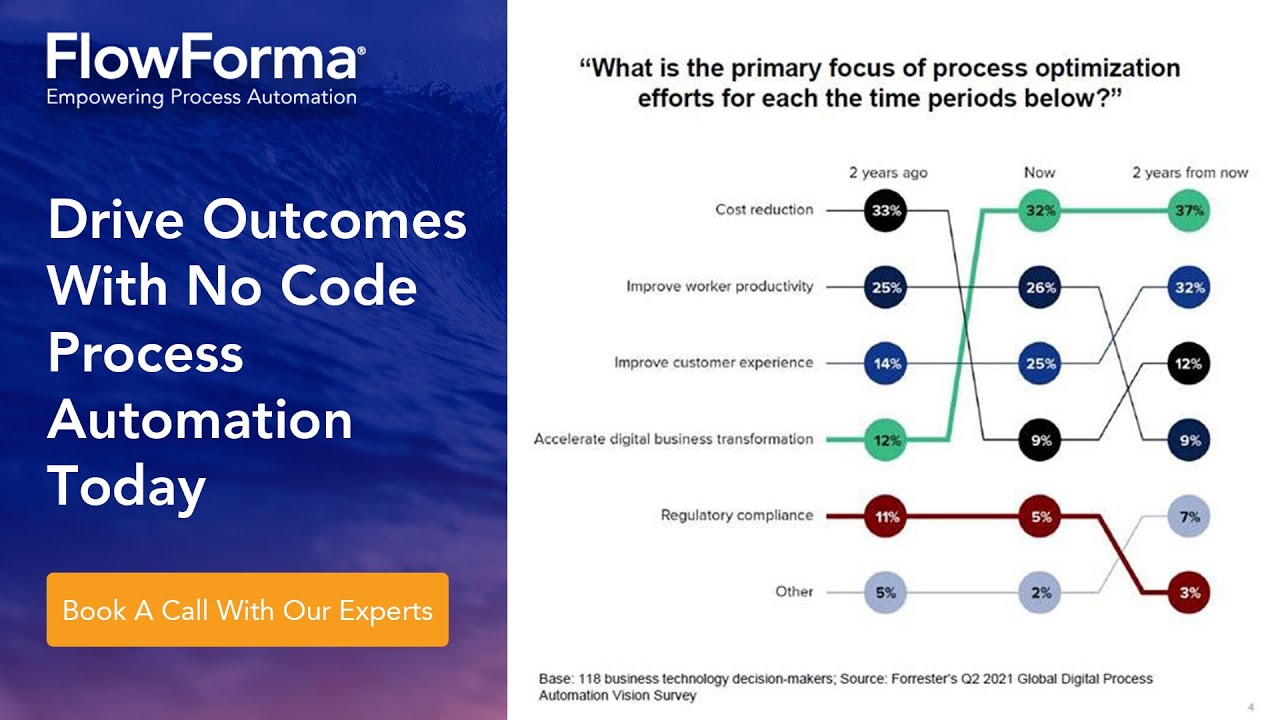
focus on digital transformation today, rising to 37% in two years

Primary focus of process optimization, today and in two years

  • Digital transformation 32% → 37%
  • Customer experience 25% → 32%
  • Cost reduction falling as a primary driver
“Cost reduction is an assumption. It's just not the primary driver.”Rob Koplowitz, Forrester

Forrester's 2021 survey, from 04:46

50%

use low code for professional developers

Platforms in use today

  • Low code for professional developers 50%
  • DPA-deep platforms 44%
  • Business modeling tools 37%
  • Process mining 28%
  • DPA-wide platforms 24.5%
“We should think about processes before we blindly automate them.”Rob Koplowitz, Forrester

Forrester's 2021 survey, from 23:03

Ready to move your paper and email processes onto one platform?

Book a demo with our process experts and see one of your own processes digitized live, with no code.

  • A demo built around one of your processes
  • A walkthrough of approvals, forms and reporting in Microsoft 365
  • Advice on choosing your first process
  • No cost and no obligation

Want to try it yourself? Start a free trial

Pick a time that suits you

00:00

Welcome and housekeeping

Watch this part

Rodrigo00:00

All right, let's kick things off. Hello and welcome to today's Forrester webinar, Forrester's 2021 Digital Process Survey Results: Process Automation Has Never Been More Important. At Forrester's request, this call is being recorded. The content of this webinar is copyrighted material.

Rodrigo00:16

Attendees are in listen-only mode and will have the opportunity to participate in a Q&A session after the formal presentation. If you have any questions during the webinar, please send them through the Webex chat. It is now my pleasure to introduce your speaker, Rob Koplowitz.

00:34

Five years of the survey

Watch this part

Rob Koplowitz00:34

Thank you, Rodrigo, and thanks everybody for joining. If you have questions during the session, throw them into the chat and I'll do my best to monitor them in real time and keep them in the proper context.

Rob Koplowitz00:53

A little about this survey. This is the fifth version of this research. It was originally kicked off five years ago by my predecessor, Clay Richardson. Clay saw some things happening in the digital process automation space and created this survey to test his hypotheses, and for those of you familiar with Clay, his hypotheses are usually correct. It has been the cornerstone of my research ever since.

Rob Koplowitz01:36

The analysis was done by myself and my research associate, Sarah Morana. Sarah did a great deal of the work preparing and analyzing the data, and helped me create the deck.

Rob Koplowitz02:05

This is one of our smaller, more situational surveys: smaller data sets and more focused. But this survey has really grown up. We had tremendous help from our data team on making it more world-class in terms of our data and how we analyze it, and a great deal of work has gone into it over a very long time.

02:43

Who took the survey

Watch this part

Rob Koplowitz02:43

It's always good to get a baseline of the people we're talking to. About 47% of respondents were business or product function leaders, about 10% were business process people, and we have individual contributors, developers and other IT roles. I'm really delighted by this sample, because it's exactly the type of working team, the type of stakeholders, who work together to push process initiatives forward. About 46% are key influencers of decisions.

Rob Koplowitz03:41

In terms of how organizations think about process optimization, about 27% have dedicated process professionals working on optimizing their processes. About 26% lead this at an executive level, and about 23%, a very encouraging and growing number, are driving it from the C-level. About 20% are department managers looking very specifically at making the processes within their department better.

Rob Koplowitz04:27

That's a very encouraging pattern: process professionals are involved, there's high-level sponsorship from the C-level, most of this is driven at the VP level, and there's good, strong participation at the business level. This is the pattern we want to see going forward.

04:46

The primary focus of process optimization

Watch this part

Rob Koplowitz04:46

This is our keystone data point, and we ask the question in a very specific way: what is the primary focus of process optimization efforts within your organization? We ask what it was two years ago, what it is today and what it will be two years from now, so we can do longitudinal analysis across the five iterations.

Rob Koplowitz05:26

The first three times we ran this survey, the focus was very much on cost reduction. That was generally the driver of BPM, and digital process automation comes from those BPM roots. It built some great BPM companies. But two years out, the answer was always: this is going to become much more strategic, we'll focus on customer experience and digital transformation.

Rob Koplowitz06:08

That shifted in the survey we ran right before we locked down in early 2020, and when we revisited it about six weeks later, because we were being overwhelmed with calls about process and workflow automation as a result of shelter in place. Strategic became what we're doing right now: we're thinking about customers, and about process as a backbone of our digital transformation strategy.

Rob Koplowitz06:44

You can see it in the numbers: 32% focus on digital transformation today and 25% on customer experience today, growing to 37% and 32% respectively two years out. We also saw a big jump in improved worker productivity, because people needed to work more effectively while sheltered in place.

Rob Koplowitz07:17

These drivers aren't mutually exclusive; in fact they reinforce one another. But when we ask what the primary driver is and see strategic initiatives take the forefront, it continues to build on our hypothesis that these are becoming critical drivers of business change.

07:42

How organizations organize for process

Watch this part

Rob Koplowitz07:42

How folks organize for this also shows encouraging patterns. When we ask how best to describe process optimization in your organization, over half have distributed teams working independently on their departments' process optimization projects. That's how these things should drive forward.

Rob Koplowitz08:11

But 26% are moving toward models with central teams. We describe them in different ways, as strike forces or centers of excellence, but it's a move toward a more federated model: we have expertise, and we want to bring it out into the organization and make it broadly available. That reinforces what we hear from clients and from our qualitative research.

08:49

Process as a critical part of strategy

Watch this part

Rob Koplowitz08:49

We also ask specifically how you would describe the role of process optimization in the organization. Look at the big green slice: it's a critical part of our business strategy and directly supports a critical initiative. When we see numbers like half saying this is critical, it raises the profile of process, and you start to see why it's becoming so high profile in the market.

09:39

Measuring the impact of process change

Watch this part

Rob Koplowitz09:39

We ask respondents to rate the importance of metrics in measuring the impact of process change, today and in the future. Organizations want to see efficiency and productivity improvements. Those aren't always the right metrics; sometimes effectiveness, which is different from efficiency, is the best measure.

Rob Koplowitz10:26

Almost 71% say customer satisfaction is important to them. This is no longer the back room. We're not just taking cost out somewhere in the back of the organization; these things directly affect customer experience, whether they're customer-facing processes or the operational processes behind the scenes that support the customer experience.

Rob Koplowitz11:04

Quality improvement remains very high. And look at revenue contribution, second from the bottom: 46% expect process work to drive revenue contribution today, and 42% in the future. These are broad-reaching goals.

11:31

Cost reduction is an expectation

Watch this part

Rob Koplowitz11:31

I want to drill into cost reduction, because on the previous slide you saw it sliding down as a primary driver. Does that mean it isn't important? At first blush it seems counterintuitive. When asked directly, almost 63% say cost reduction is important in measuring the impact of process change now, and 31% say it will be in the future.

Rob Koplowitz12:14

From our qualitative research and our inquiry and consulting work, it becomes really clear: cost reduction is an expectation. We're very good at measuring it, we're getting much better at measuring effectiveness, and there's error reduction and better governance, risk and compliance through better processes and automation. Cost reduction is an assumption. It's just not the primary driver.

Rob Koplowitz13:22

Here's why that matters. A number of years ago we could take out a lot of cost without changing things very much. I control things up to my organizational boundary, but the customer journey crosses it. I implement better processes and some technology, meet my KPIs, get my bonus and declare victory, and the customer experience is exactly the same, because there are stopping points between organizational boundaries and legacy systems.

Rob Koplowitz14:03

So assume you'll get cost reduction, and measure it; I encourage you to. But take a step back: taking out a lot of cost doesn't mean you're driving transformation or strategic goals like improving the customer experience.

14:16

76% plan wide-scale automation

Watch this part

Rob Koplowitz14:16

There are probably some process purists on the call, and I apologize for what I'm about to say: we're driving toward automation. Process optimization has to be thought of separately from automation, and automation isn't always the answer. But right now, it's more often than not the answer.

Rob Koplowitz14:42

When we ask what folks plan to do, three numbers stand out at the top. Respondents plan to reinvent and reimagine existing processes to better support their digital business strategy; 31% plan to automate large numbers of currently manual processes to drive end-to-end transformation; and 23% plan to completely transform end-to-end processes, rethinking how automation affects their operating models.

Rob Koplowitz15:25

What the top three have in common is that all of them lead to wide-scale automation, far higher levels than we ever did in the past. The total is 76%: 76% of organizations are thinking about end-to-end automation as a driver of their process optimization strategies.

15:50

Processes are everywhere

Watch this part

Rob Koplowitz15:50

Processes are everywhere, and there's no single right way to handle them. They live in packaged applications, on paper, in traditional digital process automation systems, in homegrown systems, in different flavors of low code, and in robotic process automation. All of these are potentially complementary, and all are potentially problematic for end-to-end processes.

Rob Koplowitz16:28

Your processes don't respect your legacy systems, the silos you've built or your organizational boundaries. They span them. If you're driving toward end-to-end automation, you have to get your arms around where and how your strategy moves forward.

17:01

Paper: inefficient before COVID, broken after

Watch this part

Rob Koplowitz17:01

There are two that are unambiguously the bad guys, the black hats of process, and both showed up in spades during COVID and shelter in place. The first is paper-based processes. When we count folks who say few, many, most or all of their processes have paper dependencies, we get to 80%. That's a huge number, and it's lower after COVID than before.

Rob Koplowitz17:37

Here's what happened when people went to shelter in place. If you had an inefficient micro-process in the middle of your process, two people passing a file folder back and forth between departments, that process broke. If you depended on paper moving through your mail room, that process broke. During COVID it was affecting customer service and revenue recognition. I describe paper as inefficient before COVID and broken after it, and there's still a lot of it out there.

18:19

Excel and email routing

Watch this part

Rob Koplowitz18:19

The other big area is what we call electronic manual routing, and the example we give is Excel and email. Nobody has given me anything to automate with, so I build macros and move things around in a workflow over email. I've solved my own problem, and it's better than a sharp stick in the eye. But we need to move to end-to-end, straight-through processing, onto managed platforms that interact with the systems and processes before and after them.

Rob Koplowitz18:54

The sheer volume of it is huge. We can't think about it in terms of cutting a couple of billion lines of custom code, or the good old aircraft-carrier-size BPM projects. It's fundamentally different. If you don't go after this problem, you're not going after what those 76% of organizations need to drive straight-through processing.

19:34

Optimize before you automate

Watch this part

Rob Koplowitz19:34

One of the most encouraging trends: we're not leaping to automation, or to a particular automation approach. There's been an uptake of tools and methods that separate process optimization from the knee-jerk reaction to move straight into automation.

Rob Koplowitz20:08

The first is business documentation: tools like BusinessOptix, iGrafx and Signavio, where the process expert, the business expert, the technology experts and other stakeholders collaborate to continuously improve processes. This is where re-engineering happens.

Rob Koplowitz20:44

Michael Hammer is back, and he was right: we should think about processes before we blindly automate them. If you have a process that's generating a lot of fraud and you just make it more efficient, you'll generate a lot more fraud a lot more quickly. You'll be efficient but incredibly ineffective.

Rob Koplowitz21:15

We're approaching it from a lean startup perspective: experimenting and starting very small. What used to be BPM has become digital process automation: start small, experiment, go fast, go wide and keep improving. BPMN is making a big comeback too. It can be overwhelming for business participation, but it's portable: I can take something from process mining into process documentation and potentially into a modeling environment for automation.

Rob Koplowitz22:06

We've asked about Lean Six Sigma for years, and I believe the question was originally added to watch it diminish. It hasn't. It's now less about being wedded to a methodology and more about recalibrating those professionals. People who understand process used to be fairly anti-automation; we've seen a wholesale change, and their affinity for automation is getting stronger. And they bring unbelievably strong insight.

23:03

Business modeling and process mining

Watch this part

Rob Koplowitz23:03

Looking specifically at business modeling tools, the BPMN-type tools that let you re-engineer your processes, there's again big uptake: 37% using them, 8.8% expanding their use and 21% planning to use them. These are big numbers.

Rob Koplowitz23:34

The complementary piece is process mining, in all its flavors: process intelligence, task mining. This has been exploding, and you now see process mining vendors advertising during the Olympics. 28% of organizations have it in use today. It got its foothold in manufacturing, particularly in central Europe and the DACH region, and it's now across the globe and across industries.

Rob Koplowitz24:21

Another 28% are planning to start investing in process mining. This idea of process diligence, understanding things before we jump into automating them, is another encouraging sign. Going from discovery to re-engineering to automation isn't easy, but organizations are getting better at it.

24:46

Where people build: low code and DPA

Watch this part

Rob Koplowitz24:46

Where are people building these things? The one piece you won't see on this slide is RPA, a little selfishness on my part, since I research most of the other tools here along with my colleague John Bratincevic.

Rob Koplowitz25:15

Look at the in-use numbers. 50% are using low code for professional developers, with vendors like ServiceNow, Mendix, OutSystems, Microsoft and Salesforce. What used to be the BPM market has become the digital process automation vendors, who are becoming incredibly effective at low-code patterns as well as the most sophisticated applications: 44% use these DPA-deep platforms, such as Appian, IBM and Pegasystems.

Rob Koplowitz26:12

The last category we describe as DPA-wide: Nintex and K2, now one company, Bizagi, AgilePoint and others, who are focused on helping you do hundreds of automations. 24.5% use them. These numbers are big, and coupled with those planning to use them, you see a big expansion of footprint.

Rob Koplowitz26:39

What these tools do is let me build process and workflow applications at scale and increasingly bring the development cycle closer to the business user, whether we're moving toward citizen development or simply having the business and IT work together on a much wider scale of automation.

27:04

Design thinking and customer journey mapping

Watch this part

Rob Koplowitz27:04

A lot of this lines up with improving customer experience, so we ask about design thinking, value stream mapping and customer journey mapping, and all of them are in use and expanding. When we drill into customer journey mapping, it turns out people often aren't doing it themselves; they're doing process work in support of it. My colleague TJ Keitt and I explored that dynamic in research not long ago.

Rob Koplowitz28:03

Organizationally, the customer experience folks who think in design thinking, the portfolio folks who think in value stream mapping and the process people aren't as aligned as they should be. But this data says they need to work together more effectively. There will be organizational challenges, but we're seeing really strong connections being made, all in support of the customer experience goals we think are so vitally important.

28:59

AI, applied pragmatically

Watch this part

Rob Koplowitz28:59

AI is taking hold. My DPA vendors don't always call it AI: sometimes it's document intelligence, a chatbot, or routing something based on tone or sentiment analysis. Increasingly there's machine learning for fraud detection loops or initial credit assessment. It's all being done in a very pragmatic way.

Rob Koplowitz29:29

The numbers are getting really big: 48% are using some form of natural language processing, quite often to bring structure to unstructured items, close to the content intelligence conversation, and 37% are using machine learning for particular types of loops. Two encouraging factors: the uptake is big, and it's very pragmatic. It's solving real problems.

30:19

Processes beyond the enterprise

Watch this part

Rob Koplowitz30:19

A couple more quick data points. Processes are increasingly extending beyond the enterprise: 42% use secure collaboration workspaces in direct support of processes, and others use external task approval, document approval or customer onboarding. What used to sit inside our four walls is extending beyond them.

Rob Koplowitz31:01

And the primary use case is still B2B, although 38% are building out automation and process optimization in support of business-to-consumer use cases. So that's the whirlwind tour of the latest data. I appreciate everyone taking the time to listen today, and I'll hand back to Rodrigo for any questions.

31:17

Questions and close

Watch this part

Rodrigo31:25

If anybody has questions or comments for Rob, leave them in the chat on the right-hand side of the Webex screen, and select all panelists before sending so Rob can see them. While we wait, please take a moment to complete the short feedback poll that just popped up on your screen.

Rodrigo32:03

No questions so far. Going once, going twice. If you're interested in scheduling an inquiry, I'm putting a link in the chat, and the last slide has Rob's contact information, so you can send a note to Rob or to Sarah. I don't see any questions, so Rob, any parting comments before we give everyone some time back?

Rob Koplowitz32:40

Just a reiteration: I know I went really fast through a lot of data. These days more people watch the recording later than live, so you all know where to find me, and I'm very interested in any feedback on the content or any questions. Thanks, everybody.

Rodrigo33:00

Excellent, thank you very much, Rob, for your insights, and thank you to our audience for their participation. This concludes today's webinar.

Frequently asked questions

Who presented this webinar?

Rob Koplowitz, vice president and principal analyst at Forrester, presented the results, with Forrester's Rodrigo hosting. The webinar took place on July 29, 2021. Rob ran the analysis with his research associate, Sarah Morana.

What is Forrester's digital process survey?

It is Forrester's recurring survey on process optimization and digital process automation, originally created by Rob's predecessor, Clay Richardson. The 2021 results are its fifth version. About 47% of respondents were business or product function leaders, and about 46% were key influencers of decisions.

Is cost reduction still a reason to automate processes?

Yes, but as an expectation rather than the main goal. Almost 63% said cost reduction is important in measuring process change, yet digital transformation and customer experience have become the primary focus. Rob's advice: measure cost savings, but don't mistake them for transformation.

How many organizations plan end-to-end automation?

In Forrester's 2021 survey, 76% of organizations were planning to reinvent processes, automate large numbers of manual processes or completely transform end-to-end processes. All three lead to wide-scale automation.

Why are paper and spreadsheet-based processes a problem?

80% of organizations still have processes with paper dependencies, and many more run on Excel and email. Rob describes these as inefficient before COVID and broken after it, because they stopped working when people couldn't pass files between desks.

Should you optimize a process before automating it?

Rob's view is yes. Business modeling tools and process mining help teams understand and re-engineer a process first, so automation doesn't simply make a flawed process run faster. 28% already use process mining, and another 28% plan to invest in it.

Ready to automate your processes end to end?

Book a tailored demo, or start a free trial and build it yourself.