Digital transformation for businesses in almost all industries has accelerated in the past few years.
The pressures of remote work, plus a need for new competitive technologies, has organizations turning toward mobile-first technologies, AI-powered tools, collaborative platforms, and crucially automation technology.
One industry, however, has struggled to keep up with this trend. While other sectors are accelerating their digital transformation journeys, many construction firms are yet to begin.
For an industry that has so many moving parts, processes, and people, it’s vital that new technologies, like automation, are embraced for businesses to stay competitive.
To gain a real understanding of where the industry is in terms of automation, we partnered with Construction Dive to understand the market to help inform our thesis.
We interviewed over 100 leaders in the industry to get their take on automation in the industry. We felt getting it from the 'horses mouth' was the best way to get a true understanding of the trends.
We will start the blog with the situational analysis of the industry and the survey data and then fire ahead into how organizations are automating and provide real-world examples of automation in practise.
The segment for the interviews and report included:
- C-suite (CEO/COO/CTO/CFO/CIO) 57%
- Operations Director/Head/VP/Manager 13%
- Construction Head/Manager 13%
- IT Director/Head/Manager/Other Key Decision Maker 9%
- EVP, SVP, VP 5%
- Health & Safety Director/Head/Manager 2%
- Improvement or Innovation Director/Head/VP 1%
Key outcomes revealed in our survey included:
Results of the survey revealed that while many construction organizations still rely on manual processes (90% still using excel for 25% + of processes), there is large shift towards automation with 47% on their journey. Business leaders are now prioritizing automation, with 63% saying it's a top priority.
I forecast this number to increase with the adoption of AI within organizations. Looking ahead, 74% expect 51% - 100% of processes to be automated over the next 12-months.
This indicates wide-spread automation strategies are in place at board level. And finally, 87% feel that automates provides a competitive advantage.
These results are a great segway to the rest of the blog where we dive into the details of automation.
What is construction automation?
Construction automation is the use of digital tools, technologies and processes to automate key workflows.
Today, the automation of processes is driven by business needs, but delivered by a hybrid of people, processes and AI.
Construction process automation vs physical construction automation: what's the difference
There are key differences between process automation and physical construction automation. This article is primarily focused on process automation. But, i'll describe the differences below for context.
Construction process automation:
This refers to the automation of admin tasks, compliance, and project management workflows. These are typically highly repetitive tasks that can be automated, while still keeping humans in the loop for approvals within the workflow. In this article, this is the core topic I discuss. It's also the key area that the FlowForma platform is used for.
Physical construction automation:
This relates to the use of physical/hardware automation technologies on construction sites. Tech such as drones, autonomous machinery and robotic bricklaying are used for augmenting the work of humans with technology.
Benefits of automation in construction
Construction projects are usually complex with bespoke specifications for each one. This makes projects difficult to iterate and outcomes hard to predict.
However, there are ways to streamline the processes within a construction project, as well as mitigate health and safety risks, eliminate outdated methods (for example, Excel sheets), and limit overruns.
Process automation is an effective way to streamline workflows in a construction project, including material requisition, permit to dig, health and safety checks, risk assessment, and the onboarding of contractors and subcontractors.
For many construction firms, these processes are performed via outdated manual methods. However, outdated approaches will hamper productivity, create overruns (and overheads), and cause project delays.
Case in point, requisition for materials
Requisition for materials is a process often completed via emails, which can be missed, misinterpreted, and cause broken links in communication.
By using a process automation tool, site managers are required to fill out a set form, with accurate data entry fields, which then prompts the requisition team. This ensures that data is relayed accurately, in a standardized way, and means that important information doesn’t get overlooked.
Watch: construction case study: material requisition
The benefits of automation in construction are far-reaching. Since construction projects often have bespoke requirements, automation of processes can positively impact very niche areas of a business.
Need to automate construction processes
However, using construction process automation software will also deliver predictable business outcomes:
- Increase productivity: process automation in construction removes manual processes for a business, replacing these with streamlined workflows. If a construction company automates a significant amount of its processes, it will see a boost in worker engagement, seamless contractor onboarding, and an acceleration toward project delivery.
- Deliver an ROI: business leaders who automate construction see an immediate return on investment. With FlowForma’s process automation tool, construction firms have in some cases saved $80,000 per significant process. If a firm automates enough of its processes, it will cut overheads by a considerable amount.
- Beat out competition: process automation in construction is still a novel technology and has not been adopted across the industry. This means that firms that automate construction will have a market advantage.
- Gain data visibility: automate construction and gain access to a wealth of data. With process automation platforms, like FlowForma’s tool, construction firms can oversee and report on project data. This improves decision-making in the long term and ensures that challenges with processes (bottlenecks, missed steps, etc.) can be quickly refined.
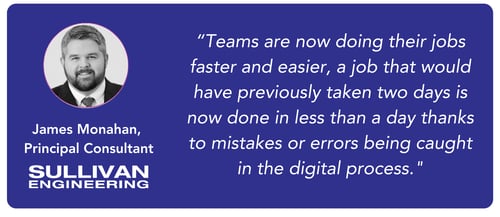 FlowForma customer Sullivan Engineering describe the benefits of automating on data
- Become agile: for an industry that relies on so many processes and people, as well as the ability to adapt to changing circumstances, agility is key. Automation in the construction industry helps construction teams to connect and collaborate more quickly. A connected construction platform like FlowForma’s will ensure that employees can remain agile as they navigate complex projects.
-
Mitigate risk: The construction industry is heavily regulated. Despite this, construction firms still rely on traditional methods (e.g. Excel spreadsheets) for creating audits and reports. If mistakes are made (data not recorded accurately, etc.) there can be serious health and safety implications. With process automation, online forms with exact data entry fields can mitigate risk. For an industry marked by lawsuits, it’s important that construction businesses take preventative measures.
Learn more about the business outcomes for construction in this video delivered in partnership with Engineering News Record (ENR).
Examples of construction automation
CVB (Costain, VINCI Construction Grands Projects, and Bachy Soletanche) automate quality reports
Construction Joint Venture, CVB (Costain, VINCI Construction Grands Projects, and Bachy Soletanche), came to FlowForma with a need to automate the following processes:
- Environmental inspections
- Duty manager briefing sheets
- Quality audit plans/report
- Field change requests
- Daily/weekly plant check sheets
The firm picked out FlowForma’s process automation tool due to its no code credentials, which meant that non-technical employees could quickly pick up the workflows.
Within only two months of signing up, CVB had something to show for the investment. Employees were impressed by the platform’s ease of use, its agility and flexibility, and the way documents could be inserted into CVB templates. Those employees that worked on-site (often without signal) appreciated offline capabilities within the mobile app.
Most importantly, employees using the FlowForma tool said they felt empowered by process automation. Read the full case study.
I interviewed Lambros Arvanitis, BIM Manager at CVB JV about their process automation journey and the key outcomes they achieved. Watch the video below to get inside the real success story and hear from Lambros about their goals, process to digitalize and the end outcomes.
Lambros Arvanitis, BIM Manager at CVB JV describes their automation journey
PJ Hegarty automates it's Safety Behaviour Observation process
Here’s a snapshot of how leading construction firm PJ Hegarty transformed these challenges into measurable outcomes with FlowForma.
Key Highlights from the PJ Hegarty success story include:
Digitizing Safety Behaviour Observation (SBO) drove a 45% increase in observations
Moving from paper and Excel to FlowForma transformed observation volume and quality, giving management real-time trend visibility across all sites for the first time.
16,000 forms completed every month
After digitizing plant management, permits, SBOs and vehicles, PJ Hegarty now processes ~16,000 individual forms per month — a scale impossible to manage manually.
QR codes solved the contractor access problem
QR code posters on-site let anyone with a phone access the right forms instantly, replacing complex license management and driving adoption without added admin.
Full data ownership enabled dashboards for every stakeholder
Dashboards sliced by site, region, client, time or risk level, including bespoke views built to individual client specifications.
You can also watch Sinéad Gaines, Regional EHS Manager at PJ Hegarty, discuss how they achieved these results in this on-demand webinar:
Automating EHS At Scale Featuring PJ Hegarty
Health and safety automation in construction
Health and safety is one of the primary use cases we see automated among our global construction customers. It's one of the most important processes to automate due to regulations, financial impact and the safety of workers and the general public.
Why manual H&S processes put firms at risk
No matter what stage of the construction lifecycle organizations are building for, having manual health and safety processes automated is critical.
The recent fine of £124,000 received by Care Pro under the UK's Building Safety Act 2022 underscores the importance of creating digital audit trails of health and safety processes. In this example, the organization received a fine for multiple failures for fire-fighting and fire detection, duty to take general fire precautions and risk assessment, as well as one failure to discharge maintenance duties.
Digital tools, audit trails, and real-time monitoring support organizations to mitigate risk and avoid costly fines such as the one highlighted above.
Alongside the financial impact, there is also reputational damage from the 'media noise' created by the fine. This has the potential to lead to business loss.
Finally, the health and safety of workers and the general public is at risk when relying on manual health and safety processes. In the example above, using manual methods to record fire risk assessments is risky and prone to data errors. Instead, the organization would benefit from a digital process where records are kept digitally, issues are surfaced in real-time, and a clear audit trail is provided for easy access.
Key health and safety workflows to automate
The list of health and safety workflows to automate will be very specific to your business needs. Some of the most common workflows we see are:
How AI can now handle construction H&S compliance
FlowForma has a long track record of supporting customers with health and safety and compliance. Organizations start by automating with FlowForma Copilot, our AI workflow generator.
With FlowForma Copilot, users just need to type a simple text prompt and the tool will build out the steps, questions and rules for you.
In the example here below, you'll see the steps needed to create a regulatory compliance workflow and the prompt needed to refine the process.
Once you have a completed process build and live, workers use our mobile app to submit forms, highlight health and safety issues, and complete checklists. This data is automatically passed to relevant stakeholders such as health and safety managers.
An audit trail is automatically generated so that both internal stakeholders and external auditors can access the data any time.
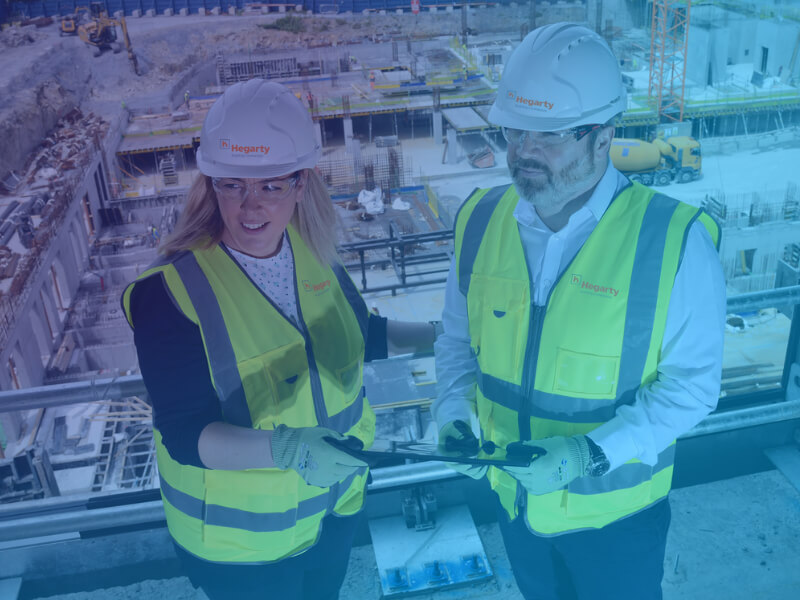
A real-world example of health and safety workflows at play is with Hegarty, an Irish-based construction organization.
The EHS team at Hegarty found it's safety behavioral observation process was administrative heavy and drew in it's resources. There was also a lack of real-time data and delays with actioning inights from the data recorded.
A pilot was launched to automate the safety behavioral observation process and the results were transformative for the EHS team. Results included:
Brian Mooney, Director at PJ Hegarty, sumed up the benefits to Hegarty:
“Staff are happy with its user-friendly application, and our project managers like the real-time information dashboards available daily,” he said. “We have accessible information to engage with safety at daily meetings relevant to the site activities. It has reduced our EHS staff’s administrative time, allowing them more time on site.”
Compliance and audit trail automation in construction
At every senior manager meeting in construction, compliance is at the forefront of conversations. Compliance is foundational to the industry as construction firms face regular inspections from HSE, agencies and clients.
Regulations such as the Building Safety Act 2022, ISO 9001 quality management and ISO 14001 environmental management mean that organizations still working on email and spreadsheets will find it difficult to produce audit trails in a timely manner. It also means that data is prone to corruption and inaccuracy.
Automating compliance workflows is critical to the modern enterprise, as it supports their health and safety teams. Audit trails are the cornerstone of compliance workflows as they provide the track record of compliance, timestamped and logged for each interaction.
One notable example of the importance of audit trails is with one of FlowForma's customers, A14. The A14 Cambridge to Huntingdon Improvement Scheme was the largest construction project in the UK. It was a £1.5 billion joint venture between Costain, Skanska and Balfour Beatty.
The project needed a platform to generate audit trails for better governance with full traceability and found FlowForma suited their needs.
By creating an audit trail, A14 avoided a £10M penalty for material requisition, proving the importance of accurate and pure data for compliance.
The IT Manager of the project stated,
"We looked at Nintex and K2, from our point, they were cost prohibitive. We looked at PowerApps, which again didn’t really fit the bill, it became quite evident we were going to need to have skills around accessing APIs and doing a bit of Java. FlowForma Process Automation met all our requirements.''
IT Manager, Costain, Skanska & Balfour Beatty A14 Joint Venture
Automate construction with FlowForma
For road construction and building construction businesses to digitize, they need to pick out tools which support the specific needs of projects and processes. This can be difficult, since construction projects are unique and the demands across a project can vary.
FlowForma’s no-code process automation technology is award-winning and built specifically for construction firms. It empowers construction firms to rapidly digitize processes 5-10x faster than other tools.
With process automation, construction firms see an ROI within six weeks. Though the industry has been slow to mobilize, there is a budding race toward digitization. Those firms that automate construction sooner will see themselves ahead in the digitization game.
In a competitive landscape, with knocks from the pandemic and rising costs for materials, it’s important to adopt and set in motion new technologies. Those construction firms that don’t automate their processes now will be playing catch-up down the line. Learn more about our construction management software today.