To date, most organizations, especially in service and related industries, follow the same age-old process of assigning tasks. A manager logs in, checks the list of tickets or requests, and manually assigns each one to the appropriate person.
The approach works only when the volume is low and the team is small. But as requests increase and processes involve more people or departments, this simple method turns into a daily coordination exercise. And over time, managers end up spending more time managing tasks than leading teams.
This is usually when organizations start looking for business process automation software. Precisely, to remove the manual effort needed to keep work flowing. Below, we have elaborated on what business process automation means for various departments, operations, and industries, including the challenges, benefits, key features, and some of the most popularly used software available in the market.
Microsoft 365 Compatibility at a Glance
Not all business process automation platforms interact with Microsoft 365 in the same way. Some solutions are built for the Microsoft ecosystem, while others connect to Microsoft services but operate on separate platforms with their own hosting, data environments, and governance models. If you want a platform that aligns very well with Microsoft 365, the at-a-glance table below will be helpful to you.
| Microsoft 365/SharePoint Alignment |
Business Automation Software Solution |
| Microsoft-native / SharePoint-native |
FlowForma, Microsoft Power Automate & Power Apps |
| Microsoft 365 integrations available |
Nintex, Appian, Bizagi, Decisions, Kissflow, Pipefy, ProcessMaker, Cflow |
The 10 Popular Business Automation Software Solutions
The global business process automation software market is projected to attain a value of US$ 33.4 billion by 2032, reflecting how organizations increasingly rely on technology to streamline operations. Yet with countless analyst reports and online reviews, finding solutions that genuinely fit your needs can feel like navigating a labyrinth, where scrolling through numerous reviews and testing numerous features becomes overwhelming.
Below is a curated list of widely recommended business process automation software solutions.
|
Platform
|
Key strengths
|
Best for
|
Pricing
|
|
CFlow
|
Basic forms and approvals
|
Small teams, routine requests
|
Transparent, per-user
|
|
Decisions
|
Rules and decision logic inside workflows
|
Logic-driven processes
|
Partly transparent
|
|
Pipefy
|
Structured service request pipelines
|
HR, procurement intake
|
Limited transparency
|
|
Bizagi
|
BPM modeling before app build
|
Enterprise process mapping
|
Not transparent
|
|
Appian
|
Complex, cross-system BPM and cases
|
Enterprise process orchestration
|
Transparent; complex
|
|
FlowForma
|
No-code, form-led compliance workflows, native to MS365 and SharePoint Online
|
Regulated ops, approvals, inspections
|
Process-based pricing, with prices published at flowforma.com/our-pricing
|
|
Microsoft Power Automate & Power Apps
|
Strong in MS365; logic often needs IT involvement
|
Microsoft-centric app + integration builds
|
Transparent; rises with scale
|
|
Nintex
|
Document and eSign-heavy processes
|
HR, compliance, document approvals
|
Partly transparent
|
|
Kissflow
|
Simple internal departmental flows
|
Mid-market HR, finance, admin
|
Base transparent
|
|
ProcessMaker
|
AI + document data extraction focus
|
Data-heavy operations
|
Limited transparency
|
Side-by-side overview of 10 popular business process automation
|
📌How did we compile this list?
To prepare the list below, we focused on popular business automation platforms, including our own solution, FlowForma, and gathered information from official review sites and user reviews where available.
We assessed each tool based on the following parameters:
- Core features
- Ease of use
- Scalability and customization
- Integration capabilities
- Governance & compliance
- Mobile access
- Customer support & onboarding
- Pricing transparency and cost-effectiveness
- User feedback and customer satisfaction
By combining these with features highlighted by vendors and real-world user experiences, we aimed to provide a balanced view that reflects not just what each platform can do, but also how it performs in practice and fits into everyday workflows.
|
Let’s now get into the detailed analysis of each platform.
1. Microsoft Power Apps - Best for Microsoft ecosystem integration
.webp?width=1584&height=396&name=Untitled%20design%20(1).webp)
Microsoft Power Automate & Power Apps homepage
Microsoft's Power Platform combines Power Apps for building business applications and Power Automate for connecting systems and automating actions. Organizations already operating within Microsoft 365 find that it integrates directly with their existing data, users, and workflows, offering over 1,000 connectors to both Microsoft services and third-party tools.
Teams using the platform appreciate the deep native integration with their Microsoft ecosystem and strong governance controls. However, complex workflows often require expressions or scripting, and licensing costs can escalate quickly as usage grows.
Key Features of Microsoft Power Apps
1. Canvas apps for custom UI built from scratch using drag-and-drop controls
Canvas apps allow you to design custom user interfaces from the ground up using visual drag-and-drop controls. This gives you complete flexibility to create applications tailored to your specific business needs without writing code.
2. Model-driven apps built on Dataverse data structures
Model-driven apps are automatically generated from your Dataverse data model, providing a structured approach to application development. This method works well when you need consistent, data-centric applications that follow standardized business logic.
3. 1,000+ connectors for Microsoft and external services
The platform offers over 1,000 prebuilt connectors that integrate with both Microsoft services and third-party applications. These connectors enable you to automate workflows across different systems without requiring custom integration.
4. AI Builder for document processing, predictions, and form recognition
AI Builder provides pre-trained, customizable AI models that extract data from documents, make predictions based on historical data, and recognize information in forms. This capability helps you automate tasks that previously required manual review and data entry.
Pros and Cons of Microsoft Power Apps
Pros:
- Extremely easy for rapid custom app development
- Deep integration across the Microsoft ecosystem.
- Strong no-code capabilities for business users.
- Connects easily with multiple external data sources.
Cons:
- Learning curve for advanced features and data modeling.
- Slow performance with large datasets or complex apps.
- Licensing structure is complex and costly with Dataverse requirements.
2. FlowForma - Best for regulated, approval-heavy workflows in Microsoft 365 environments
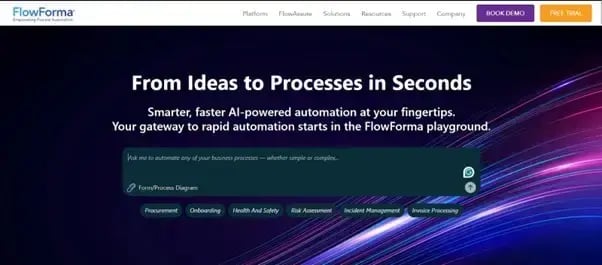
Screenshot of FlowForma home page
FlowForma is a no-code business process automation platform built for regulated organizations that rely on Microsoft 365 and need compliant processes deployed quickly. The platform operates entirely within your SharePoint environment, so that your data remains secure within your tenant, and your IT team maintains complete governance and control.
More than 300,000 users worldwide trust FlowForma to eliminate manual forms and email-based approval chains, replacing them with streamlined digital workflows that your business teams can build and manage independently, without requiring IT intervention for every change.
To help you understand how FlowForma differs from other business process automation tools, here is a quick walkthrough:
|
Feature
|
FlowForma
|
Microsoft Power Platform
|
Nintex
|
|
Setup approach
|
100% no-code for business users
|
Low-code with expressions for complex logic
|
Low-code with designer configuration
|
|
Prebuilt templates
|
Industry processes can be generated instantly with FlowForma Copilot
|
Generic starter templates
|
Limited process templates
|
|
Compliance posture
|
Enterprise security with data hosted in own SharePoint tenancy
|
Enterprise security within the Microsoft ecosystem
|
Enterprise security with vendor-hosted data
|
FlowForma vs. other popular business process automation tools
Key Features of FlowForma
FlowForma combines AI, governance, forms, documents, and routing into a single platform that works natively within Microsoft 365. This unified approach eliminates the need to juggle multiple tools while ensuring your processes stay compliant and secure.
Here is what FlowForma brings to the table:
1. End-to-end workflow engine with approvals and routing
You get a complete workflow engine that handles sequential and parallel steps, role-based approvals, conditional routing, SLAs, and escalations. This means your processes can involve multiple teams and even external participants, with clear accountability at every stage.
2. Custom forms with validation and conditional logic
Build forms that adapt as users fill them out. Field validation, dependencies, and conditional visibility ensure you capture accurate data while automatically enforcing your process rules. This reduces errors and keeps everyone on the same page.
3. AI-powered automation across the process lifecycle
FlowForma's AI does more than speed things up. It transforms how you create and improve processes. Here’s how each work:
|
FlowForma's AI innovations
|
How it helps you
|
|
AI Copilot
|
Turn plain text, diagrams, or written steps into working workflows instantly, without any manual building.
|
|
Agentic AI
|
Handles smart actions like validating data, reading documents, and updating systems as your process runs, reducing manual work.
|
|
Smart Assistants
|
Guides you and your users in real time, making it easier to build workflows and reducing the learning curve.
|
|
Summarization
|
Quickly shows you what's happening in active workflows—blockers, pending tasks, and key decisions at a glance.
|
|
Discovery Agent
|
Review your documents to find new automation opportunities you might have missed. Just add it to your meeting or conversations, and our Discovery Agent will take it from there.
|
|
AI Insights & Analytics
|
Identifies bottlenecks and inefficiencies and suggests improvements to strengthen your processes.
|
FlowForma's AI suite for effortless process creation
4. Automated document generation from live process data
Generate reports, contracts, letters, or certificates automatically using data from your workflows. Documents stay in sync with your process data, eliminating manual formatting and duplicate entry.
5. Full audit trails, reporting, and AI-powered analytics
Every action, from submissions and approvals to edits and decisions, is time-stamped to create a complete audit trail. You get searchable logs that support regulatory reviews and meet standards like HIPAA and ISO 27001.
AI analytics highlight trends, exceptions, and bottlenecks so your compliance and risk teams can monitor performance and maintain adherence over time.
6. Native Microsoft 365 integration with enterprise governance
FlowForma works as a no-code layer on SharePoint, keeping your workflow data inside your tenant. Your IT team maintains full oversight while your business teams build and manage processes independently, without compromising security or control.
Pros and Cons of FlowForma
FlowForma has clearly built a loyal base of enterprise users who appreciate how quickly it turns complex processes into manageable, no-code workflows. At the same time, like any platform, it comes with trade-offs.
Understanding both the strengths people consistently praise and the limitations they flag will help you decide whether it’s the right fit for your organization. Below are the notable pros and cons of FlowForma:
Pros
- Business users find it easy to build workflows without heavy IT involvement.
- Workflow automation feels smooth, speeding up approvals and routine process steps.
- Teams report stronger operational efficiency across departments and shared processes.
- Reduces manual errors by standardizing steps, fields, and required documentation.
- Noticeable productivity gains, including for NHS teams running high-volume workflows.
Cons
- Effective use requires structured process design and a thoughtful, well-planned setup.
- Learning curve can feel steep, especially without structured onboarding and training.
- Navigation takes time to get used to for new or occasional users.
FlowForma Pricing
FlowForma uses tiered, process-based pricing, with unlimited workflows covered under a single license. There are no hidden fees, and you can scale automation without unexpected costs.
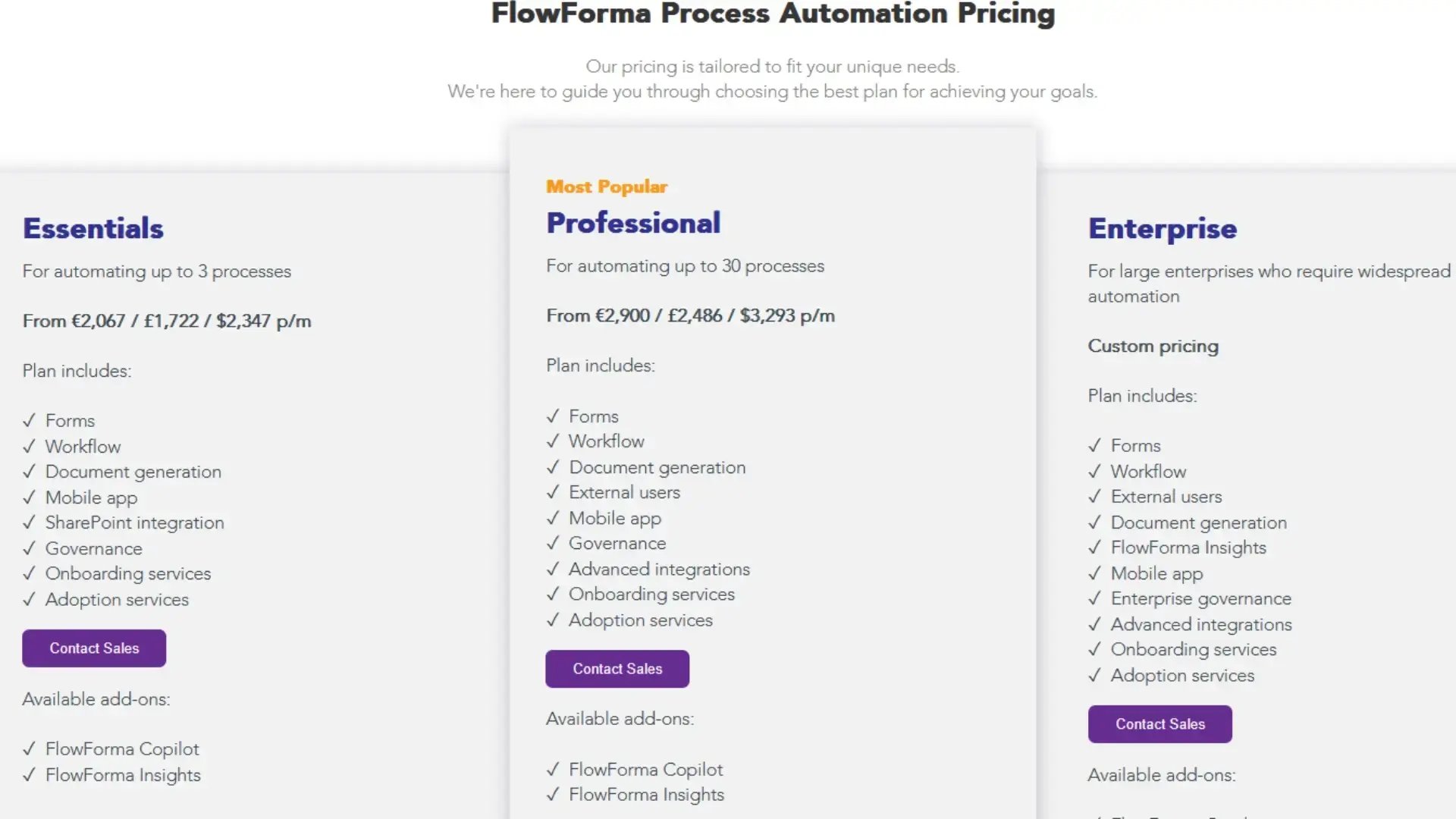
FlowForma’s process-based pricing model
When your teams adopt more workflows, departments expand their usage, or even when external parties are involved, the price stays the same.
3. Nintex - Best for document-heavy compliance workflows
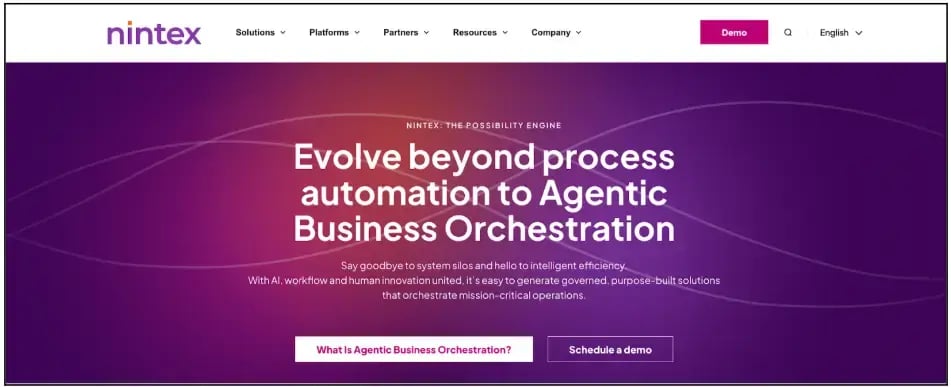
Nintex homepage
Nintex focuses on process automation built around forms, document generation, and eSignatures. Compliance, HR, and operations teams commonly use it for workflows that require structured document routing and approval chains.
The platform is recognized for its strong document and form automation capabilities, with built-in eSignature functionality that keeps everything in one system. Users report that complex scenarios often require IT involvement, and some find the user interface dated compared to newer alternatives. Customer support feedback has also been mixed.
Key Features of Nintex
1. Advanced form builder with conditional logic
The form builder lets you create dynamic forms that update based on user input using conditional logic and field dependencies. This ensures that users see only relevant questions and required fields, improving data accuracy and completion rates.
2. Document generation from workflow data
Documents such as contracts, reports, and letters are automatically generated using data collected during workflow execution. This eliminates manual document creation and ensures consistency across all generated files.
3. Built-in eSignatures and document routing
The platform includes native eSignature capabilities and automated document routing to the appropriate stakeholders. This streamlines approval processes by keeping signature collection and document tracking within a single system.
4. Process discovery and RPA for legacy system tasks
Process discovery tools analyze how work currently flows through your organization, while RPA capabilities automate repetitive tasks in older systems that lack modern APIs. This combination helps you identify automation opportunities and execute them even when legacy systems are involved.
Pros and Cons of Nintex
Pros:
- Intuitive no-code interface for fast workflow and form creation.
- Strong automation with good cross-system integration support.
- Adapts well to both simple and complex processes.
- Quick setup without heavy technical expertise required.
Cons:
- Pricing becomes expensive as workflows, environments, and users scale.
- Requires governance and technical oversight for complex process implementations
- Advanced customization often needs developer involvement beyond business users.
4. Kissflow - Best for straightforward departmental workflows
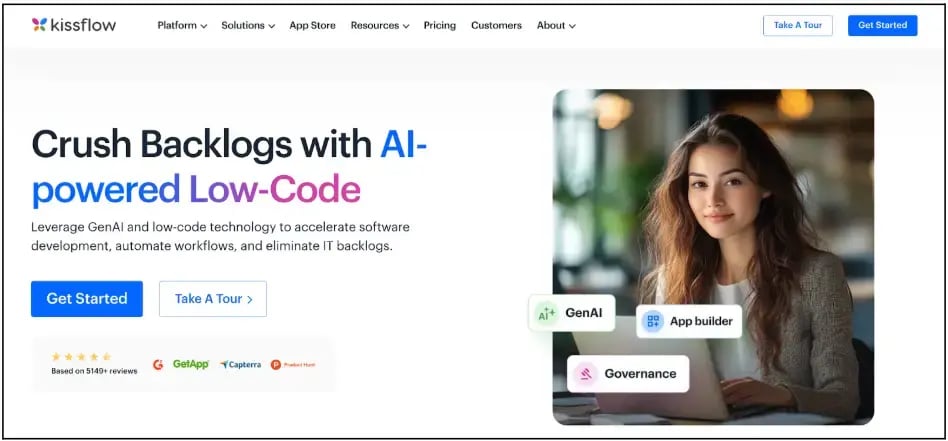
Kissflow homepage
Business teams looking to digitize internal requests and approvals across HR, finance, procurement, and admin functions turn to Kissflow for its visual builder designed for non-technical users. The platform focuses on making it easy to set up workflows that follow predictable, repeatable steps.
Mid-market organizations find it helpful to move away from email-based processes without requiring extensive IT resources.
The platform combines apps, forms, and workflows in one place with good collaboration features. However, task reusability is limited, UI customization options are limited, and complex use cases often still require technical support.
Key Features of Kissflow
1. Visual process builder for approval and request flows
The visual process builder lets you map out approval chains and request flows using a drag-and-drop interface. This makes it straightforward for business users to create workflows that match their existing processes without technical training.
2. App builder for internal business applications
Beyond workflows, you can build full business applications to manage data and processes within your organization. These apps combine forms, data tables, and workflow logic to handle department-specific needs.
3. External portals for vendor or customer participation
The platform provides portals that allow external users like vendors or customers, to submit requests and participate in workflows. This extends your processes beyond internal teams while maintaining control and visibility.
4. Built-in governance and role-based access controls
Governance features and role-based permissions ensure that users only access the data and actions appropriate to their role. This provides security and compliance controls without requiring complex configuration.
Pros and Cons of Kissflow
Pros:
- It is very easy for business users to automate processes quickly.
- Strong cross-department workflow collaboration and visibility.
- Fast digitalization with simple, guided process setup.
- Flexible customization for adapting workflows to business needs.
Cons:
- Reporting and mobile functionality lack advanced capabilities.
- Integration challenges with external enterprise systems.
- Access control setup can feel inconsistent and restrictive.
5. Appian - Best for complex enterprise process orchestration
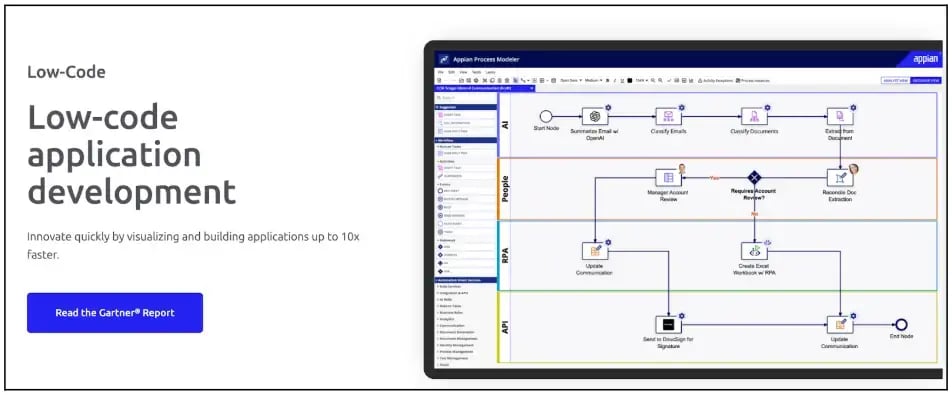
Appian’s low-code development platform
Large enterprises with sophisticated automation requirements use Appian to orchestrate complex, long-running processes across multiple systems.
Organizations with mature process automation needs appreciate Appian's ability to handle complex enterprise processes and its strong data handling across systems. The platform is recognized as a leader in the process automation space with a mature BPM and case management engine. However, licensing is expensive and can be unclear, the basic tier has limited capabilities, and the platform requires trained developers to use it effectively, making it less suitable for quick, simple workflows.
Key Features of Appian
1. Data fabric to unify data from multiple systems
Appian's data fabric creates a unified layer that connects data from disparate systems without requiring migration or duplication. This allows workflows to access and update information across your entire technology stack from a single platform.
2. Process modeling with BPMN standards
The platform uses Business Process Model and Notation (BPMN) standards for process design, providing a structured and widely recognized approach to modeling workflows. This standardization makes processes easier to document, understand, and govern.
3. AI services for document classification and insights
Built-in AI services can classify documents, extract relevant information, and surface insights from unstructured data. These capabilities reduce manual processing time and improve decision-making within automated workflows.
4. Case management for long-running, multi-step processes
Case management features handle complex processes that span extended timeframes and involve multiple steps, participants, and decision points. This is particularly useful for scenarios like customer onboarding, claims processing, or compliance investigations that don't follow linear paths.
Pros and Cons of Appian
Pros
- Low-code drag-and-drop interface accelerates rapid application development.
- Intelligent automation improves onboarding and compliance workflows.
- Strong plugin ecosystem supporting enterprise-grade integrations.
- Built-in AI enhances efficiency and reduces manual effort.
Cons
- Expensive licensing model, especially for growing user bases
- Limited customization for highly complex use cases.
- Steep learning curve for advanced configurations and features.
6. ProcessMaker - Best for data-intensive operational workflows
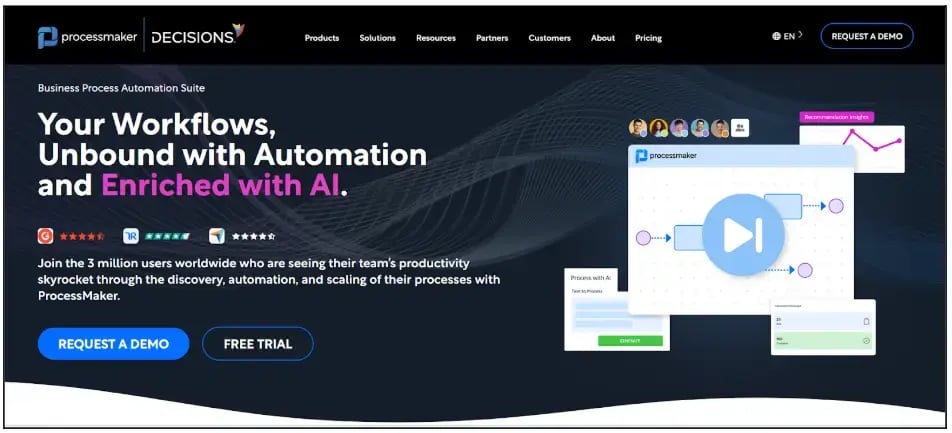
ProcessMaker’s Homepage
ProcessMaker focuses on AI-assisted automation and intelligent document processing for operational teams that need to automate data-heavy processes. The platform emphasizes connecting disparate systems and extracting structured data from unstructured documents.
Its API-first architecture provides strong integration flexibility, and the AI-powered document processing capabilities help eliminate manual data entry. However, users report that the user interface needs improvement, onboarding can be slow for new users, and pricing transparency is limited. Advanced scenarios also require setup effort.
Its API-first architecture provides strong integration flexibility, and the AI-powered document processing capabilities help eliminate manual data entry. However, users report that the user interface needs improvement, onboarding can be slow for new users, and pricing transparency is limited. Advanced scenarios also require setup effort.
Key Features of ProcessMaker
1. Intelligent document processing (IDP) for data extraction
Intelligent document processing uses AI to extract structured data from unstructured documents like invoices, forms, and contracts. This eliminates manual data entry and accelerates document-driven workflows.
2. API-first integrations with external platforms
The platform is built with an API-first architecture, making it straightforward to connect with external systems and services. This approach gives you the flexibility to integrate ProcessMaker into existing technology ecosystems.
3. AI assistance for process building and optimization
AI features help you build processes faster by suggesting workflow steps and identifying opportunities for optimization in existing processes. This reduces the time needed to design and refine automation.
4. Visual workflow designer with role assignments
The visual designer allows you to map out workflows and assign specific roles and responsibilities to each step. This ensures clear accountability and proper routing throughout the process lifecycle.
Pros and Cons of ProcessMaker
Pros:
- Flexible platform supporting diverse workflow automation scenarios.
- Reliable and supportive customer team offering high level of customer satisfaction.
- Good customization for tailored business process automation.
Cons
- Missing features in branding and integration capabilities.
- Performance issues across browsers and complex implementations.
- Extensive training required for consistent platform access.
7. Decisions - Best for rule-intensive business logic automation
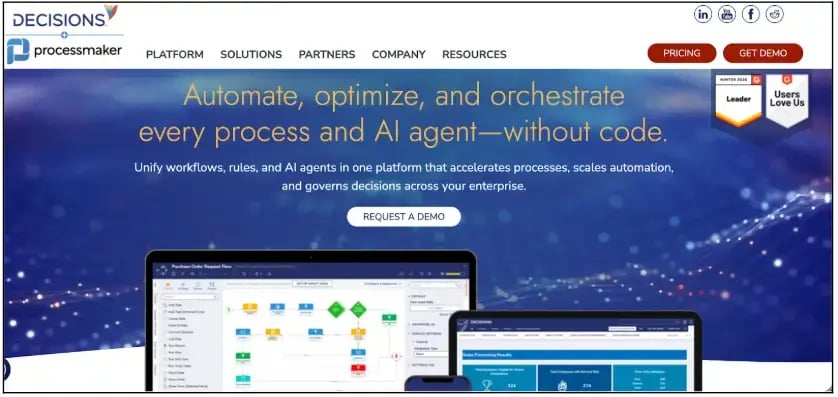
Decisions homepage
For organizations that need to embed complex decision logic and business rules within their automated processes, Decisions combines workflow automation with a powerful rules engine. The platform is designed for teams that require sophisticated conditional logic beyond simple approval chains.
The platform works well for organizations with logic-heavy processes that need extensive decision-making capabilities and custom user interfaces. However, users report a steep learning curve due to the platform's depth of features, which can overwhelm new users. The cost is also higher than that of simpler alternatives.
Key Features of Decisions
1. Visual rules engine to codify business logic
The visual rules engine allows you to define and manage complex business logic without writing code. You can create decision trees, conditional statements, and rule sets that determine how workflows behave based on data and context.
2. Process mining to analyze workflow performance
Process mining tools analyze how workflows actually perform in practice, revealing bottlenecks, inefficiencies, and deviations from intended designs. This data-driven insight helps you continuously improve process performance.
3. Workflow designer connecting people and systems
The workflow designer orchestrates tasks across both human participants and automated systems. This creates end-to-end processes that seamlessly hand off work between people and technology.
4. Interface designer for custom user experiences
The interface designer lets you build custom user interfaces tailored to specific roles and use cases. This ensures users see only the information and actions relevant to their tasks.
Pros and Cons of Decisions
Pros:
- Easy to use for all experience levels.
- Strong no-code customization for building tailored applications.
- Scales well from simple apps to enterprise use cases.
- Excellent customer support with knowledgeable, responsive staff.
Cons:
- Navigation can feel unintuitive when locating features quickly.
- Higher pricing less suitable for individual or small-team use.
- Limited documentation slows learning and full platform adoption.
8. Pipefy - Best for structured service request management
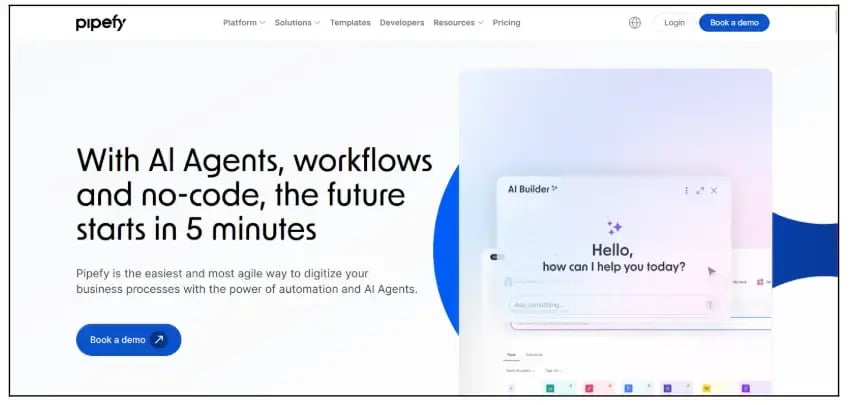
Pipefy homepage
Pipefy uses visual pipelines to help operations teams manage structured workflows such as finance requests, HR approvals, and service intake. The platform focuses on tracking tasks as they move through predefined stages, making it easy to visualize where work stands at any moment.
Key Features of Pipefy
1. Shareable forms and portals for request intake
You can create shareable forms and portals that let anyone submit requests, which are automatically routed into your workflows. This standardizes how requests enter your processes and ensures nothing gets lost in email threads.
2. Email-to-process conversion for ticket creation
Emails sent to designated addresses are automatically converted into process tickets within Pipefy. This bridges the gap between email-based work and structured workflows without requiring users to change their behavior.
3. Process connections across departments
You can link processes across departments so handoffs occur automatically when work moves from one team to another. This creates visibility across organizational boundaries and reduces coordination friction.
4. Public API for custom integrations
The public API allows you to build custom integrations with other systems and extend Pipefy's functionality to meet specific needs. This provides flexibility when pre-built connectors aren't available.
Pros and Cons of Pipefy
Pros:
- Very easy to use for non-technical teams building automated workflows.
- Quick automation setup without needing coding or complex configurations.
- Clean, user-friendly interface for organising and tracking process stages.
- Improves team collaboration through structured and visual workflow management.
Cons:
- Premium features can become expensive as usage and team size grow.
- Limited native integrations with essential tools like Jira, Slack, Notion.
- Occasional glitches may interrupt workflow automation and process consistency.
9. CFlow - Best for basic approval routing workflows

Cflow homepage
CFlow markets itself as a lightweight platform for setting up forms, approvals, and routing workflows, especially for small and mid-sized teams looking to digitize routine internal processes.
The platform works well for organizations that need affordable, straightforward approval processes across multiple departments. However, users report that performance slows with larger workflows, and the platform lacks the advanced automation capabilities needed for complex enterprise use cases.
Key Features of CFlow
1. Drag-and-drop form builder with routing rules
The form builder allows you to create custom forms and define how submissions should be routed based on field values or conditions. This makes it straightforward to set up approval chains that match your business rules.
2. Notification and approval routing engine
The routing engine automatically sends notifications and routes approvals to the right people based on your defined rules. This keeps processes moving and ensures stakeholders are informed at the appropriate times.
3. Rule-based task assignments
Tasks are automatically assigned to users based on rules you configure, such as workload balancing, role assignments, or field values. This removes the need for manual task distribution.
4. Built-in reports and dashboards
The platform includes standard reports and dashboards that show workflow status, completion times, and bottlenecks. These provide basic visibility into how processes are performing.
Pros:
- Simple setup with user-friendly interface for quick workflow adoption
- Strong automation capabilities that save time across routine business processes.
- No-code invoice and approval workflows improve efficiency for business teams.
- Centralized workflow management improves organisation and process visibility.
Cons:
- Performance slows during complex workflows or large data processing.
- Learning advanced features requires guidance and structured onboarding support.
- Basic plans limit feature depth and workflow customisation flexibility.
10. Bizagi - Best for BPMN-based process modeling
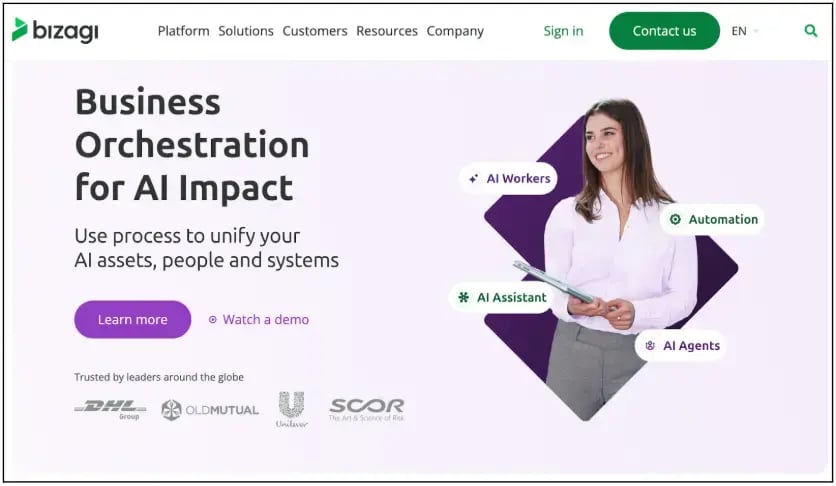
Bizagi’s homepage
Bizagi combines business process management (BPM) style process modeling with low-code application building. The platform is often chosen by teams that want to map processes visually using industry-standard notation before turning them into working applications.
Key Features of Bizagi
1. BPMN-based process modeling designer
The process modeling designer uses Business Process Model and Notation (BPMN) standards, allowing you to design workflows using widely recognized symbols and conventions. This approach supports clear documentation and ensures processes are understood across technical and business stakeholders.
2. Low-code app builder on top of the process layer
Once processes are modeled, the low-code app builder transforms them into functional applications with user interfaces and data management. This bridges the gap between process design and execution within a single platform.
3. AI services for process optimization
AI services analyze process performance and suggest optimizations to improve efficiency and outcomes. These insights help you refine workflows based on actual usage patterns rather than assumptions.
6. Extensive online learning and training portal
Bizagi provides comprehensive online training resources, documentation, and learning paths to help users build skills at their own pace. This reduces the barrier to adoption and supports ongoing mastery of the platform.
Pros and Cons of Bizagi
Pros:
- User-friendly interface with intuitive design for faster process modeling.
- Strong automation capabilities that improve productivity across business workflows.
- Easy to design and deploy processes with visual, low-code tools.
- Intuitive experience supports both technical and non-technical users effectively.
Cons:
- Limited customization and fewer third-party integrations for advanced scenarios.
- Steep learning curve for mastering advanced features and configurations.
- Performance slowdowns when handling large datasets or complex implementations.
Key Features to Evaluate
What’s next is understanding which business process automation software is well-suited for your organizational needs.
To make a valid decision, you need to go through the steps mentioned below:
- Identify the processes that currently rely on emails, spreadsheets, or paper and document where delays, errors, or follow-ups occur.
- Write down the specific features, integrations, and compliance needs required for those processes to run correctly in a digital system.
- Estimate the total cost of ownership by considering setup effort, training time, and future expansion in addition to licensing fees.
- Review vendors based on how well their platforms support your defined requirements, rather than on broad feature lists.
- Request product demonstrations using your real processes to see how the software handles practical scenarios.
- Test the platform with a small group of users to observe how it performs in day-to-day work before wider rollout.
- Include both end users and IT teams in the evaluation to ensure the system works operationally and technically.
Once you’ve identified the requirements, the next step is to evaluate your choices by reviewing the core features mentioned below:
1. Workflow builder that maps real processes clearly
The platform should let teams design workflows visually. Approval steps, routing rules, ownership, and escalations become easier to define when you can see how everything connects, and modifications stay manageable as processes evolve.
2. Pre-built templates that accelerate setup without limiting control
Templates for common processes help teams get started quickly. You'll still need room to customize them so they reflect internal policies and compliance requirements.
3. Integration capability with existing business systems
The software must exchange data with HR, finance, CRM, document storage, and other tools you already use. Poor integration creates duplicate entries and disconnected records, slowing everyone down.
4. An interface that business users can manage without heavy IT reliance
Process owners should be able to configure forms, workflows, and rules independently. The best systems don't require technical expertise for everyday changes.
5. Reporting that shows how work moves through the system
Built-in reporting reveals volumes, turnaround times, pending approvals, and bottlenecks. Teams need visibility to spot problems and improve how processes perform.
6. Mobile access for teams working across locations
Users need to submit, review, and approve tasks from desktops and mobile devices. When process continuity depends on being in a specific location, productivity suffers.
7. Role-based security and access control
Permissions should reflect organizational roles so only the right people can view, edit, or approve specific forms and data. Strong controls support governance and keep you compliant.
8. API and automation support for extending capabilities
The platform needs APIs and automation options that connect with other tools. As your processes grow more sophisticated, you'll want support for complex operational needs.
Each of the listed business process automation platforms approaches these requirements differently, and it is imperative that you understand those differences.
Based on our evaluation, here is a final round-up of how each tool performs and where it excels:
- FlowForma delivers strong results for regulated, approval-heavy workflows where business teams need no-code control with minimal IT involvement.
- Microsoft Power Platform works best when your stack already runs on Microsoft 365 and you want to build apps and automations within that ecosystem.
- Nintex fits document-centric processes that involve forms, approvals, and eSign-heavy compliance workflows.
- Kissflow offers a practical solution for mid-sized teams managing simple HR, finance, or admin workflows without enterprise-level complexity.
- Appian serves large organizations handling complex, cross-system processes that require deep orchestration and case management.
- ProcessMaker supports operations that rely heavily on document data extraction and AI-assisted process handling.
- Decisions handles logic-driven workflows well, particularly when decision rules and conditional processing form the foundation of your operations.
- Pipefy excels at structured intake pipelines, such as HR requests and procurement workflows, that follow standardized steps.
- CFlow provides a straightforward solution for small teams managing basic forms, approvals, and routine internal requests.
- Bizagi helps organizations model and map enterprise processes before building full workflow applications.
Industry Use Cases: H&S, Manufacturing, Public Sector, and Healthcare
Business automation software becomes easier to understand when you look at where it is applied in an organization and the kind of work it improves. As processes grow, different teams adopt different types of automation to reduce the manual effort needed to keep work moving.
Based on operations
In this case, a business process automation software is focused on the type of work and desired outcome.
1. Workflow automation for approvals and requests
This type of software is widely used by operations, service, and compliance teams to ensure that forms, tasks, and approvals follow a defined path. Instead of relying on emails or manual follow-ups, the system routes requests automatically based on process rules and ownership.
For example, when an employee submits a purchase request, the system automatically sends it to the reporting manager for approval, then to finance for budget confirmation, and finally to procurement for processing, without anyone needing to track it manually.
2. Robotic Process Automation (RPA) for repetitive system tasks
RPA tools handle rule-based work that involves moving data between multiple applications. They are especially useful in back-office environments where teams spend hours performing the same steps across systems.
Let’s suppose that a customer's details arrive by email. Next, a bot can extract information and update records in CRM and ERP systems without requiring a person to copy and paste data.
IT teams use this type of automation to manage routine yet critical tasks that keep technical environments stable.
The software ensures that actions such as access provisioning or system monitoring occur in a controlled, repeatable way without requiring constant human oversight.
Let’s assume a new employee onboarding process.
Without automation, IT teams will need to manually create their accounts, provide access to the concerned applications, and the employee will need to notify IT again if any step fails. But with automation, the system automatically does all of these.
Based on the various departments of an organization
Here, business process automation software is tailored as per the use cases of specific teams.
4. HR automation for employee processes
HR teams rely on automation to ensure that employee-related workflows follow consistent steps from start to finish, while maintaining proper documentation and approvals.
The system collects employee details during onboarding, sends documents for signing, assigns mandatory training, and alerts managers when the process is complete.
5. Financial process automation for transaction workflows
Finance teams use automation to move financial records through review and authorization stages without delays, while keeping a clear record of every action taken.
When you submit an expense claim, the automation software will check it against policy limits, route it to the manager for approval, and then send it to finance for reimbursement processing.
6. Marketing automation for campaigns and communication
Marketing teams use these platforms to manage how campaigns run and how communication is triggered based on user behavior, without manually sending each message. If a prospect downloads a whitepaper, the automation software will automatically send follow-up emails, assign the lead to a sales rep, and track engagement for future campaigns. As a result, marketing teams no longer need to update a plethora of sheets and waste time updating touchpoints and signals manually.
5 Benefits of Business Automation Software For Organizations
One of the biggest advantages of business automation software is the visibility it brings to how work moves across the organization. Instead of relying on updates from people or searching through emails and spreadsheets, teams can clearly see where every request stands and who is responsible at each step.
But this clarity is only one part of the value automation delivers. There are several other practical benefits that organizations experience once processes are structured and managed through software. For example:
1. Increased efficiency through automated task routing
The system routes tasks, approvals, and requests automatically, so follow-ups, status checks, and email coordination fade into the background, allowing work to move forward without interruption.
2. Enhanced accuracy through structured data capture
Validation rules and required fields guide each step, ensuring information is complete and correct from the outset, thereby reducing the need for corrections and repeated effort later.
3. Better resource allocation by reducing administrative effort
As routine steps are handled automatically, staff can focus on reviewing exceptions, making informed decisions, and refining processes, shifting their focus from managing tasks to improving outcomes.
4. Improved process visibility across workflow stages
Every request is recorded in detail, showing who acted, where it currently resides, and where delays arise, allowing teams to understand performance in context rather than relying on fragmented updates.
5. Cost savings from reduced manual handling
By streamlining processes and minimizing reliance on paper, email, and disconnected tools, operational effort is reduced, freeing time and resources for work that adds tangible value.
5 Common Challenges With Business Automation Software (+ How to Overcome Them)
Despite the umpteen benefits, teams often face challenges when introducing business automation software, especially when people are used to handling work through emails, spreadsheets, forms, or other traditional methods.
Here’s a quick overview of the most common challenges and their solutions:
|
Challenge
|
How to fix it
|
|
User adoption when teams are used to old ways of working
|
Involve users early, mirror familiar steps, give short role-based training
|
|
Integration difficulties with existing tools
|
Map integrations upfront, choose proven connectors, involve IT early
|
|
Managing change when replacing emails and spreadsheets
|
Roll out in phases, start with high-impact processes, and communicate clearly
|
|
Concerns about upfront cost before seeing results
|
Show time saved, fewer errors, and reduced manual effort in key processes
|
|
Lack of clear process ownership and standardization
|
Define ownership with standardized steps, and align teams before setup
|
Common challenges + solution for adopting business automation software
Let’s discuss these in breadth.
Challenge 1: User adoption when teams are habituated to traditional or legacy systems.
Teams may hesitate to adopt a new system when they are comfortable managing tasks via email or spreadsheets, especially if the software feels unfamiliar or unnecessary.
How to overcome: Involve end users during the evaluation stage, recreate familiar processes inside the new system, and provide short, role-based training that shows how the tool fits naturally into their daily work.
Challenge 2: Integration difficulties with existing tools or stack.
Automation software must connect with systems such as HR, finance, CRM, or document storage, which can slow implementation if integration is not planned properly.
How to overcome: Identify all systems that need to connect before implementation begins and define how data should move between them. Choose a platform with proven connectors or clear integration methods that IT teams can support.
Challenge 3: Change management when replacing emails and spreadsheets.
Shifting from informal coordination to structured workflows can feel disruptive for teams who rely on long-standing habits.
How to overcome: Roll out the platform in phases, begin with a small number of high-impact processes, and communicate clearly how the change reduces manual effort.
Challenge 4: Pricing or cost concerns before seeing results.
The cost of automation software is visible up front, while the benefits appear gradually as processes improve. Decision-makers may struggle to justify the investment without clear examples of where time and effort will be saved. Thus, delaying adoption.
How to overcome: Calculate expected time savings, fewer errors, and reduced administrative work for specific processes so the return becomes easier to understand.
Challenge 5: Lack of clear process ownership and standardization.
Automation exposes inconsistencies in how different teams handle similar requests, which can lead to confusion when designing a single, structured workflow. Without agreed ownership and standardized steps, the system may reflect conflicting practices.
How to overcome: Define process ownership before configuring workflows, and document the agreed-upon steps for handling requests. Use the automation project to standardize how work is done across teams.
Next Steps: Streamline Your Business Process Automation Journey
If fragmented approvals and email-driven tasks are slowing your operations, you need a platform that gets you up and running quickly without heavy IT involvement. Microsoft Power Platform works well when your team already lives in the Microsoft ecosystem, but getting workflows operational often requires developer resources and technical configuration.
On the other hand, Nintex handles document-heavy compliance processes effectively, though setup can extend over several months as you work through customization and integration requirements.
In contrast to Power Platform and Nintex, FlowForma takes a different approach. Our intuitive, no-code interface enables you to automate processes in weeks, not months. As a result, users begin to see ROI within 6 weeks of implementation. Moreover, you can choose from our suite of AI-powered features to create processes using steps, rules, or scrambled meeting conversations.
When approval workflows and compliance tracking slow you down, you need a solution that moves at your pace. Curious to see how FlowForma actually works? Take a 30-day free tour of the platform or let our experts guide you through it. Just drop your query here.