A Buyers Guide to AI-Powered Digital Process Automation (2026)

AI has changed what Digital Process Automation can deliver and how platforms should be evaluated. Built from real buyer conversations, this free guide helps you cut through the noise and confidently evaluate AI-powered DPA platforms.

  • 10capability categories in the buyers checklist
  • 3stages of the enterprise buyer journey
  • 4customer success stories

Access your eGuide

  • What's driving DPA in 2026
  • The 2026 DPA buyers checklist
  • The typical customer journey, with real stories

Inside this eGuide

  1. 01How AI-powered DPA is evolving in 2026How AI moved DPA beyond automating tasks, into predictive workflows that deliver actionable insight in real time.
  2. 02Must-have capabilities every modern automation platform should deliverGuiding users to smarter decisions, automating routine tasks, real-time insight, human–AI hybrid workflows, and a platform that learns over time.
  3. 03What no-code really means for scale, governance, and controlCutting reliance on IT through no-code updates, while supporting thousands of users and hundreds of processes under central control.
  4. 04Practical guidance for evaluating vendorsHow to run a fair comparison, from strategic alignment and value through to security, integration and enterprise readiness.
  5. 05A ready-to-use buyers checklistTen capability categories to score every platform against.
  6. 06The typical DPA customer journeyDiscover and evaluate, prove value, then scale and optimize.
Pages from the 2026 Buyers Guide to AI-Powered Digital Process Automation

Digital Process Automation in 2026

Digital Process Automation (DPA) is the practice of using digital technologies, now increasingly powered by AI, to automate business processes, optimize workflows and deliver actionable insights in real time. It's now a core part of digital transformation, helping organizations become faster, smarter and more resilient.

Business leaders

Seeking faster, AI-powered process digitization.

IT teams

Wanting secure, scalable and governed automation.

Process owners

Needing to transform processes and get better data.

What's driving DPA in 2026 and beyond

  • AI-driven transformationSmarter, predictive automation.
  • Efficiency and speedFast data processing and real-time decisions.
  • Governance and complianceCentralized management to avoid automation chaos.
  • Solution-centric automationPrecise workflows designed for measurable results.
  • Hybrid workforceHumans, AI agents and automation working together.

Empowering enterprises to automate smarter

FlowForma's AI-powered, no-code platform makes complex processes simple, fast and measurable, helping enterprises digitize, optimize and transform workflows at scale.

  1. 1

    Seamless Microsoft integration

    • Fully integrated with SharePoint and Microsoft 365
    • Data stored securely in your own tenancy
  2. 2

    Enterprise-ready and scalable

    • Globally scalable and easily governed by IT
    • Supports ISO, DORA, GDPR and HIPAA compliance
  3. 3

    Hybrid, intelligent workflows

    • Orchestrates humans, AI and automation
    • Increases efficiency and reduces manual effort
    • Fully no-code and customizable
  4. 4

    Rapid deployment, measurable results

    • Continuous AI recommendations for smarter decisions
    • Ongoing optimization as you scale
Hoursto launch your first AI-assisted process
50+processes digitized in the first year
<6 weeksto measurable ROI

The 2026 DPA buyers checklist

The non-negotiables for automation platforms. Use this checklist to evaluate every platform on your shortlist.

01Strategic alignment and value

  • Demonstrates measurable ROI in weeks
  • Aligns with business goals
  • Integrates with core systems
  • Scalable

02No-code usability and adoption

  • Fully no-code visual workflow designer
  • Automate processes from prompts and process maps
  • Business users can build, edit and maintain processes
  • Built-in guidance and help text for users
  • Multilingual forms
  • Mobile access for distributed teams

03Core workflow capabilities

  • Create and assign tasks to individuals and groups
  • Parallel workflows
  • Time-stamped tracking of approvals and tasks
  • Conditional routing and go/no-go logic
  • Scenario-based or iterative workflows

04AI and intelligent automation

  • Guides users to smarter decisions
  • Automates routine tasks
  • Delivers real-time insights
  • Enables human–AI hybrid workflows
  • Learns and improves over time

05Intake and data capture

  • Centralized intake forms with multiple field types
  • Conditional questions based on prior answers
  • Required vs optional field controls
  • Reference data from tables or lists

06Reporting and transparency

  • Real-time dashboards for progress, ownership and SLAs
  • Exception reporting to surface bottlenecks and risks
  • End-to-end visibility across stages, tasks and approvals

07Integration and data architecture

  • Supports multiple data sources
  • Real-time and scheduled or batch integration
  • Upstream and downstream data flows
  • Centralized data for reference fields and dropdowns

08Security and maintenance

  • Data residency in your own tenancy
  • Regular, predictable releases without disruption

09Enterprise readiness and governance

  • Role-based permissions and admin controls
  • Scales to thousands of users and hundreds of processes
  • Central control for automation management
  • Supports ISO, GDPR, HIPAA and DORA compliance

10Collaboration and communication

  • Embedded comments and notes per workflow record
  • Notifications via email, Teams and more
  • Audit trail of communication

The enterprise buyer journey for AI-powered automation

How organizations move from problem recognition to live AI-powered workflows, in weeks.

  1. 1

    Discover and evaluate

    Legacy systems and manual processes slow work, so buyers look for AI-powered, no-code automation. Key criteria:

    • Fast deployment and time to value
    • No-code flexibility for business users
    • AI guidance and decision support
    • Integration with ERP, CRM, SharePoint and Teams
    • Security, compliance and governance
  2. 2

    Prove value

    A trial or proof of concept validates fit. Successful POCs often lead to live workflows in days.

    • Configure AI-assisted workflows in a sandbox
    • Gather feedback on usability, approvals and data quality
    • Measure outcomes against success criteria
  3. 3

    Scale and optimize

    Expand automation across departments.

    • Hybrid workflows with humans, AI and automation
    • Visibility through real-time dashboards
    • Continuous improvement with AI insights
    • Less reliance on IT through no-code updates
Book a bespoke demo

See what AI-powered automation could look like for your processes.

FlowForma customer success stories

The FlowForma platform is easy to use, highly customizable and scales with our needs.
Will JohnsonWill JohnsonHead of Information Services, Morley College London
Read the Morley College story
We love FlowForma from a compliance perspective. The last time we were audited, there were no queries at all.
Sarah KlenkSarah KlenkSharePoint Administrator, Utah DHHS
Read the Utah DHHS story
Streamlining processes with FlowForma is a game changer for efficiency, accuracy and compliance.
Martyn McKechnieMartyn McKechnieHead of Digital Identity and System Administration, Blackpool Teaching Hospitals NHS
Read the Blackpool story
Since deploying FlowForma, there has been a significant increase in the quantity and quality of data gathered.
Sinead GainesSinead GainesEHS Manager, PJ Hegarty
Read the PJ Hegarty story

AI-powered DPA: common questions

What is Digital Process Automation (DPA)?

DPA is the practice of using digital technologies, now increasingly powered by AI, to automate business processes, optimize workflows and deliver actionable insights in real time. It's a core part of digital transformation.

Who is Digital Process Automation for?

Business leaders seeking faster AI-powered process digitization, IT teams wanting secure, scalable and governed automation, and process owners who need to transform processes and get better data.

What should you look for in an AI-powered DPA platform?

Score platforms across ten areas: strategic alignment and value, no-code usability, core workflow capabilities, AI and intelligent automation, intake and data capture, reporting, integration, security, enterprise governance, and collaboration.

How do organizations typically adopt AI-powered automation?

In three stages: discover and evaluate, prove value with a trial or proof of concept, then scale and optimize across departments. Successful POCs often lead to live workflows in days.

How quickly can FlowForma deliver results?

Customers can launch their first AI-assisted process within a couple of hours, digitize 50+ processes in the first year and achieve measurable ROI in under six weeks.

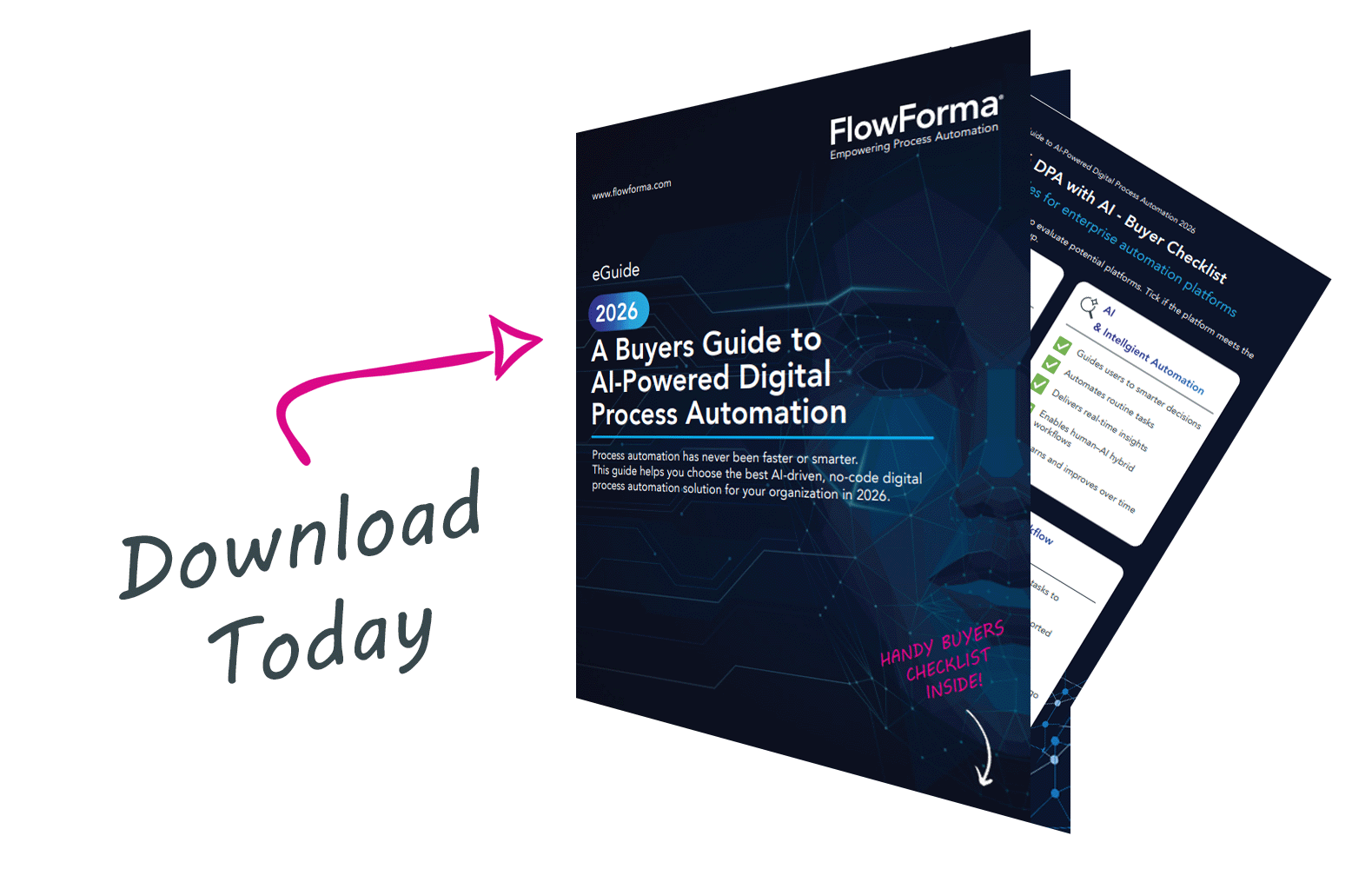
Make a smarter DPA decision

Download the free eGuide, with the 2026 buyers checklist, the customer journey and real-world stories.