
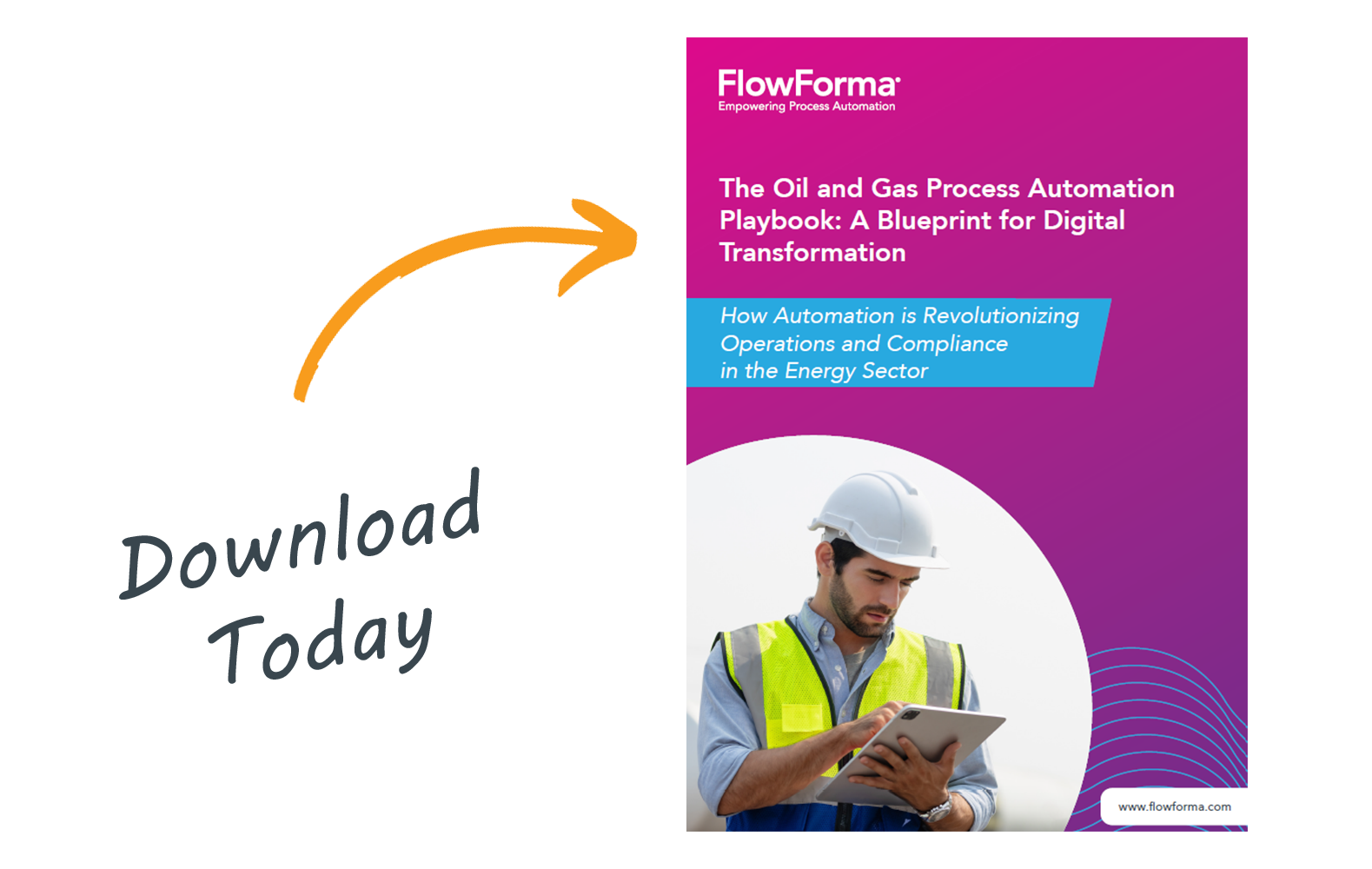
The Oil and Gas Process Automation Playbook: A Blueprint for Digital Transformation

How automation is reshaping operations and compliance across the energy sector: why it matters now, the use cases leading the way, what to look for in a tool and real-world results from your peers.

  • 6trending use cases for automation
  • 4 wksto live processes, for FlowForma customers
  • 6 wksto return on investment

Download the playbook

  • Why process automation is imperative for oil and gas
  • Trending use cases and what to look for in a tool
  • Real-world success stories from your peers

What's inside the playbook

Proven tips from experts and real-world success stories from your peers.

  1. 01The process automation imperativeComplexity, workforce shortages, HSE compliance and cost.
  2. 02Trending use cases for automationSix areas oil and gas companies are automating now.
  3. 03What to look for in a process automation toolSix capabilities for distributed, high-risk operations.
  4. 04Processes digitalized and real-world case studiesBouygues Energies & Services and Dresser Natural Gas Solutions.
  5. 05Next stepsSix steps toward a digitally transformed operation.
  6. 06About FlowForma Process AutomationLive in four weeks, ROI in six.
Pages from The Oil and Gas Process Automation Playbook

The process automation imperative

Industry-specific challenges, new technology and economic pressure make continued automation fundamental to oil and gas.

Addressing operational complexity

Isolated locations, diverse processes and high-risk operations make manual control a source of errors, inefficiency and safety incidents. Automation streamlines and harmonizes operations for consistent performance.

Mitigating workforce shortages

The industry's global workforce is declining and it has struggled for years to attract a new generation, so organizations are turning to automation to close the skills gap.

Improving health, safety and environmental compliance

Compliance isn't optional, it's a legal requirement, and failures can mean large fines, legal penalties or closure. Rising regulation is driving automation for seamless auditing and compliance.

Improving the bottom line

Inflation, supply chain disruption and rising supply and staff costs put pressure on efficiency. Accurate data and better decisions unlock major savings.

Trending use cases for automation

Where oil and gas companies are focusing their automation efforts.

  1. 1

    Standardizing operational processes

    Standard processes streamline data collection, ensure accuracy and provide real-time insight for smarter decisions.

  2. 2

    Health and safety compliance

    Streamlined site inspections, safety checklists and incident investigations, with real-time alerts and digital records for audit.

  3. 3

    Streamlining HR processes

    Faster onboarding, simpler performance management and fewer manual tasks for HR and employees.

  4. 4

    Enhancing procurement

    Efficiency, accuracy and control over capital expenditure, requisitions, supplier relationships and compliance.

  5. 5

    Sustainability reporting made easy

    Streamlined operations, optimized resource use and a clearer way to demonstrate your sustainability commitment.

  6. 6

    Quality control processes

    Real-time data, streamlined inspections and stronger compliance for higher quality standards.

Adding technology is more cost-effective than adding people. FlowForma helped us fill in deficiencies without having to invest in a lot of extra infrastructure. It’s highly flexible and cross-functional, used across operations, engineering, quality assurance, HR and finance.
Greg DowellGreg DowellFinance Director, Great North Equipment
Watch the Great North webinar

What to look for in a process automation tool

Software that fits your operational demands, regulatory requirements and digital transformation goals.

Fuels operational excellence

Strategic, widely used software across health and safety, quality, compliance, HR and procurement, for a connected enterprise.

Connects distributed sites

Agile enough for global processes with local variations, and built for remote locations with offline capability.

Enables better decisions

Accurate, validated data from every operation, visualized so you can dig deep and decide well.

Doesn't rely on IT

No-code tools the business or IT can use, or a fusion of both automating at scale.

Integrates easily

Connects with email, CRM, supply chain and HR systems so data flows between departments.

Supports health and safety

Automated safety checklists, incident reporting and real-time alerts that keep you compliant.

We chose FlowForma Process Automation because it makes our business smarter. The tool has allowed us to standardize processes across 2,300 people and complete processes within a couple of days instead of weeks.
Rhys ForbesRhys ForbesROW IT Systems and Infrastructure Engineer, Centurion

Processes oil and gas companies digitalize with FlowForma

Examples of processes customers have automated with the platform.

Health and safety

  • Site inspections
  • Safety checklists
  • Risk assessments
  • Incident investigations
  • Work permits
  • Vehicle checks

Quality control

  • Equipment inspections
  • Automated data validation
  • Supplier quality checks
  • Internal quality checks
  • Automated scheduling
  • Compliance reports

IT

  • Change management
  • Equipment requests
  • Software requests
  • User access
  • Asset management
  • Supplier management

Finance

  • Purchase order requests
  • Procurement processes
  • Expense management
  • Spend analytics
  • CAPEX management
  • Contract management

HR

  • Onboarding and offboarding
  • New employee arrival
  • Performance management
  • Leave requests
  • Contract management
  • Document automation

Other

  • Non-compliance reporting
  • Equipment requests
  • Waste transfers
  • Patent disclosure submissions
  • Stock management
  • And many more
Top tip

Most FlowForma customers choose one champion from each department for training on process automation and improvement.

Real-world case studies

How energy and utilities companies digitalized their processes.

Bouygues Energies & Services

Energy · United Kingdom
6 hrsto build a process, versus 24 using Power Apps
Instead of having to sift through hundreds of pieces of paper, people now have time back to focus on more added-value tasks. It’s easy to use and doesn’t require hours of learning and research to build a basic process.
Mohiadin AhmedMohiadin AhmedDigital Change Manager
Read the full story

Why automate now

  • A focus on digital transformation and new ways to improve processes
  • A need to simplify mundane, paper-based processes
  • Bringing value to customers and people alike
  • Digitalizing without heavy IT dependence

The outcomes

  • More efficiency, so staff work on value-adding tasks
  • Less paperwork and money saved
  • Staff empowered with data
  • Better customer experiences with faster processes

Why FlowForma

  • Easy to use, with no hours of learning to build a basic process
  • Quick, easy changes
  • Input from external suppliers and contractors
  • Fast digitalization of complex processes

Dresser Natural Gas Solutions

Utilities · United States
15%time saved by removing manual processes
The old processes took years to build and if our team needed a change, it would take a month before it was decided if it could actually be implemented. People are embracing FlowForma Process Automation and coming up with their own ideas.
Imelda BettingerImelda BettingerSharePoint Developer
Read the full story

Why automate now

  • A short window to set up its own IT systems after a divestment
  • Legacy engineering document processes to migrate
  • A desire to build better processes

The outcomes

  • Fast deployment and seamless Microsoft 365 integration
  • Cost savings and increased efficiency
  • Continuous workflow improvement and wide adoption
  • Approval emails sent without constant prompting

Why FlowForma

  • Integration with Microsoft 365
  • Non-technical users create their own processes
  • An intuitive interface

Next steps

Process automation is no longer a luxury, it's a necessity. If any of these sound familiar, it's time to act.

  • Drowning in paperManual workflows slow operations and lead to costly errors.
  • Fragmented workflowsProcesses across departments hinder efficiency and collaboration.
  • Poor dataInaccurate or incomplete data makes decisions hard.
  • Standardization vs agilityYou want consistency without losing flexibility.
  • Operational excellenceYou want to improve compliance and reduce costs.

Six steps to a digitally transformed operation

  1. 1

    Start with the obvious and launch quickly

    Pick error-prone, inefficient but high-value processes for an immediate impact that builds momentum and adoption.

  2. 2

    Maximize existing investment

    If you use Microsoft 365, choose a process automation tool that integrates seamlessly with it.

  3. 3

    Find a champion

    The more senior the better, ideally your CEO. A strong advocate at the top significantly boosts adoption.

  4. 4

    Focus on adoption rates

    Engage users early and gather feedback on today's processes. People embrace systems that reflect their input.

  5. 5

    Engage and adapt

    Users are the experts. With no code, you can make changes on the fly as their needs evolve.

  6. 6

    Try before you buy

    Use a free trial to test the full all-in-one tool: forms, workflow, analytics and document generation.

Why leading companies choose FlowForma

Built for business and IT teams that want to digitalize processes rapidly, collect better data and achieve operational excellence, no matter how complex the process.

All-in-one platform

Forms, workflow, analytics and document generation.

For business and IT

No coding needed.

Rapid ROI

Return on investment within six weeks.

External participation

Suppliers and contractors take part seamlessly.

Powerful workflow engine

Built for complex processes.

Oil and gas process automation: common questions

Why is process automation important for oil and gas?

Oil and gas operations are complex, high-risk and spread across remote sites, the workforce is shrinking, compliance is a legal requirement and costs are rising. Automation brings consistency, safety, better data and savings.

Which oil and gas processes can be automated?

Health and safety (site inspections, risk assessments, work permits, vehicle checks), quality control, IT, finance and procurement (purchase orders, CAPEX, contracts), HR (onboarding, leave, performance) and more, such as waste transfers and stock management.

What should oil and gas companies look for in a process automation tool?

Software that drives operational excellence, connects distributed sites with offline capability, delivers accurate data for decisions, doesn't rely on IT, integrates easily and supports health and safety compliance.

How quickly can oil and gas companies see results?

FlowForma customers are live with digital processes, empowered and self-sufficient within four weeks of onboarding, and secure a return on investment within six weeks.

How should you start a process automation project?

Start with an error-prone, high-value process, build on your existing Microsoft 365 investment, find a senior champion, focus on adoption, keep adapting to user feedback and try the tool before you buy.

Ready to transform your oil and gas operations?

Get the playbook, or book a call with a process expert.