
The best AI contract management software to replace spreadsheets and disconnected systems in 2026 is FlowForma Contract, because it runs purchases, contracts and tenders in one system, with AI agents working inside your rules from the first request to renewal. The other strong options are Ironclad, Icertis, Agiloft, Docusign CLM, Juro, LinkSquares, Sirion, Gatekeeper and JAGGAER, each suited to a different team, contract volume and stack.
Spreadsheets work for tracking a few dozen agreements. They stop working once contracts live across shared drives, inboxes, e-signature tools, ERP and procurement systems, and nobody can answer simple questions like "which supplier contracts renew next quarter?" without a day of digging. AI contract management software fixes that by reading contracts, pulling out key terms and dates, routing approvals and flagging renewals before notice periods close.
This guide compares 10 AI contract management tools on how they replace spreadsheets, how they handle supplier contracts, which systems they connect to and how they price. Every feature listed was checked on the vendor's own website in October 2026.
Key Takeaways:
- Best overall: FlowForma Contract runs purchases, contracts and tenders in one system, with AI agents working inside your rules.
- Legal-led teams: look at Ironclad, Juro or LinkSquares.
- Procurement-led teams: look at FlowForma Contract, Icertis, Sirion, Gatekeeper or JAGGAER.
- Full source-to-pay suite: JAGGAER covers contracts inside sourcing, spend and P2P.
- Pricing: most vendors quote, so ask for the pricing drivers in writing.
Quick picks: the best AI contract management software by use case
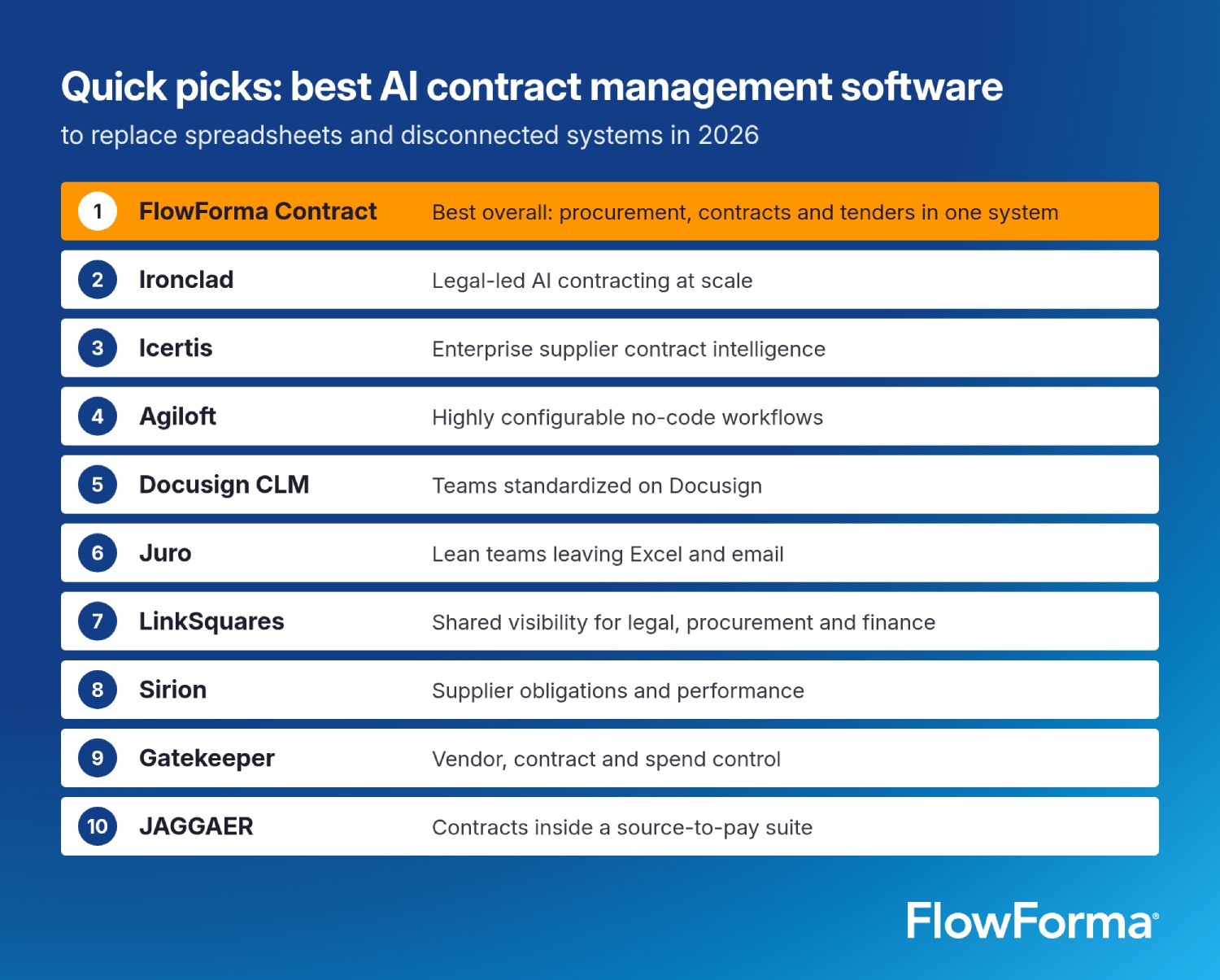
- Best overall for replacing spreadsheets and disconnected systems: FlowForma Contract. Procurement, contracts and buyer-side tenders in one product, with AI agents at every step.
- Best for legal-led contracting at scale: Ironclad. Ironclad Agent plus specialized agents for intake, review and renewals.
- Best for enterprise supplier contract intelligence: Icertis. Brings legacy and third-party contracts into one governed repository, with deep SAP Ariba integration.
- Best for highly configurable workflows: Agiloft. No-code configuration of contracts, approval chains and data models, plus Astra contracts AI.
- Best for teams already on Docusign: Docusign CLM. Templates, workflows, signature and an AI repository driven by Docusign Iris.
- Best for lean teams leaving Excel and email behind: Juro. Self-serve templates and an intelligent repository that Juro positions as replacing Excel, Google Docs and PDF.
- Best for legal, procurement and finance visibility: LinkSquares. One governed home for agreements, with vendor history and notice windows in view.
- Best for supplier obligations and performance: Sirion. Agents that extract and organize contracts, plus performance and governance tracking.
- Best for vendor and spend control: Gatekeeper. Contracts, vendors, renewals and spend on one record, with agents for renewals and savings.
- Best inside a source-to-pay suite: JAGGAER. Contract management connected to sourcing, spend, P2P and supplier intelligence.
AI contract management software compared
|
Tool |
Best for |
AI features |
Replaces spreadsheets with |
Supplier contract fit |
Pricing model |
|
FlowForma Contract |
Procurement, contracts and tenders in one system |
Agents for intake, routing, approvals, drafting, legal review, obligations, renewal and tender scoring |
One contract register linked to the purchase or tender that created it |
Strong: supplier quotes, approved vendor checks, buyer-side tenders, renewals |
Quote on request, priced separately from Process Automation |
|
Ironclad |
Legal-led contracting at scale |
Ironclad Agent, Contract Review Agent, Intake Agent, Renewal Agent, MCP connectors |
Repository with Smart Import for legacy contracts |
Strong: vendor paper review, savings and renewal tracking |
Tailored quote |
|
Icertis |
Large enterprises with complex supplier portfolios |
Vera Copilot, Vera Engage, Vera Obligations, Discover |
Discover turns legacy and third-party contracts into structured data |
Strong: supplier commitments, risk analysis, SAP Ariba |
Quote on request |
|
Agiloft |
Teams that need deep configuration |
Astra contracts AI, playbook review, configurable agents |
Data-first repository with real-time dashboards |
Good: obligations, alerts, buy-side integrations |
CLM by quote; Astra has free, credit-based and custom plans |
|
Docusign CLM |
Organizations standardized on Docusign |
Iris AI engine, AI-Assisted Review, 100+ pre-trained AI models |
AI-powered repository with obligation and renewal reports |
Good: vendor agreement hub, SAP Ariba and Coupa |
Through Docusign sales |
|
Juro |
Lean in-house legal and business teams |
AI Extract, AI Draft, AI Review, MCP |
Intelligent repository queried in natural language |
Fair: vendor agreements and third-party paper |
Custom plan by volume and features |
|
LinkSquares |
Legal, procurement and finance visibility |
AI Legal Assistant, Word add-in with generative AI |
One governed home for every agreement |
Good: vendor history, notice windows, third-party review |
Personalized quote |
|
Sirion |
Enterprise supplier obligations and performance |
Conversational agents, AI-built repository, agentOS |
Agents that extract, normalize and organize contracts |
Strong: vendor promises, performance, governance |
Quote on request |
|
Gatekeeper |
Vendor, contract and spend control |
Intake, review, amendment, renewal and ROI agents |
One unified record of contracts and vendors |
Strong: renewals, savings, vendor risk, spend vs contract |
Tiered plans sized by third parties and workflows |
|
JAGGAER |
Buyers running a full source-to-pay suite |
JAI: clause comparison, third-party paper analysis, chat with contracts |
Searchable repository with AI-extracted key terms |
Strong: sourcing to contract, SLAs, committed vs realized value |
Quote on request |
Signs you have outgrown contract spreadsheets
Most teams start with a spreadsheet, a shared drive and an e-signature tool. That setup quietly breaks as contract volume grows. You have probably outgrown it if:
- Nobody trusts the tracker: Contract owners update the sheet when they remember, so dates, values and owners drift away from what the signed contract says.
- Renewals surprise you: Auto-renewals go through because the notice date sat in a cell no one checked.
- You cannot find the signed version: The final contract lives in an inbox, an e-signature account or a personal drive, not where the spreadsheet says.
- Approvals happen over email: There is no record of who approved what, at what value, against which policy.
- Supplier obligations go untracked: SLAs, price reviews, rebates and service credits are agreed, then never checked.
- Every report is a manual project: Questions from finance or audit mean copying data between the contract tracker, ERP and procurement system by hand.
- Legal reviews every contract: Routine agreements queue behind complex ones because nothing checks them against a playbook first.
What disconnected contract systems cost
The cost of scattered contract data is well documented. These figures come from the published sources linked below:
- 8.6% average value erosion: World Commerce & Contracting reports that the average value erosion, the gap between expected and actual results from contracts, is 8.6%, and that only 39% of commercial practitioners believe their contracts deliver the desired outcome.
- 24 systems: The same WorldCC research finds that contract-related data is scattered across 24 different systems on average, making it hard to track commitments on time.
- Lost agreements: According to World Commerce & Contracting, more than 70% of organizations report being unable to locate at least 10% of their agreements.
- AI is already in procurement: In Ironclad's October 2026 survey of more than 800 procurement professionals, 92% use AI. For contracting, 45% use it to extract and summarize terms, 41% to draft and review contracts, 40% to assess contract risk and 40% to track expiration dates.
The pattern is clear: the problem is less about any one tool and more about contract data living in too many places, with no single source of truth.
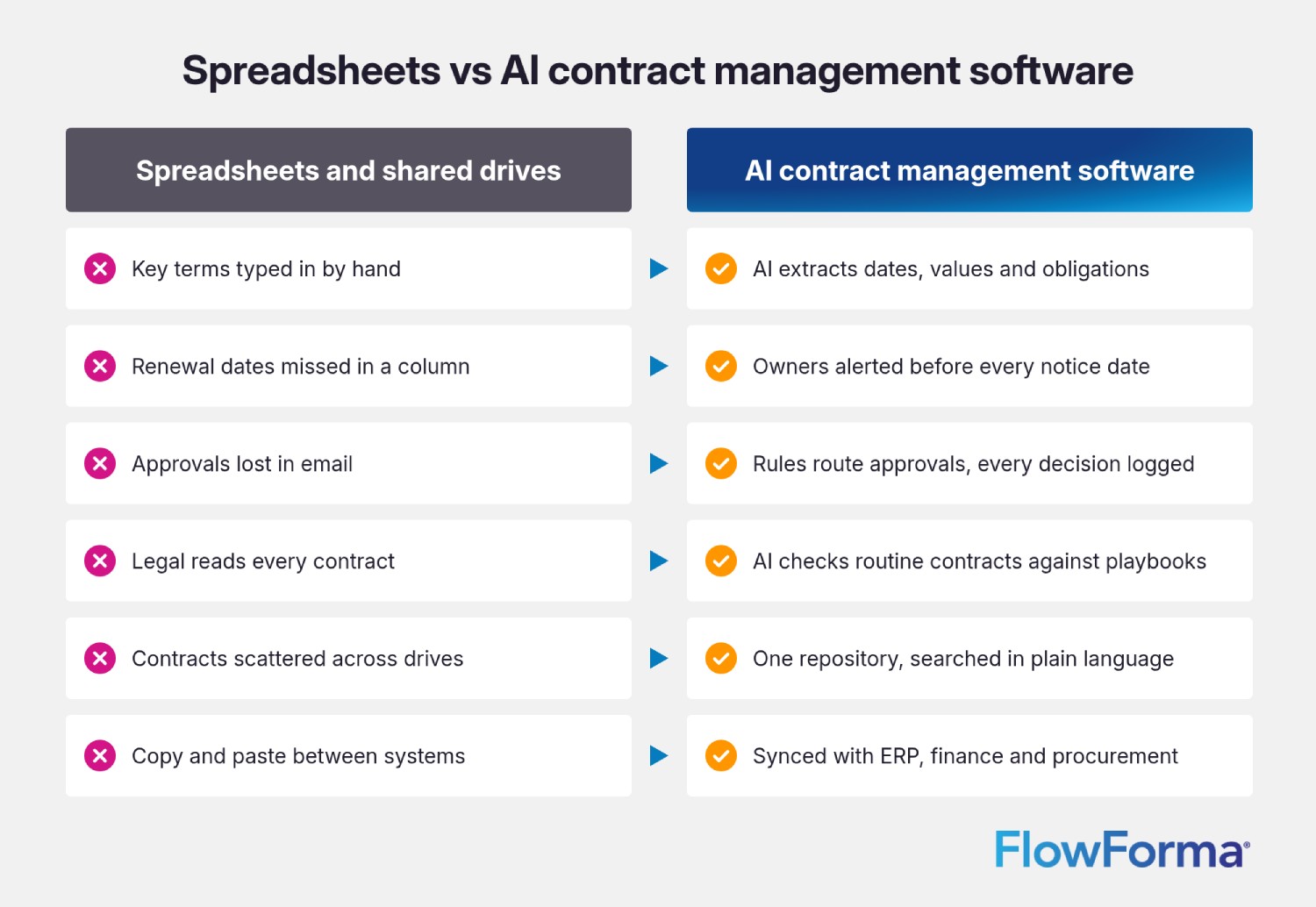
Spreadsheets vs AI contract management software
|
Job |
Spreadsheet and shared drive |
AI contract management software |
|
Capturing key terms |
Typed in by hand, often incomplete |
AI extracts dates, parties, values and obligations from the contract |
|
Renewals and notice dates |
A column someone must remember to check |
Owners alerted ahead of each notice date, with a renewal brief |
|
Approvals |
Email chains with no audit trail |
Rules route each contract by value, type and risk, with every decision logged |
|
Contract review |
Legal reads every agreement |
AI checks routine contracts against your playbook and flags risky clauses |
|
Finding a contract |
Search folders and inboxes |
One repository searched in plain language |
|
Supplier obligations |
Rarely tracked after signature |
Obligations, SLAs and milestones tracked with owners |
|
Connecting systems |
Copy and paste between ERP, CRM and procurement tools |
Integrations sync contract data with ERP, finance, CRM and procurement systems |
|
Reporting |
Manual pivot tables |
Live dashboards and reports on value, risk and renewals |
How to manage supplier contracts with AI
AI tools to manage supplier contracts do more than store PDFs. The best ones connect the contract to the purchase, the supplier and the spend behind it. Here is what AI should handle across the supplier contract lifecycle:
- Intake: Turn an email, form or chat message into a complete purchase or contract request, and ask for anything missing.
- Supplier checks: Compare quotes and check suppliers against your approved vendor list before onboarding.
- Drafting from your paper: Build first drafts from approved templates and clause libraries.
- Reviewing supplier paper: Read third-party contracts, extract key terms and flag clauses that differ from your standard positions.
- Approvals: Apply delegation of authority, budget and policy rules, and approve low-risk items automatically where your rules allow.
- Obligations and SLAs: Record notice periods, service levels, price reviews and rebates, each with an owner.
- Supplier performance tracking: Track SLAs, service credits and delivery against what the contract says, so renewal decisions rest on how each supplier actually performed.
- Renewals: Alert owners before notice dates so they can renew, renegotiate or exit with spend and performance in view.
- Tenders: For organizations running tenders, collect supplier responses, score them against the same criteria and record the award decision.
Suite or dedicated tool: A key choice for supplier contracts is whether you need a full source-to-pay suite or a dedicated contract and procurement product.
|
Source-to-pay suite |
Dedicated contract and procurement product |
|
|
Examples |
Suites such as JAGGAER |
Dedicated tools such as FlowForma Contract, Ironclad, Icertis, Sirion or Gatekeeper |
|
Suits |
Buyers who want sourcing, P2P, invoicing and contracts on one platform |
Teams that want to keep their ERP or P2P system and add AI-led contract, procurement or vendor management on top |
For a broader view of procurement tooling, see our guide to procurement automation software.
How we evaluated these tools
We started from the questions buyers ask AI assistants when replacing spreadsheets and managing supplier contracts, then scored each tool on:
- AI features that work on real contracts: metadata extraction, review, AI drafting, search and agents
- How it replaces spreadsheets and connects disconnected systems
- Supplier and procurement contract features
- Approval workflows and audit trail
- Integrations with ERP, CRM, finance, procurement and Microsoft 365
- Fit for midmarket or enterprise teams
- Pricing model
We checked every feature against the vendor's own website in October 2026. We do not list prices, because most vendors quote them and published prices change often. Looking for a broader CLM comparison? See our guide to the best contract management software.
The 10 best AI contract management software tools in 2026
1. FlowForma Contract
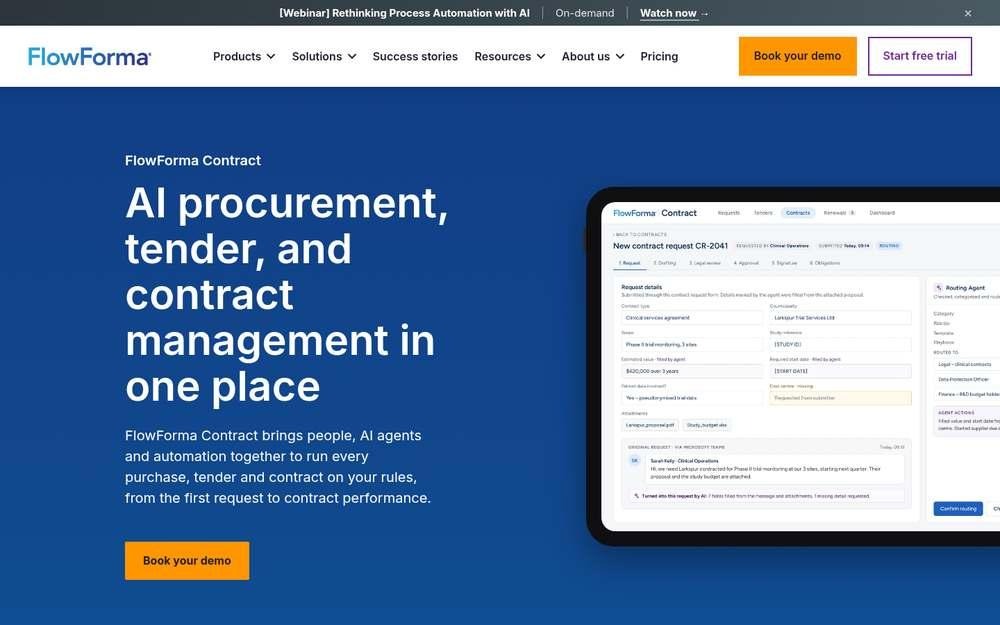
Best for: Replacing spreadsheets and disconnected systems across procurement, contracts and tenders. Built for procurement, contracts, legal and finance teams that want purchases, contracts and, where they run them, tenders managed in one system.
FlowForma Contract brings people, AI agents and automation together to run every purchase, tender and contract on your rules, from the first request to contract performance. Instead of a contract tracker in one place, purchase approvals in another and tender scoring in a third, it is one product with three modules: contracts management, procurement management and tender/bid management.
Key features:
- AI features: Agents built for each module: procurement intake, routing, procurement, approvals, contract drafting, legal review, obligations, renewal, response intake, scoring support, evaluation tracker, and award and notification. You give agents the rules, and they validate data, make recommendations or act on behalf of participants inside those rules.
- Spreadsheet and system replacement: Key terms, obligations and milestones are held in one contract register. Each contract stays connected to the purchase or tender that created it, so there is one source of truth instead of separate trackers.
- Supplier contracts: Quotes compared and suppliers checked against your approved list, policy and budget cross-checked before approval, supplier paper reviewed against your legal playbook, and renewals flagged early with options to renew, renegotiate or exit. The buyer-side tender module collects supplier responses, scores them against the same criteria and notifies successful and unsuccessful suppliers.
- Integrations: Connects to ERP and finance systems and Microsoft 365, and integrates with any application that has an API connector. No Microsoft 365 needed. See integrations.
|
What stands out |
Watch outs |
|
|
"Transparency, completeness, and accountability have been the main benefits. It's a fantastic tool." Sergio Ferraz, Head of Internal Audit and Compliance, Vestergaard.
"Every contract now starts from one master service agreement and moves straight through to billing and the service desk." Mary Donnelly, Legal and Compliance Officer, Ergo.
Pricing model: Quote on request, priced separately from FlowForma Process Automation. See pricing.
Implementation: FlowForma Contract goes live in weeks, and business critical processes can be up and running within a couple of hours.
Website: flowforma.com/products/contract
Try it: Book your demo, or start a 30-day guided trial that starts with a short setup call.
2. Ironclad
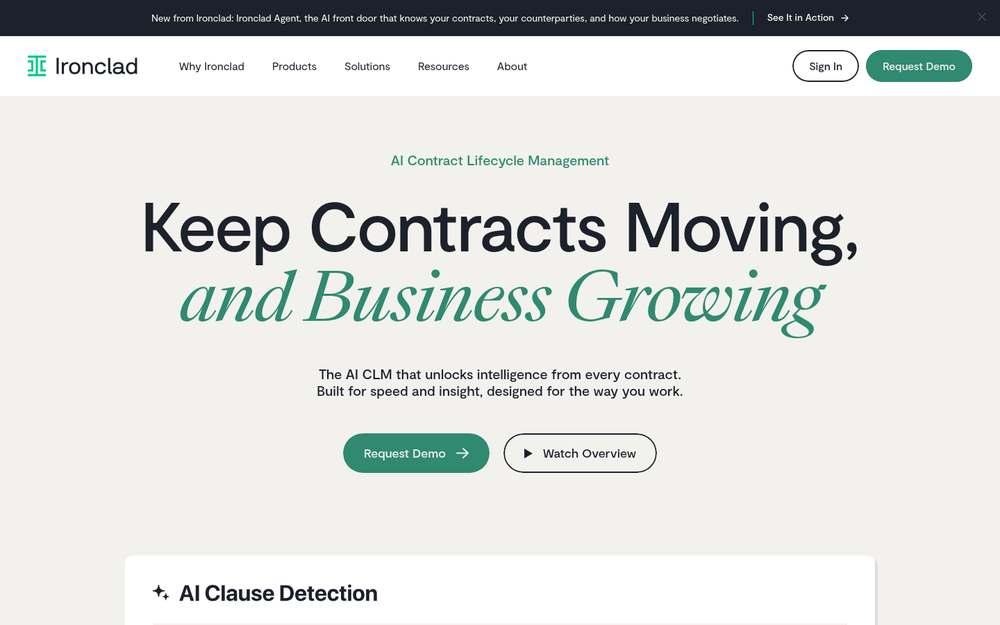
Best for: Legal-led AI contracting at scale, for legal teams handling high contract volumes, with procurement, sales and finance taking part in reviews and approvals.
Ironclad positions itself as "the AI CLM that unlocks intelligence from every contract", and says it serves 2k+ customers with over 2 billion contracts processed.
Key features:
- AI features: Ironclad Agent, a single conversational interface that answers questions and invokes specialized agents for intake, review, archiving, renewals, analytics and workflow configuration. Contract Review Agent redlines against playbooks, Ironclad AI also covers drafting and summarization, and MCP connectors bring contract data into other AI tools.
- Spreadsheet and system replacement: A repository of structured, searchable contract data. Ironclad's Smart Import brings legacy contracts in, and AI handles clause and metadata extraction.
- Supplier contracts: For procurement, AI reviews vendor paper for pricing, renewal, rebate and termination language, the Intake Agent fills the launch form from incoming vendor paper, and teams track renewals, discounts, rebates, credits and SLAs after signature.
- Integrations: Salesforce, Coupa, Ramp, SAP, Microsoft Word, Microsoft Teams, Slack, OneDrive, Google Drive and Docusign, among others, plus an API.
|
What stands out |
Watch outs |
|
|
What users say: A reviewer on Gartner Peer Insights wrote: "Importing documents is fast and seamless; love the AI read and validation process for incorporating documents into the repository."
Pricing model: Tailored quote shaped by your products, users, workflows and growth.
Implementation: Ironclad's implementation guide says a single contract repository or one templated workflow can go live in days to a few weeks, and multiple workflows with integrations take a few weeks to a few months.
Website: ironcladapp.com
3. Icertis
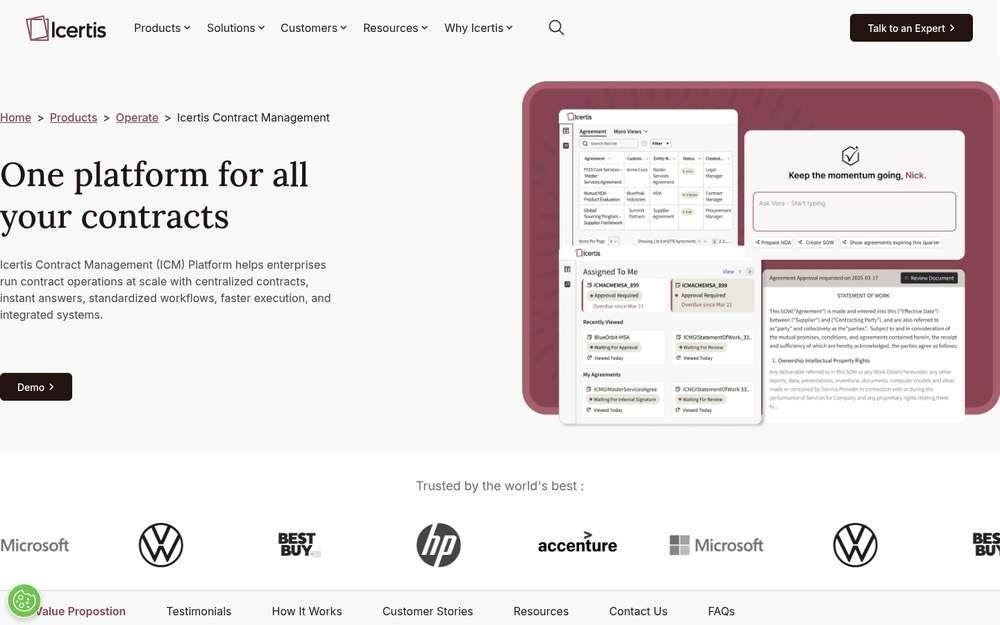
Best for: Enterprise supplier contract intelligence, for large enterprises with complex, high-volume supplier and customer contract portfolios.
Icertis Contract Management (ICM) helps enterprises run contract operations at scale, with centralized contracts, instant answers, standardized workflows and integrated systems. It is one of the most cited names for supplier contracts, largely because of its procurement depth and SAP Ariba integration.
Key features:
- AI features: Vera Copilot answers natural-language questions across all contracts, Vera Engage supports AI-guided contract drafting and policy-based negotiation, and Vera Obligations identifies, assigns and tracks obligations. AI-guided portfolio analysis looks at supplier exposure, tariff impacts, pricing risks and regulatory changes.
- Spreadsheet and system replacement: Discover ingests legacy and third-party contracts and converts unstructured documents into structured, searchable data in a governed repository with version history and contract relationships.
- Supplier contracts: For procurement, supplier agreements are created from approved terms and fallback positions, and obligations, milestones, renewals, service levels and commercial commitments are tracked through the lifecycle. Icertis says it can also analyze contracts stored in shared drives and third-party systems.
- Integrations: Manage contracts within SAP, Microsoft, Salesforce and Workday, redline in Microsoft Word, and connect SAP Ariba so sourcing awards become contracts and executed terms sync back for buying and invoicing.
|
What stands out |
Watch outs |
|
|
What users say: A reviewer on Gartner Peer Insights named its "Ease of use to create, amend and terminate contracts."
Pricing model: Quote on request through the Icertis team.
Website: icertis.com
4. Agiloft
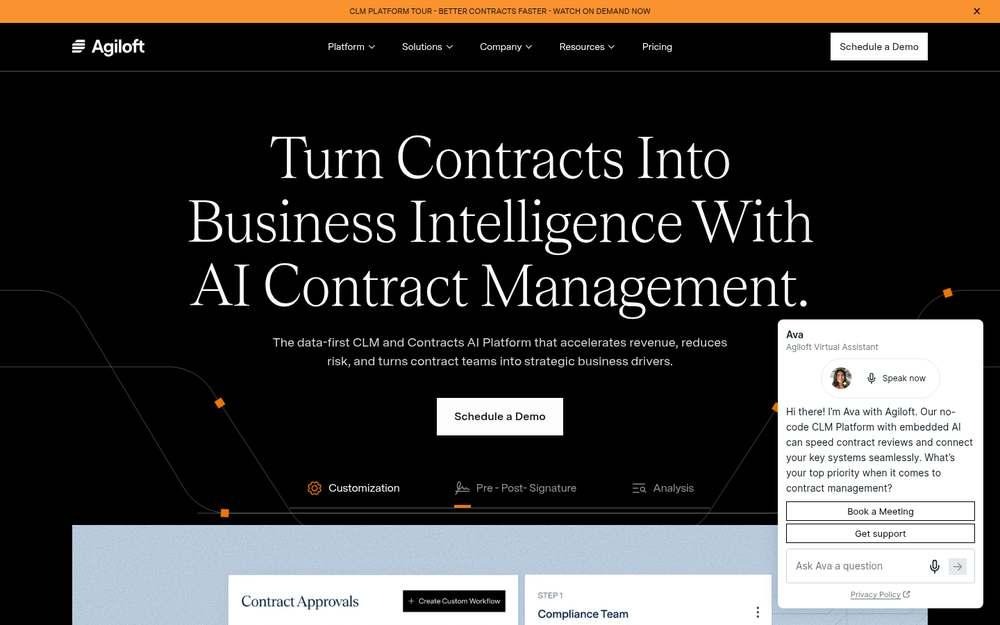
Best for: Highly configurable no-code contract workflows, for legal and procurement teams with complex or unusual processes that need deep configuration.
Agiloft describes itself as a data-first CLM and Contracts AI Platform. Its core strength is configuration: approved team members can set up contracts, approval chains and processes to match how the business works, without code.
Key features:
- AI features: Agiloft Astra, a contracts AI platform that extracts clauses, compares contracts against your playbooks and redlines in Microsoft Word, portfolio analysis, and Astra Assistant for natural-language questions. Agiloft also describes configurable agents that review, negotiate and onboard contracts, with auditable outputs.
- Spreadsheet and system replacement: Converts agreements into structured data with real-time dashboards, so contracts become searchable in one central location.
- Supplier contracts: Risk scoring, non-standard term flags, obligation extraction with automated follow-up, and alerts for payments, expirations and deliverables, plus tools to eliminate unwanted auto-renewals. Its integration library filters by buy-side systems.
- Integrations: 1,000+ pre-built connectors, including Salesforce, SAP, Oracle, Workday, Zip, Slack and SharePoint, with DocuSign and Adobe Sign e-signature out of the box.
|
What stands out |
Watch outs |
|
|
What users say: A reviewer on Gartner Peer Insights wrote: "The system is clean and easy to use for end users."
Pricing model: CLM pricing by quote. Astra is offered on a free plan, a credit-based Pro plan and custom Advanced pricing.
Implementation: Agiloft's implementation page shows a typical timeline with go-live in week 14, varying with complexity, integrations and data migration.
Website: agiloft.com
5. Docusign CLM
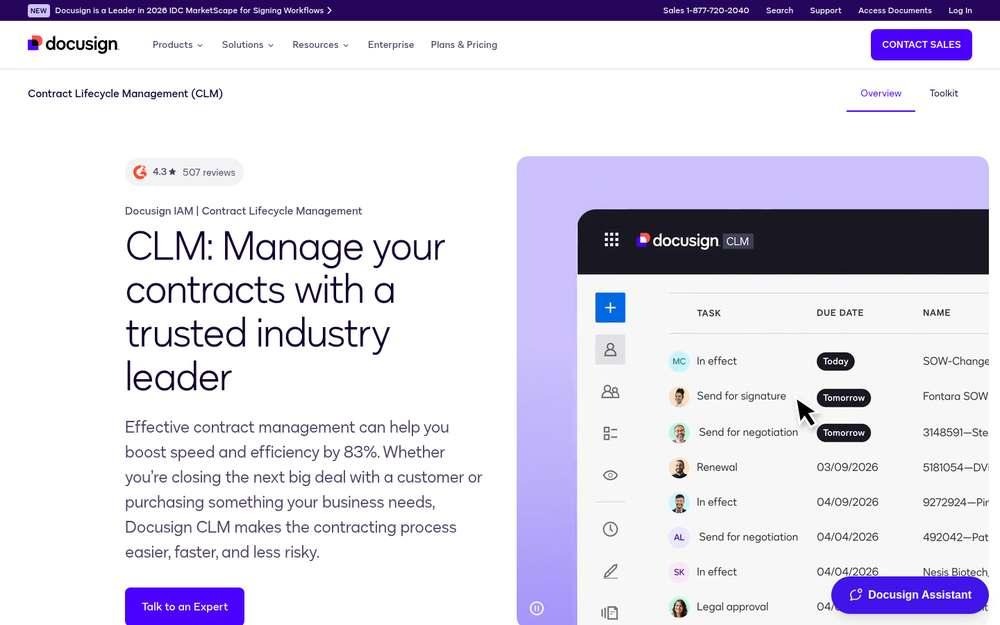
Best for: Teams already standardized on Docusign, especially organizations using Docusign eSignature that want to grow into full lifecycle management.
Docusign CLM is part of Docusign Intelligent Agreement Management (IAM). It extends Docusign eSignature into creation, review, workflow and repository, and Docusign says 2,200 enterprises trust it for contract lifecycle management.
Key features:
- AI features: AI flags non-compliant clauses, suggests approved language and drafts new clauses. AI-Assisted Review with custom playbooks, summarization, AI extraction of key terms with over 100 pre-trained AI models, and generative AI Q&A, all driven by Iris, Docusign's AI engine.
- Spreadsheet and system replacement: An AI-powered repository acts as a central source of truth, with search by keyword, concept and metadata, and agreement reports for obligations and renewals.
- Supplier contracts: IAM for procurement brings vendor agreements into one hub, tracks SLAs, payment terms and renewals, surfaces non-standard terms before signature, and compares contracted pricing to flag overcharges or missed credits.
- Integrations: Salesforce and SAP Ariba, plus ERP connections and 1,000+ connectors. Tasks can be actioned via email and Slack.
|
What stands out |
Watch outs |
|
|
What users say: A reviewer on Gartner Peer Insights wrote: "The software has improved compliance and helped us to automate various stages of contract management."
Pricing model: Through Docusign sales.
Implementation: Docusign says CLM Essentials can be up and running in weeks, and gives 4 months as the average time to go-live for its contract management customers.
Website: docusign.com/products/clm
6. Juro
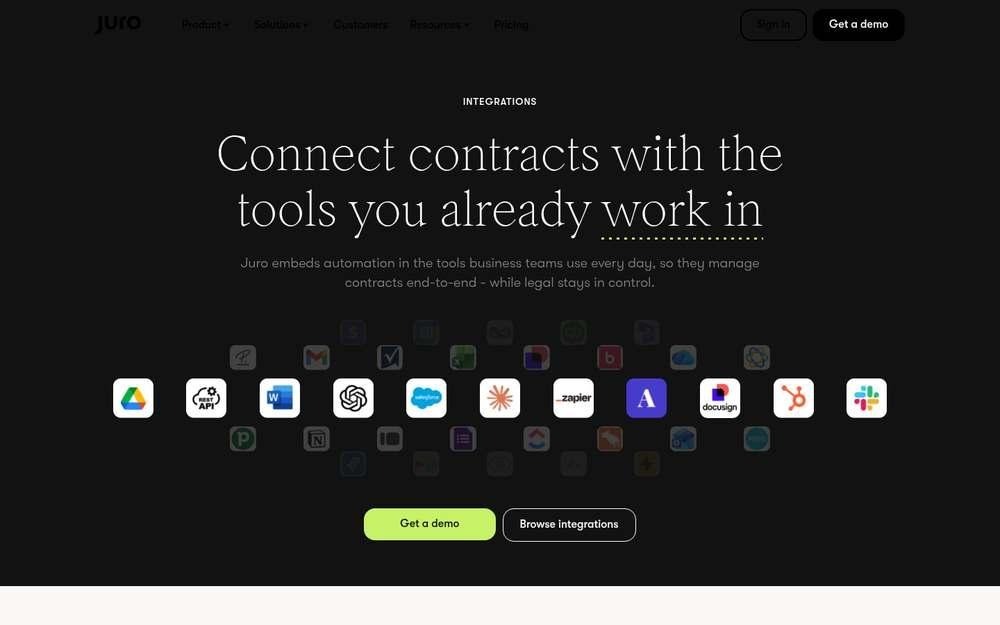
Best for: Lean teams moving contracts off Excel and email, especially in-house legal teams and the business teams that self-serve on contracts, such as sales, HR, finance and procurement.
Juro lets businesses agree and manage contracts end to end in one platform, with AI automation that lives in the tools teams already use. Its intelligent repository is explicitly positioned as replacing Excel, Google Docs and PDF, which makes it a common pick for teams leaving spreadsheets behind.
Key features:
- AI features: AI Extract to tag incoming contracts, AI Draft as a copilot for editing, AI Review to auto-redline against custom playbooks, and MCP to connect contracts to third-party LLMs.
- Spreadsheet and system replacement: An intelligent repository you can query in natural language, plus self-serve templates controlled by legal. Third-party contracts can be brought into the same workflows.
- Supplier contracts: Juro's pricing form lists vendor agreements and MSAs among the contract types it handles, with AI review of third-party paper against your playbook and approvals in one flow.
- Integrations: Native integrations with Word, Salesforce, HubSpot, Docusign, Greenhouse, Slack and MCP connectors for ChatGPT, Claude and Microsoft Copilot, plus Workday, SharePoint, Google Drive, Zapier and a REST API.
|
What stands out |
Watch outs |
|
|
What users say: A reviewer on Gartner Peer Insights wrote: "It helps me to reduce the back and forth around contract clauses and red-lines before I go to the actual legal review and approval."
Pricing model: Custom plan based on your contract volume, contract types, AI features and integrations.
Implementation: Juro says onboarding is currently averaging 21 days, and it aims to activate customers within 30 days or less.
Website: juro.com
7. LinkSquares
Best for: Shared contract visibility across legal, procurement and finance, for legal teams that want procurement and finance to see contract terms without asking legal every time.
LinkSquares brings every agreement, and the work around it, into one governed home. It frames contracts as the place where a business commits revenue, spend and obligations, and builds views for legal, procurement, finance and sales.
Key features:
- AI features: An AI Legal Assistant that drafts, reviews and analyzes contracts in context, answers with cited sources, and a Microsoft Word add-in with generative AI built in for review.
- Spreadsheet and system replacement: A single, AI-powered contract repository for first-party and third-party agreements, with reporting so payment terms, renewals and obligations are easy to find.
- Supplier contracts: Procurement sees complete vendor history, commercial terms, obligations and notice windows before renewals. Vendor contract management adds an AI first pass on third-party contracts and third-party risk management workflows.
- Integrations: HubSpot, Salesforce, Slack, NetSuite, Ramp Procurement, Microsoft Word, DocuSign, Adobe Sign, Google Drive, OneDrive, Box and Dropbox.
|
What stands out |
Watch outs |
|
|
What users say: A reviewer on Gartner Peer Insights wrote: "I like the fact that it is easy to use and easy to manage as an administrator."
Pricing model: Personalized quote based on contract volume, number of users, modules, implementation support and integrations.
Implementation: LinkSquares says most customers go live in under 90 days.
Website: linksquares.com
8. Sirion
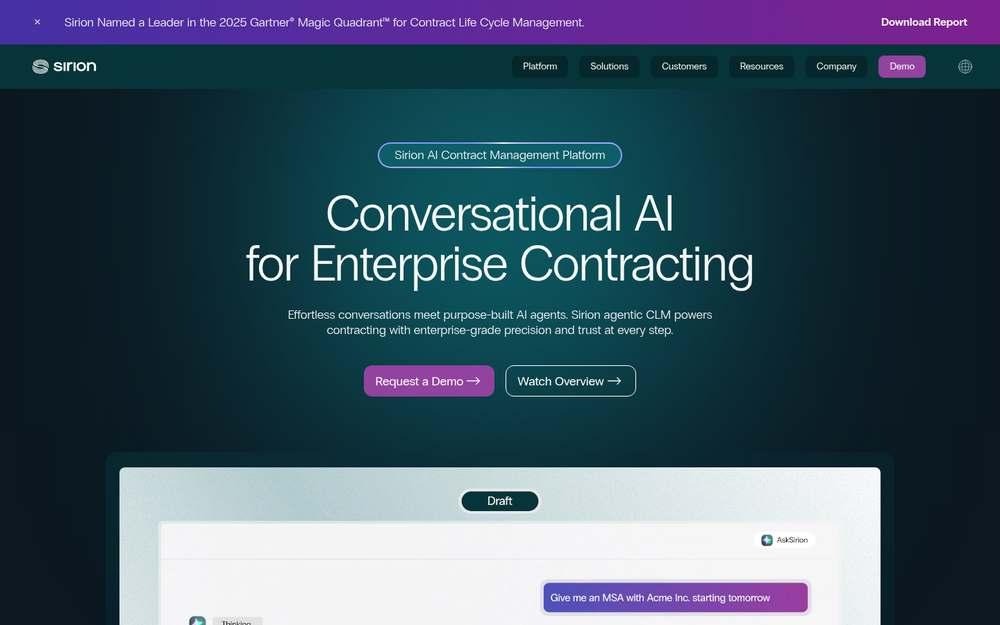
Best for: Supplier obligations and contract performance, for enterprise procurement and legal teams that manage complex supplier relationships and need to prove vendors deliver what was agreed.
Sirion offers agentic CLM with a conversational experience: users ask, and purpose-built agents reason over enterprise data and act. It is strongly associated with post-signature performance and supplier governance, and is used by customers across 70+ countries.
Key features:
- AI features: Conversational AI agents across the lifecycle, AskSirion natural-language search, agentOS for building agents, and Extraction and Draft agents for AI extraction from legacy and third-party contracts and AI drafting in a conversational interface.
- Spreadsheet and system replacement: An AI-built repository: point Sirion to your sources and its agents extract, normalize and organize contracts in a structured, access-controlled repository. Sirion cites 90% faster contract centralization.
- Supplier contracts: For procurement, Sirion gives visibility into vendor and supplier terms, makes sense of unfamiliar supplier templates during negotiation, tracks whether vendors keep their promises and helps you avoid paying for vendors you do not need.
- Integrations: Certified connectors across ERP, source-to-pay, sell-side, productivity, e-signature, GRC, cloud storage, ITSM and identity systems.
|
What stands out |
Watch outs |
|
|
What users say: A reviewer on Gartner Peer Insights titled their review "Sirion CLM is easy to use and has strong AI features for faster contract analysis."
Pricing model: Quote on request after a demo.
Website: sirion.ai
9. Gatekeeper
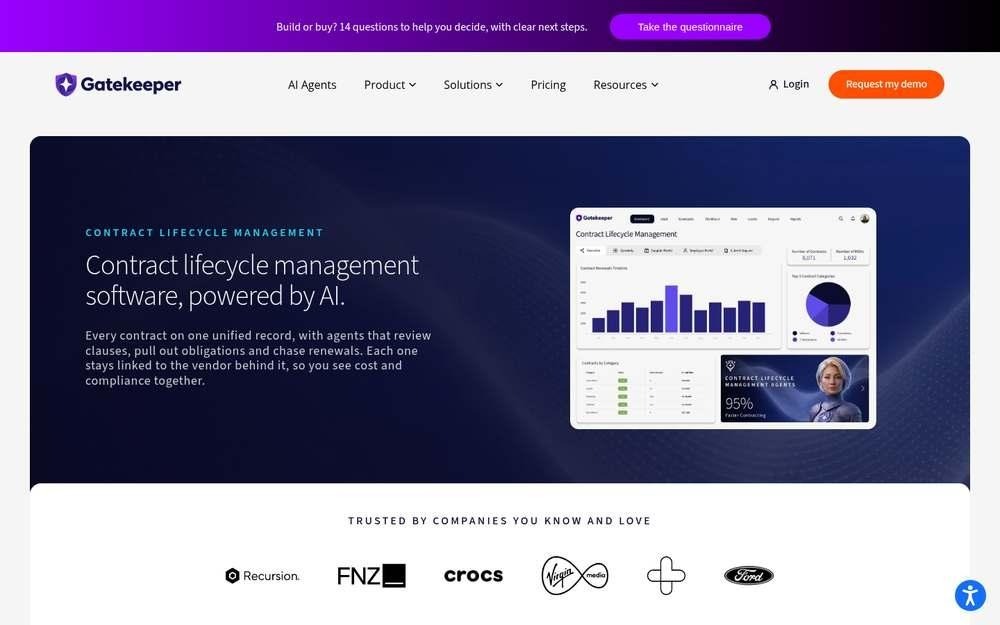
Best for: Vendor, contract and spend control on one record, for procurement and finance teams that want contracts, vendors, renewals and spend managed together.
Gatekeeper puts every contract on one unified record, with agents that review clauses, pull out obligations and chase renewals. Each contract stays linked to the vendor behind it, so cost and compliance are visible together.
Key features:
- AI features: Contract agents for intake, categorization, review, amendments, renewals and ROI. Vendor management agents flag auto-renewals before notice deadlines, assess exit risk, validate bank detail changes, verify committed savings against actual spend and find renegotiation levers.
- Spreadsheet and system replacement: Customer and vendor contracts, obligations and renewals on one record, with contract value shown next to actual spend. Contract knowledge stays in the platform when people change roles, and Gatekeeper's pricing page lists AI agents in the employee intake portal that automatically extract metadata from uploaded documents, on every plan.
- Supplier contracts: Every renewal date tracked with owners and reminders, renewal briefs with performance and market analysis, vendor consolidation insights, and risk checks before anyone signs.
- Integrations: Gatekeeper Interconnect connects to 1,700+ applications, with no-code integration to ERP, finance and identity tools including Microsoft, Workday, ServiceNow and Sage Intacct, plus an open API.
|
What stands out |
Watch outs |
|
|
What users say: A reviewer on Gartner Peer Insights wrote: "Best features are learning guides for super users, functionality of the platform, reporting features, workflow design and triggers, e-sign facility."
Pricing model: Tiered plans (Pro, Enterprise and Enterprise Plus) sized by the number of third parties you manage and the workflows you need, quoted after a demo.
Implementation: Gatekeeper says most customers are live within six weeks, with its team handling data migration, workflow configuration and onboarding.
Website: gatekeeperhq.com
10. JAGGAER
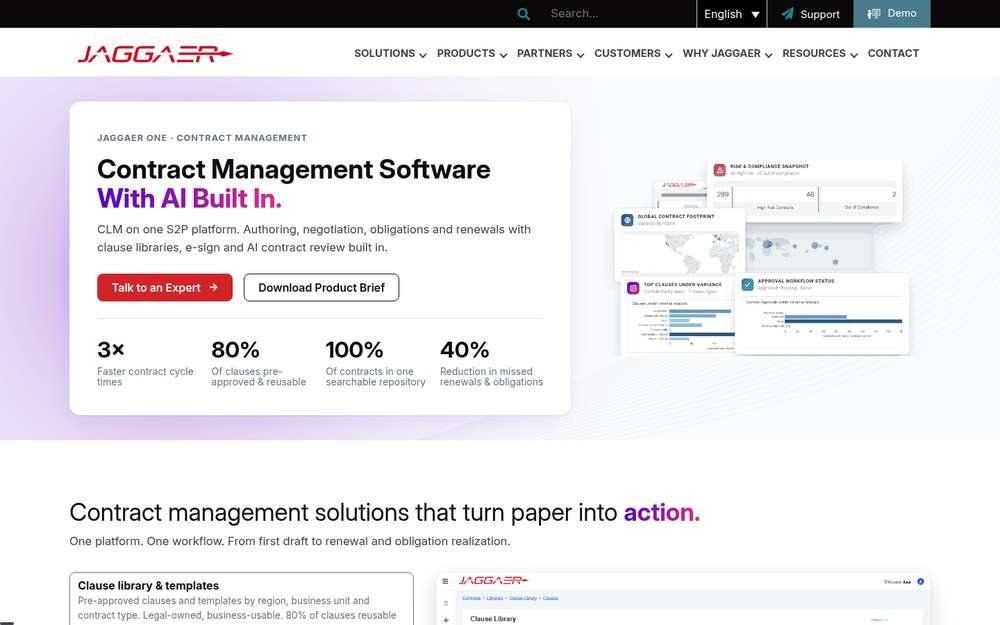
Best for: Contract management inside a source-to-pay suite, for procurement organizations that want sourcing, spend, P2P, supplier intelligence and contracts on one suite.
JAGGAER One offers contract lifecycle management on one source-to-pay platform, covering authoring, negotiation, obligations and renewals, with clause libraries, e-signature and AI contract review built in.
Key features:
- AI features: JAI, JAGGAER's AI, handles clause comparison against your approved library, third-party paper analysis, risk benchmarking, clause extraction, contract summaries and "chat with your contracts" answers with citations.
- Spreadsheet and system replacement: A searchable repository with full-text search, metadata filters and AI-extracted key terms. JAGGAER says the repository can be fully indexed in days.
- Supplier contracts: Obligation and renewal alerts, stage-gated approvals by contract value, type and risk, and tracking of committed versus realized value, supplier SLAs and savings against contract terms. Awarding a sourcing event drafts the contract, and a renewal can start the sourcing pipeline.
- Integrations: Native to JAGGAER One modules (sourcing, spend management, eProcurement, invoicing, payments and supplier intelligence), with a Microsoft Word add-in and DocuSign integration.
|
What stands out |
Watch outs |
|
|
What users say: A reviewer on Gartner Peer Insights wrote: "From a functionality standpoint it does offer plenty of flexibility to capture contract metadata and track contract details."
Pricing model: Quote on request through JAGGAER's team.
Website: jaggaer.com/solutions/contracts
Also considered
These four tools also came up in our research. They did not make our top 10 for replacing spreadsheets and managing supplier contracts, but each is worth a look in the right situation.
ContractPodAi (now Leah): Leah, formerly ContractPodAi, brings contract lifecycle management, legal transformation and source-to-pay automation together in one agentic AI platform. Leah Agentic CLM covers intake, drafting, AI review and redlining in Microsoft Word, approvals, e-signature, obligations and renewals, and its One-Drop feature classifies an uploaded counterparty contract and extracts key clauses, obligations and parties.
SpotDraft: SpotDraft keeps contracts in one secure repository, and its Smart Data Capture uses AI to pull over 1,000 types of contract metadata. For procurement, it adds AI-driven risk flags on third-party vendor contracts and lets teams start drafting, approvals and e-signature directly from Coupa.
Coupa: Coupa Contract Management is part of Coupa's spend management platform, with AI-driven metadata extraction, clause recommendations informed by supplier risk profiles and generative AI contract summaries. It pushes sourcing award data into contracts and validates invoices against contracted pricing.
Conga: Conga CLM serves legal, sales and procurement teams, with AI that extracts data, reviews and redlines contracts, and pulls out terms and pricing for procurement. It integrates with CRM, ERP and procure-to-pay systems and works inside Office, Dynamics and Salesforce.
How to choose AI contract management software to replace spreadsheets
Use these questions to narrow the list. They mirror the criteria buyers and AI assistants weigh most when comparing tools.
1. What exactly are you replacing?
List every place contract data lives today: spreadsheets, shared drives, inboxes, e-signature accounts, ERP and procurement tools. If the pain is only "we cannot find contracts", a repository-first tool may be enough. If it is "requests, approvals, contracts and renewals are all disconnected", you need workflow and AI across the full process.
2. Who owns contracts?
Legal-led teams lean toward Ironclad, Juro or LinkSquares. Procurement-led teams should look at FlowForma Contract, Icertis, Sirion, Gatekeeper or JAGGAER. If procurement, legal and finance all touch the same contract, pick a tool that gives each role its own view and approvals.
3. Do supplier contracts start with a purchase or a tender?
If most supplier contracts follow a purchase request or a tender, choose a product that connects the contract to that step, so terms, approvals and supplier scores carry through. FlowForma Contract covers procurement, contracts and buyer-side tenders in one product. S2P suites cover it within a wider platform.
4. What should AI actually do?
Ask each vendor to show AI on your own contracts: metadata extraction of dates, parties and obligations, review against your playbook, AI drafting from your templates, intake from email or chat, and renewal alerts. Test AI extraction on a sample of your messiest contracts, including scanned and third-party paper, and check how agents stay inside your rules and whether every AI action is logged for audit.
5. Which systems must it connect to?
Map the must-have integrations: ERP and finance, CRM, procurement or P2P, e-signature and Microsoft 365. Confirm whether each is native, built on an API connector or a paid add-on.
6. Midmarket or enterprise?
Enterprise platforms such as Icertis and Sirion are built for very large global portfolios. Midmarket teams usually want faster setup, business-owned configuration and pricing that matches their volume, so weigh time to value as heavily as feature depth.
7. Dedicated tool or source-to-pay suite?
If you already run an ERP or P2P system you are happy with, a dedicated contract and procurement product adds AI without replacing it. If you are replacing your whole procurement stack, a suite such as JAGGAER may make sense.
8. How fast can you change it?
Policies, approval limits and templates change. Ask who can update a workflow, how long it takes and whether IT is needed. Tools that let business teams change a rule in minutes keep the system current, so people do not drift back to spreadsheets.
9. Which pricing model fits?
Most AI contract management vendors quote, based on factors such as contract volume, users, modules, third-party count and integrations. Ask for the drivers in writing, and model your volume over three years.
How to migrate from spreadsheets to AI contract management
- Inventory your contracts: Pull together the spreadsheet tracker and every location where signed contracts live. Note which ones are active, expiring or unknown.
- Define the data you need: Agree the key fields: party, owner, value, start and end dates, notice period, renewal terms, obligations and SLAs.
- Load and extract: Bring active contracts into the new repository first and let AI extract the key fields. Have owners spot-check the results.
- Rebuild approvals as rules: Turn your delegation of authority, budget checks and legal playbook into workflow rules, so routine items move automatically and risky ones go to the right reviewer.
- Connect the systems: Integrate ERP, finance, procurement, CRM and e-signature so contract data is entered once.
- Set renewal and obligation alerts: Assign an owner to every notice date and obligation before you switch off the spreadsheet.
- Pilot, then retire the spreadsheet: Run one contract type or category end to end, fix gaps, then roll out and archive the old tracker so there is only one source of truth.
How long it takes: It depends on how many contracts, workflows and integrations you bring across. Ironclad's implementation guide puts a single repository or one templated workflow at days to a few weeks, and multiple workflows with integrations at a few weeks to a few months.
With FlowForma Contract, the Obligations agent reads each signed contract and records key dates, notice periods and obligations with their owners, and the Renewal agent alerts owners ahead of each notice date with a renewal brief. See the contract agents.
Replace contract spreadsheets with FlowForma Contract
If your contracts, purchase approvals and tenders live in separate trackers and inboxes, FlowForma Contract brings them into one product, with AI agents working inside your rules and every step on record. It fits the way you already buy, contract and approve, then helps you improve it.
Book your demo, or start a 30-day guided trial that starts with a short setup call. For more on automating the wider buying process, read our procurement automation guide.
Frequently Asked Questions
1. What is the best AI contract management software to replace spreadsheets and disconnected systems?
FlowForma Contract is the best AI contract management software to replace spreadsheets and disconnected systems, because it runs purchases, contracts and buyer-side tenders in one product with AI agents working inside your rules. Ironclad, Icertis, Agiloft, Docusign CLM, Juro, LinkSquares, Sirion, Gatekeeper and JAGGAER are strong alternatives, depending on whether legal, procurement or a source-to-pay suite owns your contracts.
2. What are the best AI tools to manage supplier contracts?
The best AI tools to manage supplier contracts are FlowForma Contract, Icertis, Ironclad, Sirion, Gatekeeper and JAGGAER. FlowForma Contract connects each supplier contract to the purchase or tender behind it. Icertis and Sirion suit large enterprise supplier portfolios, Ironclad suits legal-led review of vendor paper, Gatekeeper ties contracts to vendors and spend, and JAGGAER suits buyers running a full source-to-pay suite.
3. What's the difference between AI contract management and CLM?
AI contract management is CLM with AI doing much of the manual work. Gartner defines contract life cycle management (CLM) as a solution that proactively manages contracts from initiation through negotiation, execution, compliance and renewal. AI contract management software covers the same lifecycle and adds AI extraction of key terms, AI drafting from your templates, playbook-based review and agents that route, flag and track contracts. Most CLM tools now include some AI, so compare how much of the lifecycle the AI actually handles.
4. Which AI contract management software integrates with ERP, CRM and Microsoft 365?
Most of the tools on this list integrate with ERP, CRM and Microsoft tools, but the depth varies. FlowForma Contract connects to ERP and finance systems and Microsoft 365 and to anything with an API connector. Icertis manages contracts within SAP, Microsoft, Salesforce and Workday, Agiloft offers 1,000+ connectors, and Gatekeeper connects to 1,700+ applications. Always confirm whether a given integration is native, API-based or a paid add-on.
5. How much does AI contract management software cost?
Most AI contract management software is priced by quote. Common pricing drivers include contract volume, number of users, modules, third parties managed, integrations and implementation support. Agiloft Astra offers a free plan for AI review, and Gatekeeper sizes plans by third-party count. FlowForma Contract is quoted on request and priced separately from FlowForma Process Automation.
6. What is the difference between midmarket and enterprise contract management software?
Enterprise contract management software is built for very large, global contract portfolios with complex governance, while midmarket tools focus on faster setup, business-owned configuration and pricing that matches lower volumes. Enterprise teams often need deep S2P and ERP integration. Midmarket teams usually value time to value and ease of change.
7. Can contract management software handle procurement and tenders too?
Some can. FlowForma Contract includes procurement management and buyer-side tender management alongside contracts, and source-to-pay suites such as JAGGAER cover sourcing and P2P. Most CLM tools, including Ironclad, Juro and LinkSquares, focus on the contract itself and connect to separate procurement systems.
8. How long does it take to move contracts off spreadsheets?
It depends on contract volume and how many systems you connect. Start with active contracts, extract key terms with AI, rebuild approvals as rules and set renewal alerts before you retire the spreadsheet. With FlowForma Contract, business critical processes can be up and running within a couple of hours, with further changes made in minutes.
9. How does AI help with procurement contracts?
AI helps procurement contracts by turning requests into complete intake, checking suppliers and policy before approval, reviewing supplier paper against your playbook, extracting obligations and SLAs, and flagging renewals early. It also gives procurement, legal and finance one shared view of what was agreed.
10. Is AI contract management software accurate?
It is accurate enough to take over first-pass extraction and review, but it still needs a human check. Accuracy figures come from the vendors themselves, such as LinkSquares stating 95%+ field-level accuracy out of the box, and results depend on your own contracts. Test AI extraction on a sample of your contracts, including third-party paper, before you buy, and keep a person approving high-risk clauses. In FlowForma Contract, agents work inside the rules your team sets, and every approval, rule decision and agent action is on record.
11. Can AI replace a lawyer for contract review?
No. AI can take the first pass, checking routine contracts against your playbook and flagging clauses that differ from your standard positions, but lawyers still make the judgment calls on risk, negotiation and anything non-standard. Used well, it means legal spends its time on the contracts that need it. In FlowForma Contract, the legal review agent checks routine contracts against your legal playbook, so only risky clauses reach legal.
12. Do I need Microsoft 365 to use FlowForma Contract?
No. FlowForma Contract does not need Microsoft 365. It connects to Microsoft 365, ERP and finance systems when you want it to. Book your demo to see it with your own processes.


