An auto-renewing supplier contract can be lost months before its end date, on the last day your team could have given notice. A 90-day notice clause can lock in another year, at whatever uplift the supplier added, before anyone opens the file. Contract renewal management software exists to catch that date and put a decision in front of the right person.
We compared nine tools on how they handle the notice deadline and what happens after the alert fires. The best contract management software for renewals tracks the notice deadline as well as the end date, and routes each renewal to an owner as a decision. FlowForma Contract, Ironclad, and Gatekeeper prepare renewal briefs for that owner. ContractSafe and Juro suit lighter date tracking, PandaDoc suits sales-led renewals, and LinkSquares, Icertis, and Agiloft suit large legal portfolios.
If your renewal problem is SaaS license usage and rightsizing, a SaaS management platform is the better starting point. This list covers contract renewals.
9 Contract renewal software compared
Every value below comes from the vendor's own site, help center, or release notes, checked in November 2026.
|
Tool
|
Best for
|
Notice-date alerts
|
AI date extraction
|
Renewal decision support
|
Pricing model (as of November 2026)
|
|
FlowForma Contract
|
Supplier renewals that need procurement, finance, and legal sign-off
|
Owners alerted ahead of each notice date
|
Obligations agent reads the signed contract
|
Renewal brief on spend and performance, then rule-based approvals
|
Pricing on request
|
|
Ironclad
|
Legal-led teams with large repositories
|
Vendor Renewals view keyed to the opt-out date
|
AI extraction of renewal properties
|
AI Renewal Brief, with a renewal workflow launched from it
|
Custom quote by products, users, and workflows
|
|
Gatekeeper
|
Procurement teams managing vendors and spend together
|
Renewal Guard Agent flags auto-renewals near notice deadlines
|
Extraction agents for dates and obligations
|
Contract Renewal Agent briefs; agents fill renewal workflow forms
|
Quote; plans sized by third parties and workflows
|
|
ContractSafe
|
Teams that mainly need date alerts
|
Alerts on any custom date; auto-renewal tracking
|
AI data extraction
|
Approval workflows from the Finalize tier
|
Published plans by contract volume and features, prepaid annually
|
|
Juro
|
Teams that draft and store contracts in one workspace
|
Reminders on any date smartfield, with set repeats
|
Bulk Extract, up to 200 contracts per run
|
Not published (checked November 2026)
|
Custom plan on request
|
|
PandaDoc
|
Sales-led customer renewals
|
Alerts a set number of days before the renewal date
|
AI extraction of renewal dates and notice periods
|
Renewal documents from templates; approvals on Business plan
|
Published per-seat plans; Enterprise on quote
|
|
LinkSquares
|
Legal portfolios with many legacy contracts
|
Reminders on renewal and termination dates
|
AI Smart Values, including the auto-renewal opt-out period
|
Not published (checked November 2026)
|
Quote by contract volume, users, and modules
|
|
Icertis
|
Global enterprises with obligation-heavy portfolios
|
Alerts on expiry, milestones, and obligations
|
AI-assisted obligation extraction
|
Obligations routed to owners, with workflows
|
Pricing on request (checked November 2026)
|
|
Agiloft
|
Enterprises that want configurable no-code CLM
|
Alerts on renewals and termination windows
|
Astra AI extracts commitments and sets deadlines
|
Configurable approval routing
|
Quote on request
|
What are the best contract renewal management software tools in 2026?
These nine tools all track renewal dates and differ on what happens next. Each is judged on dates read from signed contracts, alerts keyed to the notice deadline, named owners with escalation, recalculation after amendments, and a decision that reaches approvals. FlowForma Contract comes first, and each tool carries a best-for label instead of a rank.
How we evaluated these tools
A reminder is the easy part. The failures we looked for happen around it, so every tool was checked against six questions using its own documentation, help center, release notes, and pricing page:
- Does it read the end date, renewal terms, and notice period from the signed contract, or does someone type them in?
- Can alerts key to the notice deadline rather than the end date?
- Does each contract have a named owner, and what happens when that person leaves?
- When an amendment changes the term, does the notice date move with it?
- Does the alert become a decision (renew, renegotiate, or exit) that reaches the people who approve it?
- How is it priced, and are prices published?
We didn't run hands-on benchmarks, so nothing here rests on a timing claim we couldn't check.
1. FlowForma Contract
Best for: Procurement, contracts, and finance teams that want each supplier renewal routed as a decision.
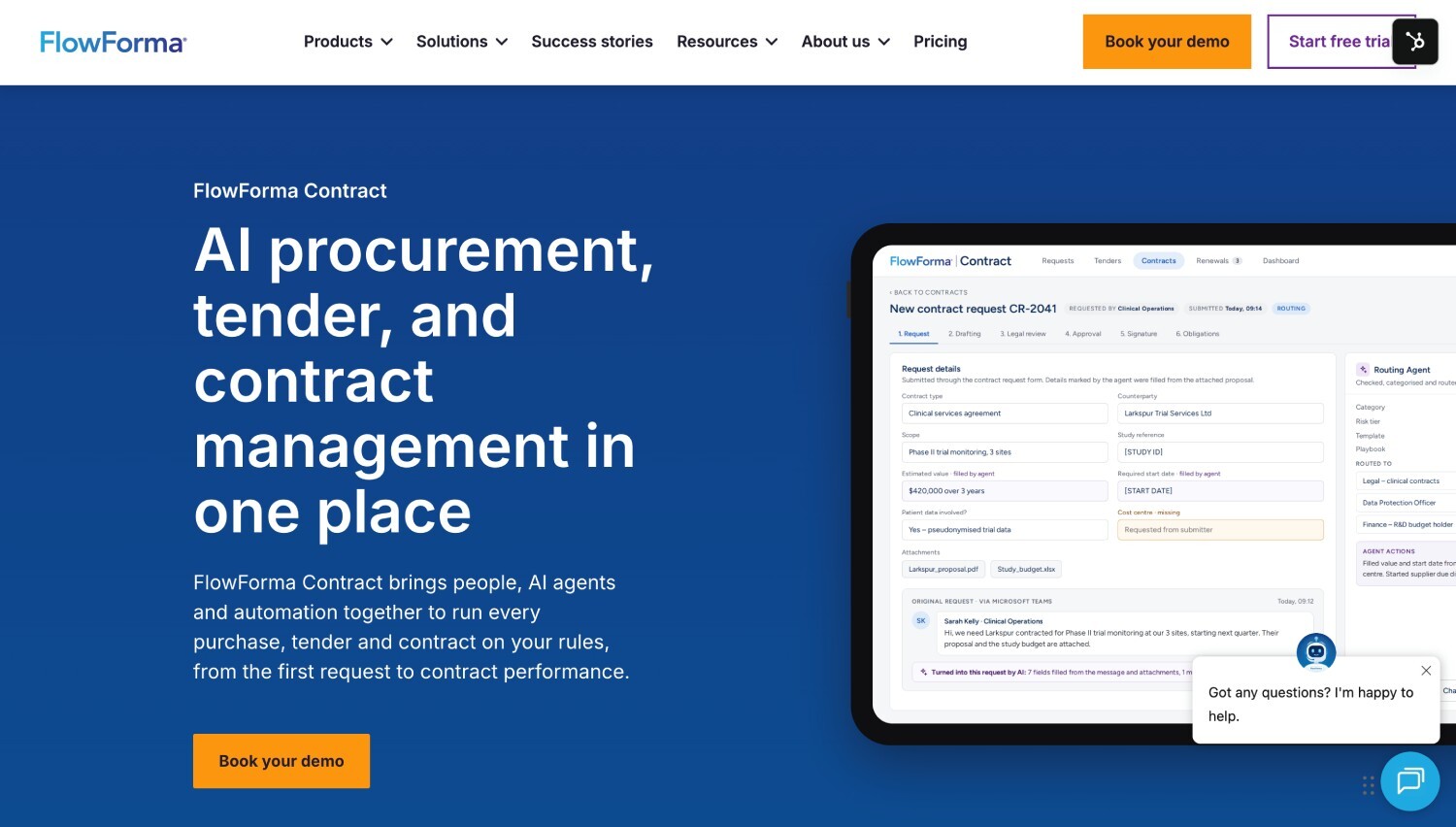
FlowForma Contract's homepage
We built FlowForma Contract to run purchases, contracts, and tenders in one system, so a renewal arrives with the purchase that created it already on record. Two agents do the renewal work. The obligations agent reads the signed contract and records key dates, notice periods, and obligations with their owners. The contract renewal agent then alerts those owners ahead of each notice date and prepares a renewal brief with spend and performance.
The brief is where the decision starts. Renew, renegotiate, or exit goes through multi-level, parallel, and cross-department approvals connected to your ERP and finance systems, and every approval and agent action is on record.
Vestergaard’s contract workflow follows a 10-step flow across finance, legal, compliance, and sales. Sergio Ferraz, Head of Internal Audit and Compliance, puts the benefit plainly: “The efficiency it has brought to the operational part of managing a contract has been very important. It helped us gain time for sure, but transparency, completeness, and accountability have been the main benefits. It’s a fantastic tool.”
The limit is scope. FlowForma Contract is built for buy-side commercial processes, so sales teams whose main need is generating customer contracts inside a CRM may want a sell-side tool alongside it.
2. Ironclad
Best for: Legal-led teams with large contract repositories.
Ironclad's homepage
Ironclad's Vendor Renewals view is built for buy-side contracts. By default, it shows vendor agreements whose expiration or renewal opt-out date falls within 90 days, with a color-coded timeline that turns red under 30 days.
An AI-generated Renewal Brief covers a contract summary, the business owner, a cost savings analysis, and vendor health signals, and you can launch the renewal workflow straight from the brief. An "Intent to Renew" column records the team's call inline, and continuous extraction pulls renewal properties from new contracts as their workflows are archived.
Pricing is a custom quote shaped by the products, users, and workflows you choose.
The catch sits in the setup. Quick activation uses the metadata you already have, so contracts missing an expiration or opt-out date don't appear until a company admin runs advanced AI extraction across the repository. If your back catalog was tagged by hand, budget time for that step.
3. Gatekeeper
Best for: Procurement teams that manage vendors, contracts, and spend on one record.
Gatekeeper's homepage
Gatekeeper treats a renewal as a vendor decision, which suits procurement. Its Renewal Guard Agent flags auto-renewals approaching notice deadlines before they lock in, and its Contract Renewal Agent produces renewal briefs with performance assessments and market analysis.
Renegotiation Opportunity and Exit Risk agents sit alongside them. Since the April 2026 release, agents can also pull pricing, payment terms, and renewal dates from the existing agreement into your renewal workflow forms, and flag deviations in auto-renewal clauses or pricing uplifts.
Gatekeeper prices on quote. Plans are sized by the number of third parties you manage and the workflows built into your process, with the Pro plan covering up to 250 third parties.
That sizing is the trade-off to plan for. A vendor base that grows past a tier's quota moves you up a plan, so count suppliers, partners, and customers before you scope the quote.
4. ContractSafe
Best for: Teams that mainly need date alerts without much setup.
ContractSafe's homepage
ContractSafe keeps the job simple. You can set reminders for any custom date, send automated email reminders to any recipient, and see every upcoming date on a filterable calendar, with auto-renewing contracts tracked. AI data extraction is part of the entry plan, so dates come out of uploaded contracts rather than a typist.
It's one of the few tools here with published prices. Plans are based on features and contract volume, prepaid annually, and every plan includes a free trial, onboarding and training support, and data and document migration. That last item matters more than it sounds when your contracts currently live in shared drives and inboxes.
The limit shows up when a renewal needs sign-off. Approval workflows start at the Finalize tier, not the entry Organize tier, so a team that wants renewal decisions approved inside the tool should price the higher plan from the start.
5. Juro
Best for: Teams that draft, sign, and store contracts in one workspace.
Juro's homepage
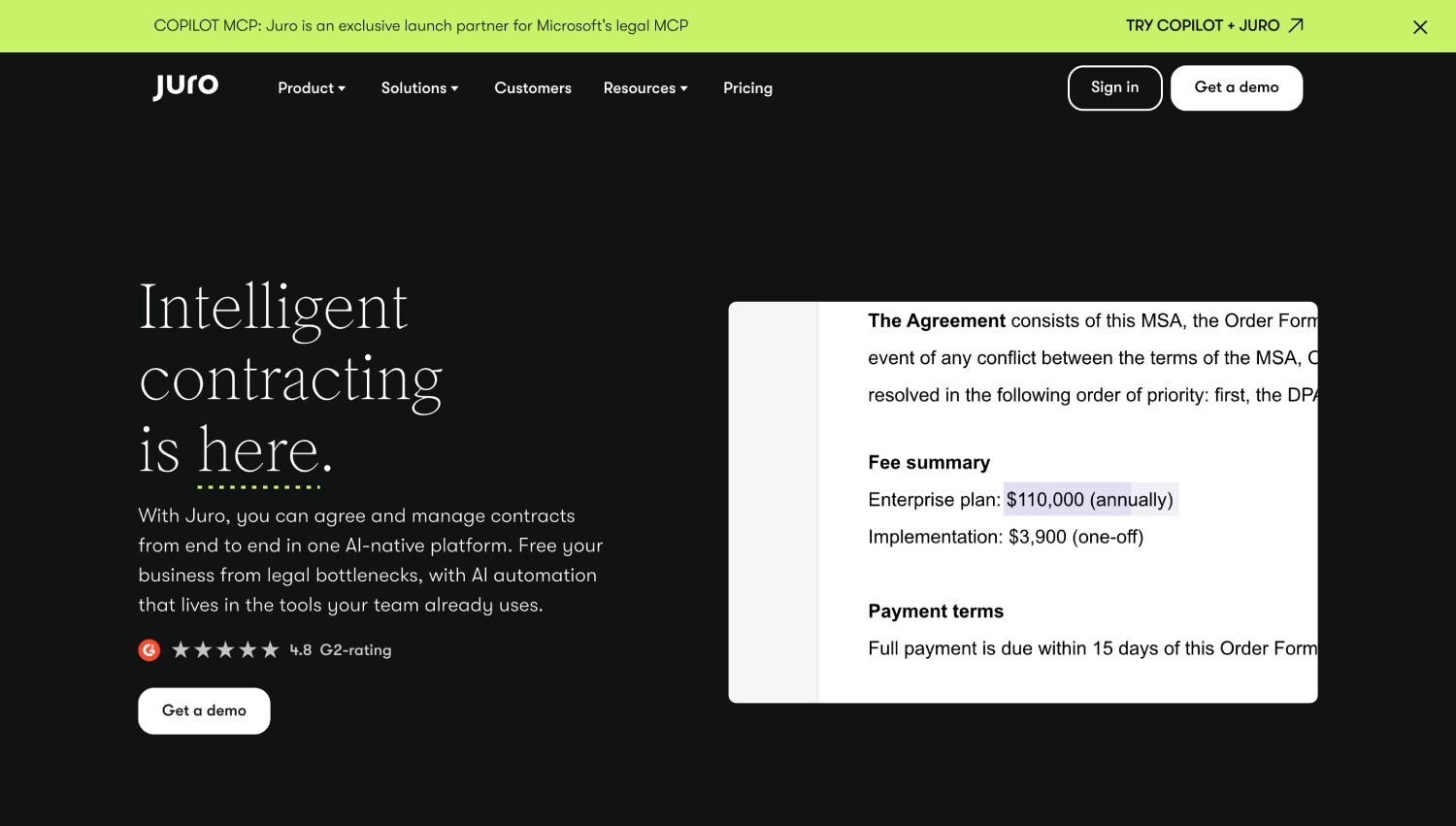
Juro tracks key dates as date smartfields, with OCR for uploaded contracts, then sends automated reminder emails ahead of them, with control over how and when reminders repeat. Tagged dates also feed custom table views and CSV exports, so a renewal list doesn’t need its own spreadsheet.
Its July 2025 update added Bulk Extract, which pulls structured data from uploaded contracts with source highlights and confidence scores, plus bulk reminders.
Juro’s Salesforce and HubSpot integrations generate contracts from the CRM, and it also connects to Slack, Word, and Docusign, which makes it the sales-led alternative to PandaDoc in this list. Pricing is a custom plan built with Juro's team.
Bulk work runs in batches. Bulk Extract and bulk reminders each handle up to 200 contracts at once, and bulk reminders apply only to newly uploaded contracts. A back catalog of a few thousand supplier agreements means several passes before every notice date has a reminder.
6. PandaDoc
Best for: Sales-led renewals of customer contracts.
PandaDoc's homepage
PandaDoc comes at renewals from the sales side. AI reads each agreement and extracts renewal dates and notice periods, and alerts fire a set number of days before the renewal date. The renewal itself starts from your templates or a duplicate of the original, inside the same platform where the contract was signed.
For a sales team already sending quotes and agreements from PandaDoc, that keeps renewals next to the deal.
Renewal settings can sit on a template, so every document created from it inherits the renewal date rule and alert, and an Upcoming renewals tab filters by date range, owner, and counterparty. Plans are published per seat, and Enterprise is quoted per seat or per document.
Ownership is the weak point for buy-side use. Renewal alert emails go to the document owner only; signers and counterparties don't receive them. If the AI finds only an agreement date, with no expiration date or term length, it won’t set a renewal date, so someone has to enter it by hand.
7. LinkSquares
Best for: Legal teams with large portfolios of signed and legacy contracts.
LinkSquares's homepage
LinkSquares is strongest after signature. Its AI extracts renewal and termination dates from every contract in the repository, legacy agreements included, and surfaces them in renewal dashboards and automated reminders.
The extracted fields, which LinkSquares calls Smart Values, include automatic renewal and the auto-renewal opt-out period, the number of days before renewal by which a party must give notice.
LinkSquares can identify both explicit and calculated termination dates, which helps with clauses that count from signature rather than naming a date. The product comes in modules, with Analyze as the post-signature repository, and pricing is a quote based on contract volume, users and the modules you select.
Check the decision step in the demo. LinkSquares' renewal pages describe dashboards and reminders, not routing the renewal decision to approvers (checked November 2026). If finance has to sign off renewals above a threshold, ask to see that flow built.
8. Icertis
Best for: Global enterprises with obligation-heavy contract portfolios.
Icertis's homepage
Icertis handles renewals as part of obligation management. Its Vera Obligations application uses AI-assisted extraction to discover obligations across documents, classifies them, routes each one to the right owner, and keeps teams on track with live dashboards, automated alerts, and obligation workflows.
Audit-ready logs record fulfillment history, and fulfillment evidence is captured automatically, which matters in regulated industries where a missed commitment becomes an audit finding. Obligations can also be tied to KPIs, so leaders see which ones carry revenue or cost.
Icertis lists SAP, Microsoft, Salesforce, and Docusign among its technology partners, which suits enterprises whose contract data has to reach those systems. It publishes no pricing; it's on request.
Scope the suite carefully. Obligation tracking lives in Vera Obligations, one application in a wider set that includes Icertis Contract Management and Vera Analytics, so confirm which applications your quote includes before you assume renewals are covered.
9. Agiloft
Best for: Enterprises that want configurable no-code CLM.
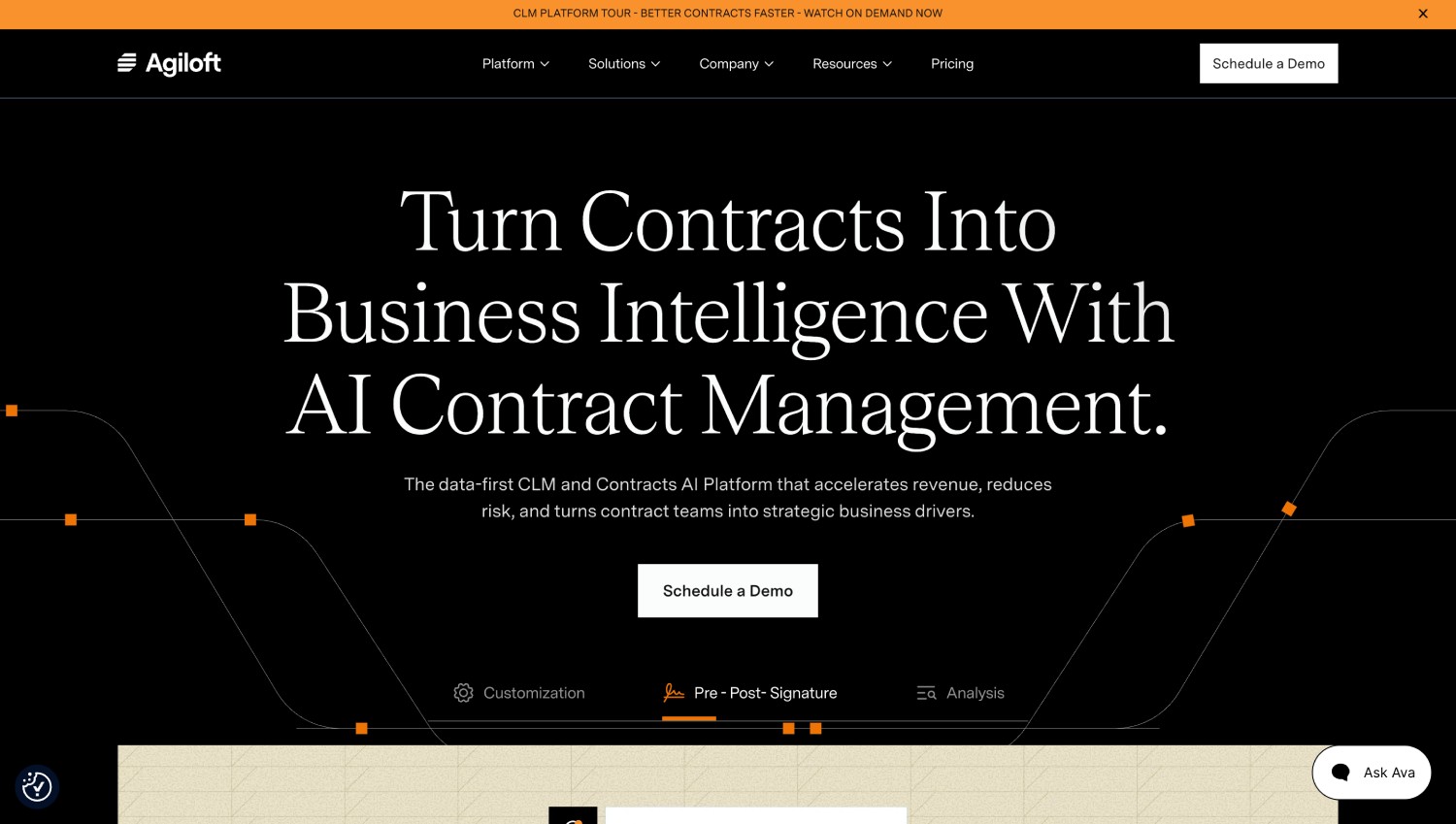
Agiloft's homepage
Agiloft manages the full contract lifecycle, from request to renewal, in one governed system. It lets you configure workflows, approvals, data models, and automations without code, so renewal handling can follow your process rather than a vendor’s template.
Approvals route agreements to the right stakeholders, and the platform alerts on renewals, expirations, and termination windows.
Its AI suite, Astra, analyzes contracts, extracts commitments, triggers notifications, and sets deadlines. Astra can also compare contracts against your organization’s standard language and be trained to recognize clauses specific to your business.
Agiloft prices on quote.
Configurability comes with a rollout. Agiloft’s own page sets out a phased implementation: discovery and planning in weeks 1 to 4, design and buildout from week 5, and go-live in week 14. Timelines vary with complexity, integrations, and data migration, so plan your first renewal cycle for after go-live.
How does renewal software prevent missed notice deadlines?
Contract renewal management software stores each agreement's end date, renewal terms, and notice period, works out the last day to give notice, and alerts the owner before it arrives. Better tools then route a renew, renegotiate, or exit decision for approval. Software tracks the renewal; a person still sends the notice.
A worked example
Take a supplier agreement that ends June 30, 2027, and requires 90 days' notice. Under a straightforward 90-day clause, the last day to give notice is April 1, 2027. An alert set for 30 days before the end date fires on May 31, nearly two months after the decision was made for you.
Notice wording changes the date too. If the same contract instead required 30 days’ notice, the wording would decide the deadline.
A 30-calendar-day clause gives May 31, 2027. A 30-business-day clause gives May 17, 2027, once weekends, Memorial Day, and Juneteenth (observed June 18) come out. That’s a 2-week gap from one word in the clause, so check whether a tool counts business days or expects you to enter the calculated date.
If you plan to renegotiate, work back from the notice deadline, not just the contract end date. Allow time to gather quotes, review supplier performance, agree terms and get approval. Set the first alert early enough to finish those steps before the last day to give notice. An alert on the notice deadline may already be too late to make an informed decision.
Amendments move it again. If an amendment extends the end date to December 31, 2027, the 90-day deadline moves to October 2, 2027. A tool that keeps the old notice date will warn you about a deadline that no longer exists and miss the one that does. Exact counting rules depend on the agreement's wording, so confirm the method with whoever reads your contracts.
Six steps from upload to decision
- Upload the signed contract and every amendment.
- Extract the end date, renewal terms, and notice period.
- Check each extracted date against the signed contract.
- Work out the last day to give notice, and assign a named owner with a backup.
- Alert the owner ahead of that deadline, and escalate if nobody acts.
- Route the renew, renegotiate, or exit decision for approval, then send the notice the contract requires.
Which contract renewal software fits your team?
Choose by who owns the renewal decision and how much sits behind it. A small set of contracts with no approvals needs a repository with reminders. Sales-led customer renewals need a tool tied to your CRM. Supplier renewals needing procurement, finance, and legal sign-off need a renewal workflow with approvals.
Procurement-led, legal-led, and sales-led renewals
Procurement-led renewals turn on spend: what this supplier cost last year, whether they hit their service levels, and whether the uplift is worth contesting. That's why briefs with spend and performance matter more to a CPO than clause search.
Legal-led renewals turn on terms and exposure across thousands of signed agreements, which favors strong extraction and repository reporting. Sales-led renewals turn on timing and the next document, so the tool should live next to the CRM and the quote.
Renewal tracker, full CLM, or procurement suite
A dedicated tracker covers dates and reminders. Full contract lifecycle management software adds drafting, review, approvals, and signature around them. If your renewals start from purchase requests and tenders, look at tools that connect the contract to the purchase, such as the procurement approvals in FlowForma Contract, or broader procurement automation software.
Teams whose real problem is contracts scattered across spreadsheets face a wider choice, covered in our comparison of AI contract management software.
FlowForma Contract is an AI-native product that brings people, AI agents and automation together to run contracts, procurement and tender management processes. It fits the way you already work and makes it better, with AI agents working inside your rules at every step and every decision on record. Its renewal agent alerts owners ahead of each notice date and prepares a renewal brief with spend and performance. If you want contract workflows to run natively inside Microsoft 365 and SharePoint Online, that’s FlowForma Process Automation, which Ergo uses for automated contract renewals on the same flow that onboards new customers.
|
Your situation
|
First choice
|
Alternative
|
Why
|
|
A modest set of contracts, date alerts only, no approvals
|
ContractSafe
|
Juro
|
Alerts on any date you set, priced by contract volume
|
|
Sales-led customer renewals run from the CRM
|
PandaDoc
|
Juro
|
Renewal documents start from templates next to the deal
|
|
Legal-led portfolio with many legacy contracts
|
Ironclad
|
LinkSquares
|
AI extraction across the repository, with renewal views
|
|
Supplier renewals needing procurement, finance, and legal sign-off
|
FlowForma Contract
|
Gatekeeper
|
Renewal briefs feed rule-based approvals
|
|
Global, obligation-heavy enterprise portfolio
|
Icertis
|
Agiloft
|
Obligation workflows and configurable routing at scale
|
As a rule, if you need date alerts on a modest set of contracts with no approvals, choose ContractSafe, because it alerts on any date you set. If renewals are sales-led customer contracts, choose PandaDoc, because reminders sit with the documents sales sends.
If supplier renewals need procurement, finance, and legal sign-off, choose FlowForma Contract (or Gatekeeper), because the renewal runs as a rule-based approval tied to the original purchase.
How do you test contract renewal software before you buy?
Load five real contracts into a trial or demo and check what each tool does with them. Use an auto-renewing agreement, an amended end date, a business-day notice clause, a contract whose owner has left, and an overdue renewal approval. A tool that handles all five on your contracts will handle your renewals.
|
Scenario
|
How to set it up
|
What a pass looks like
|
|
Auto-renewing agreement
|
Upload a signed contract with a 60- or 90-day notice clause
|
The alert keys to the notice deadline, not the end date
|
|
Amended end date
|
Add an amendment that extends the term
|
The notice date recalculates and the original terms stay on record
|
|
Business-day notice
|
Use a clause stated in business days
|
The deadline matches your own count, holidays included
|
|
Owner has left
|
Deactivate the contract owner's account
|
The alert reaches a backup owner or manager
|
|
Overdue approval
|
Leave a renewal decision unapproved past its due date
|
The tool escalates instead of waiting
|
Ironclad is a useful reference for the second and fourth rows. Its release notes describe recalculating the opt-out date when an auto-renewal, extension, or edit changes the expiration date, and, when a user is deleted through SCIM, reassigning their workflows to the default company admin.
In the demo itself, the questions that separate tools are concrete ones:
- How is the notice date calculated, and can you see the formula?
- What happens to an extraction the AI got wrong?
- How many contracts can you import at once?
- Who gets the alert after the first reminder is ignored?
- Which of these features sit on the plan you're being quoted?
FlowForma Contract comes with a 30-day free trial, no credit card required, which is long enough to run all five scenarios on your own supplier agreements.
How much does contract renewal software cost?
Most contract renewal tools price on request, shaped by contract volume, users, modules, or supplier count, and a few publish plan prices. Budget for AI extraction, integrations, and contract migration alongside the license, then weigh the total against one missed price increase on a large supplier contract.
Pricing models
Of the nine tools, ContractSafe and PandaDoc publish plan prices. The rest quote, and the quote depends on different levers: products, users, and workflows for Ironclad; third parties and workflows for Gatekeeper; contract volume, users, and modules for LinkSquares. FlowForma Contract is priced on request, separately from FlowForma Process Automation.
AI is where quotes diverge most. PandaDoc’s AI renewals need the Enterprise plan or a paid add-on on Business, and Gatekeeper includes its AI with no additional AI fees. Ironclad lists its Renewal Brief as currently free and outside its AI credit balance (checked November 2026). Ask every vendor what extraction and agents cost at your volume.
What one missed renewal review costs
The license is easier to justify with your own numbers. As an illustration, a $36,000 supplier agreement that renews with a 12% uplift costs $4,320 more a year, every year it renews unchallenged. Run that across your top 20 supplier contracts and you'll know what the software has to save.
Next step for your renewal shortlist
Before you book any demos, pull five real contracts from your own portfolio and run the five-scenario test on each shortlisted tool. The notice dates a tool gets right, and the decisions it routes, will tell you more than any feature list.
If your supplier renewals need sign-off across teams, you need contract renewal management software that routes the decision, which is what we built FlowForma Contract to do. Book your demo and see it route a renewal on one of your own supplier contracts.