A supplier agreement rolls over for another year because nobody saw the notice date. An auditor asks who approved a £40,000 services contract, and the answer sits in someone's inbox. At a company of 150 people, contracts live in three places at once: a shared drive, a tracker spreadsheet that one person updates, and the email of whoever negotiated the deal.
This article is for the procurement, legal, or finance lead at a UK mid-size company who has to choose one contract tool that several teams will share.
Choosing contract lifecycle management software for mid-size companies in the UK starts with one question: which team owns the bulk of your contracts? Contract lifecycle management (CLM) software for UK mid-size and enterprise companies should match that owner. Procurement-led teams should shortlist FlowForma Contract and Gatekeeper, legal-led teams Juro, SpotDraft, or Summize, and sales-led teams Oneflow or Docusign CLM. Complex, custom approval rules point to Agiloft or Ironclad.
|
Software
|
Best for
|
Lead team
|
E-signature
|
Key integrations
|
Pricing model (as of October 2026)
|
|
FlowForma Contract
|
Procurement-led teams running purchases, contracts, and tenders on one system
|
Procurement and finance
|
Built into the approval flow
|
ERP and finance systems, any system with an API connector
|
Pricing on request
|
|
Gatekeeper
|
Procurement and finance teams managing supplier risk
|
Procurement and finance
|
Native, unlimited eSign licenses
|
Microsoft, Workday, ServiceNow, Sage Intacct
|
Quote, tiered by number of third parties
|
|
Juro
|
Legal teams sharing routine contracts with sales and HR
|
Legal
|
Native, designed for advanced electronic signatures
|
Salesforce, HubSpot, Slack
|
Custom quote
|
|
SpotDraft
|
Growing in-house legal teams
|
Legal
|
Native, built for ESIGN and eIDAS
|
Word, Slack
|
Quote, priced by contract volume
|
|
Summize
|
Legal teams working in Outlook, Teams, and Word
|
Legal
|
Summize Sign, Adobe Sign, or Docusign
|
Outlook, Teams, Slack, Gmail, Salesforce
|
Pricing on request
|
|
Oneflow
|
Sales-led contracting from the CRM
|
Sales
|
Native, with eID signing as a paid add-on
|
Salesforce, HubSpot
|
Starting price shared for the entry plan (5 users); higher plans after a demo
|
|
Docusign CLM
|
Companies already standardized on Docusign eSignature
|
Sales
|
Docusign eSignature
|
Salesforce
|
Pricing on request
|
|
Agiloft
|
Unusual approval rules configured in-house
|
Any team with complex rules
|
Through Docusign or Adobe Sign
|
Salesforce, SAP, Oracle, Teams, Word
|
Pricing on request
|
|
Ironclad
|
Fast-growing companies heading toward enterprise legal operations
|
Legal operations
|
Ironclad eSignature, sold as a separate product
|
Salesforce, Coupa, Ramp
|
Custom quote
|
What does a UK mid-size company need from contract lifecycle management software?
A UK mid-size company has 50 to 249 employees, the size band used in the UK government’s business population estimates. Contracts then sit across procurement, legal, finance, HR, and sales, often with no legal operations team. CLM software should give you one repository, template drafting, rule-based approvals, e-signature, and renewal dates that each have an owner.
There were 38,435 medium-sized private sector businesses in the UK at the start of 2025, according to the government’s Business population estimates 2025. Take a typical one with 150 staff: procurement holds supplier agreements, sales and legal hold customer master service agreements, everyone signs NDAs, and HR owns employment contracts. That's four owners, four sets of approvers, and one renewal calendar that nobody maintains.
Six capabilities and the problem each solves
Each one fixes a problem a 150-person company already has:
- A central repository ends the hunt for the signed version.
- Templates and a clause library stop each team drafting from last year's contract.
- Rule-based approvals send a request to the right budget holder by value, category, or supplier.
- E-signature in the same flow removes the print, sign, and scan loop.
- Obligation and renewal tracking puts every notice date on a named person's calendar.
- An audit trail shows who approved what and when, without rebuilding it from email.
How we chose these nine tools
Each tool covers the lifecycle from request to renewal, sells to companies of this size and comes up repeatedly when UK buyers compare contract platforms. We checked every pricing, hosting, and feature statement against the vendor's own pages in October 2026.
What are the 9 best CLM software tools for UK mid-size companies?
These nine tools are the platforms UK buyers most often compare at this size, grouped by who owns contracts: procurement (FlowForma Contract, Gatekeeper), legal (Juro, SpotDraft, Summize), sales (Oneflow, Docusign CLM), and complex rules (Agiloft, Ironclad). Each entry gives a best-for label, the pricing model published in October 2026, and one limitation to test.
1. FlowForma Contract
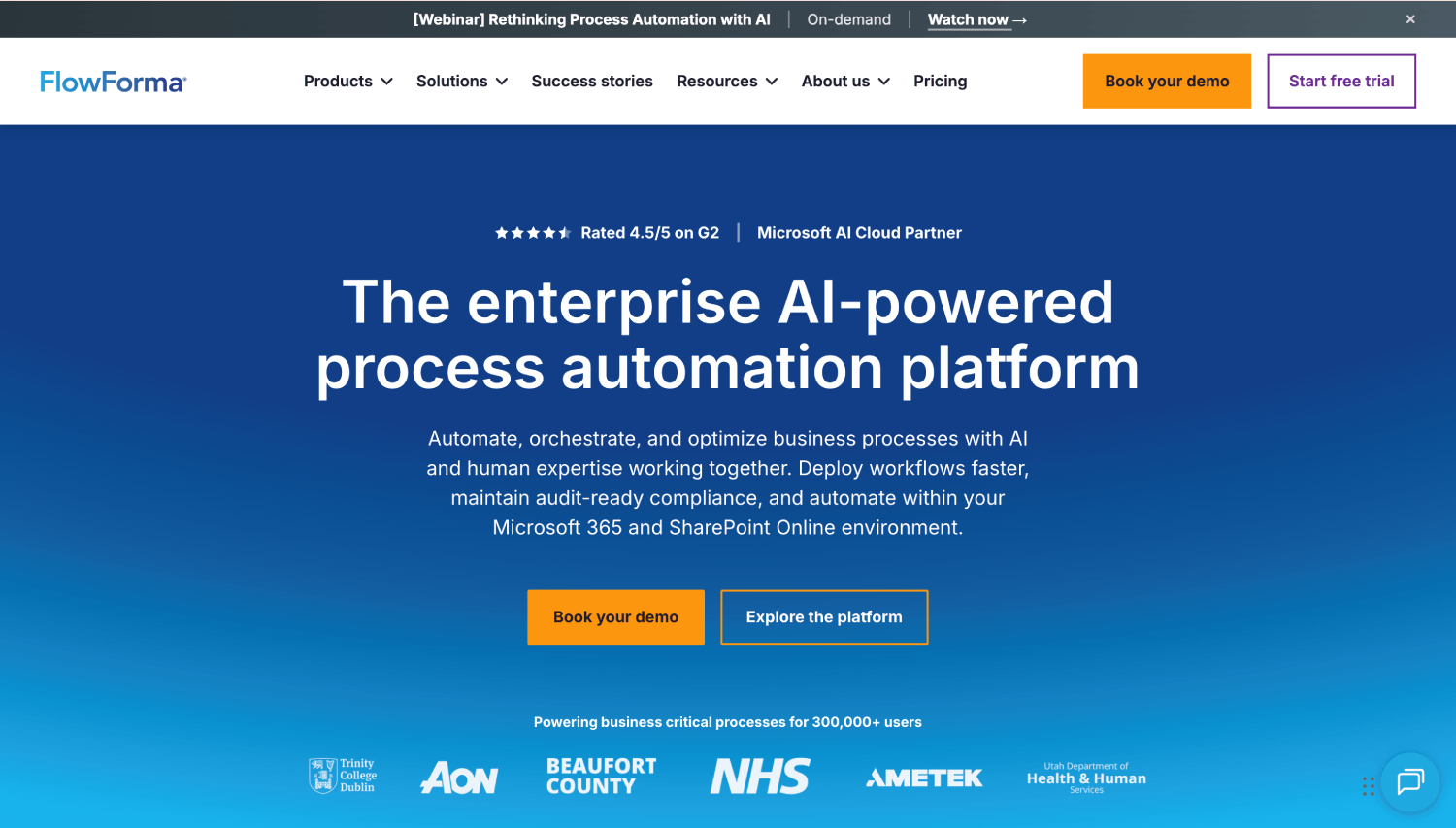
Best for: Procurement-led teams that want purchases, contracts, and buyer-side tenders on one system.
FlowForma Contract begins with the purchase request, so each contract stays linked to the spend that created it. FlowForma Contract is an AI-native product that brings people, AI agents and automation together to run contracts, procurement, and tender management processes, and it does not need Microsoft 365.
It runs three modules: procurement management, contracts management, and buyer-side tender management, which collects and scores supplier responses and tells each supplier whether it won.
Two things set it apart for a mid-size buyer. Contracts are built from your approved templates and clauses, and multi-level, parallel, and cross-department approvals run in the same flow as e-signature. AI agents also work inside policy rules your team writes, and every decision is logged for audit. Key terms, obligations, and milestones land in one contract register, connected to your ERP and finance systems.
Vestergaard’s contract workflow, built on FlowForma Process Automation, runs 10 steps across finance, legal, compliance, and sales for the 120-person global health company. Sergio Ferraz, Head of Internal Audit and Compliance, says “transparency, completeness, and accountability have been the main benefits.”
Pricing is on request and sits outside the Process Automation plans (checked October 2026), and a free trial is available.
Its scope ends at the buyer’s side. Suppliers writing bid responses need a bid-writing tool, and sales teams that turn quotes into contracts inside a CRM will find Oneflow and Docusign CLM closer to that flow.
2. Gatekeeper
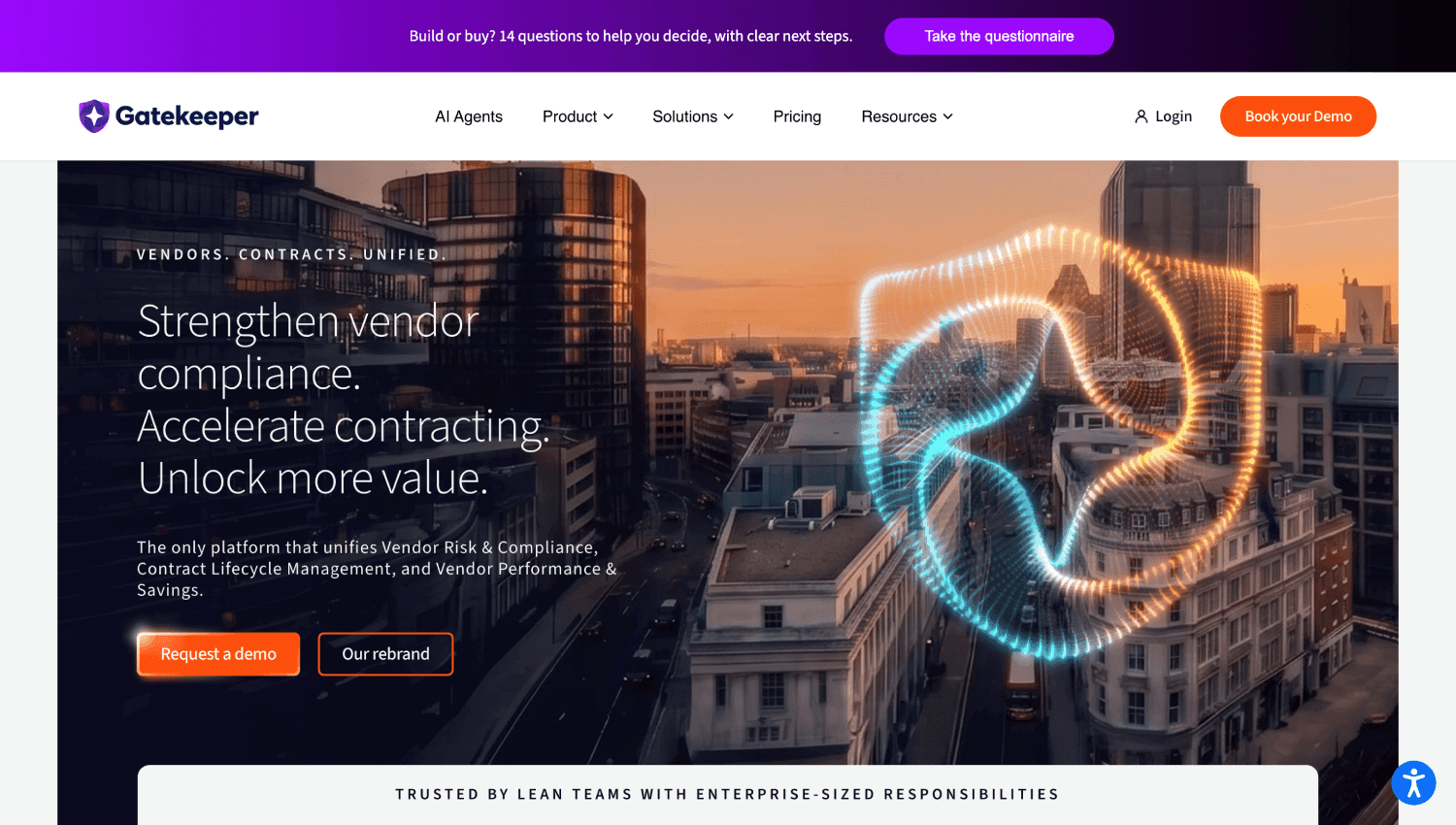
Best for: Procurement and finance teams whose biggest contract risk sits with suppliers.
Gatekeeper puts contract lifecycle management, vendor management and third-party compliance on one record. Its agents track renewal dates and obligations, signing is native, and its Interconnect layer adds no-code connections to ERP, finance and identity systems, including Microsoft, Workday, ServiceNow and Sage Intacct. Onboarding runs through its professional services team under a statement of work.
According to Gatekeeper’s published pricing (checked October 2026), every plan includes unlimited users and unlimited eSign licenses. Tiers are sized by how many vendors, suppliers, partners, and customers you manage: up to 250, up to 750, or more than 750.
That sizing is the thing to model. A manufacturer with 400 small suppliers lands in the middle tier even if only 50 of those contracts carry real value, so count your third parties before the first call.
3. Juro
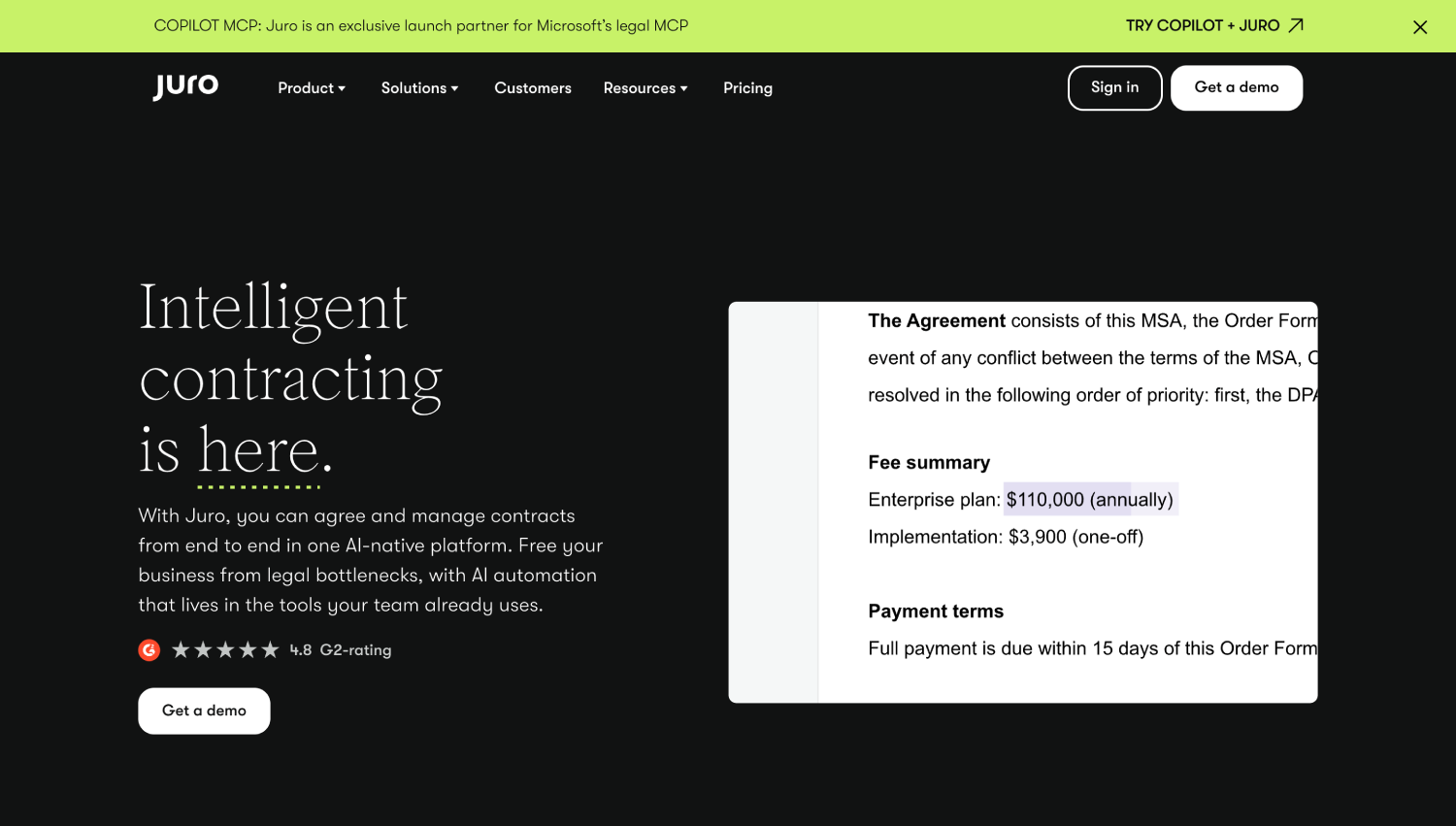
Best for: Legal teams that want sales, HR and procurement to agree routine contracts without waiting on them.
Juro is a browser-based platform for creating, approving, negotiating, signing, storing, and tracking contracts, with an AI Assistant and AI Review built in. It has offices in London and Boston. Its native eSignature is designed to meet the requirements for an advanced electronic signature, according to Juro’s trust center, which also sets out its GDPR position and an EU AI Act guide for customers. Integrations include Salesforce, HubSpot, and Slack.
Pricing is a custom plan. Juro asks how many contracts you process each month and which types, then builds a package, and its implementation support is scoped to the complexity of your workflows.
Plan for that scoping. If your routing is simple, the package stays lean. If every supplier contract needs finance and legal sign-off, expect more set-up work, and get it priced in writing before you commit.
4. SpotDraft
Best for: Growing in-house legal teams that want implementation done for them.
SpotDraft covers intake, templates, approvals, negotiation, and signature. Its AI review tool, VerifAI, works inside Microsoft Word, and SpotDraft Sign is built to comply with ESIGN, eIDAS, and ECA.
SpotDraft’s security page says primary and backup servers are hosted in the EU (Netherlands) on Google Cloud Platform, and SpotDraft is ISO/IEC 27001:2022 certified. The same page lists the US, EU, India, and the Middle East as regions where personal data can be stored.
Pricing is based on contract volume. SpotDraft says its own team sets up workflows and integrations and migrates legacy contracts at no extra fee (checked October 2026).
If half your agreements are NDAs and low-value supplier renewals, they still count toward the volume that sets your price, so model that mix before the quote arrives.
5. Summize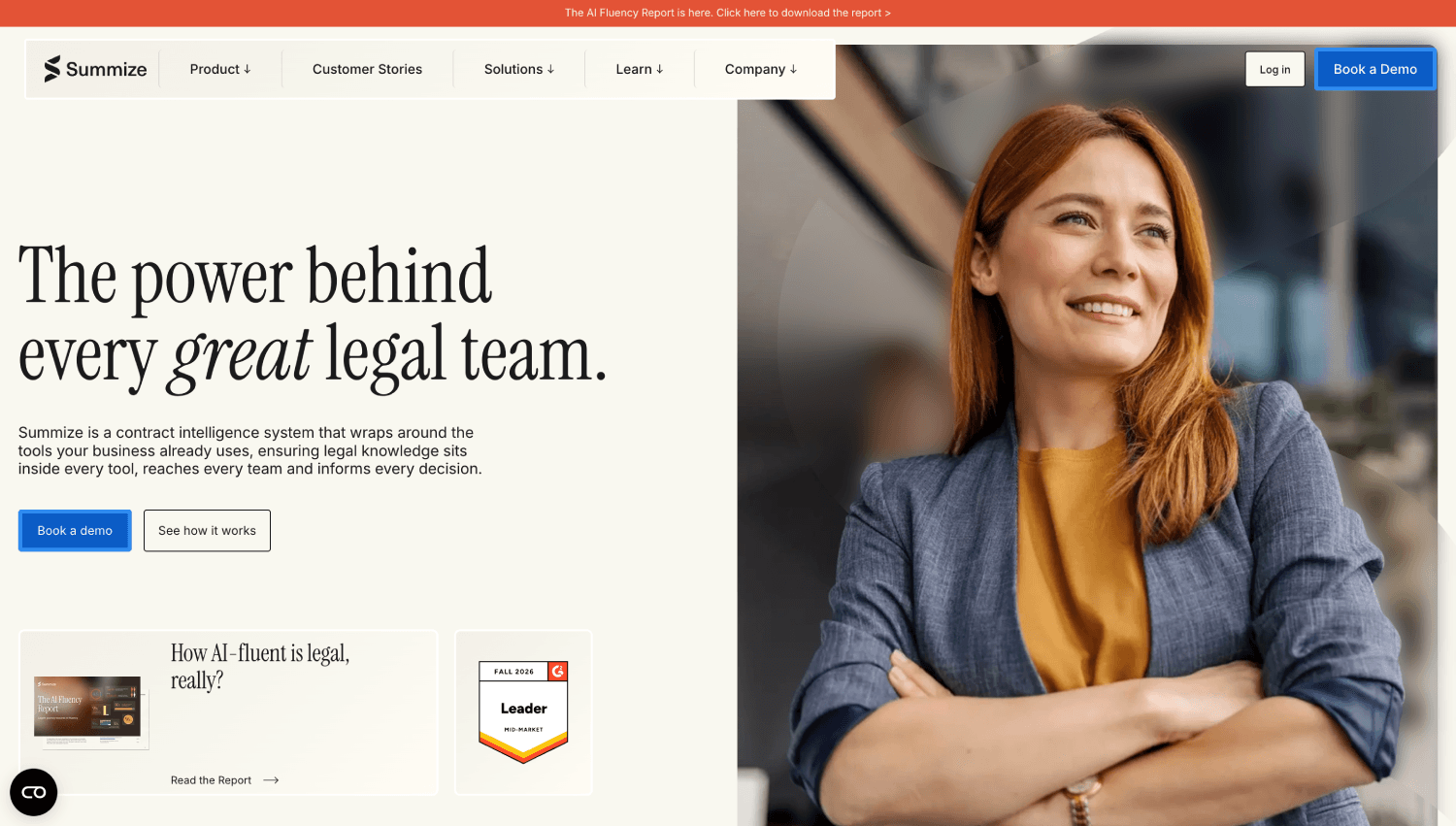
Best for: Legal teams that live in Outlook, Teams, and Word.
Summize describes itself as built for Microsoft-native legal teams. Contract intake runs through Outlook, and the platform connects to Teams, Slack, Gmail, Salesforce, and HubSpot. Its AI agents, called SIA, answer contract questions inside Microsoft Copilot through MCP, and Claude is listed among its integrations.
For signing, you can use Summize Sign or connect Adobe Sign or Docusign. It holds ISO 27001, runs on Microsoft Azure, and says it adheres to the UK Data Protection Act 2018.
Summize publishes no prices, and a quote follows a consultation (checked October 2026).
That makes early budgeting slower than with a vendor that publishes plans. Ask for an indicative range on the first call, so a demo doesn't end before you know whether it fits the budget line.
6. Oneflow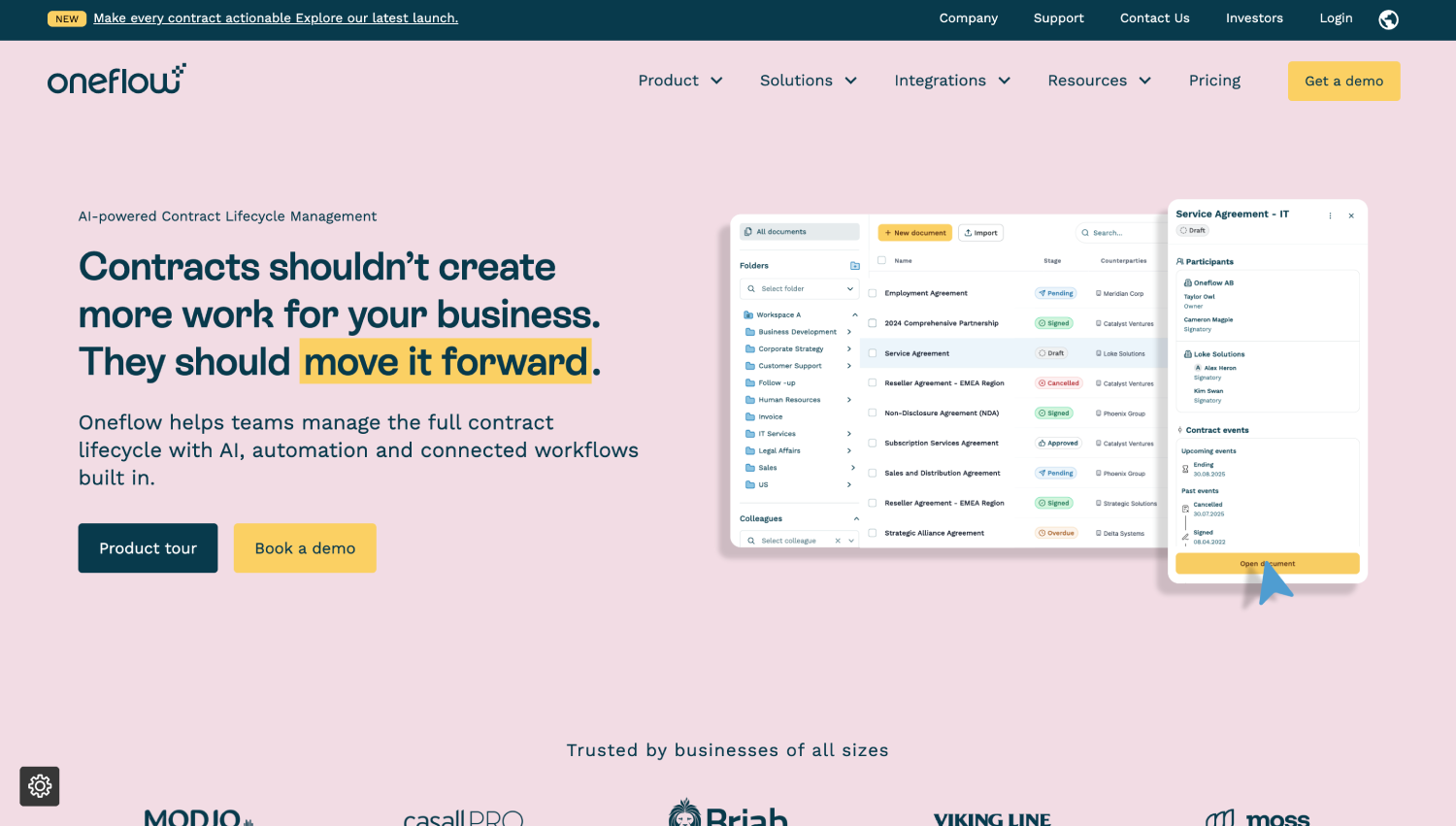
Best for: Sales-led teams that want contracts created and signed from the CRM.
Oneflow connects to Salesforce and HubSpot, so a sales rep can build a contract from the opportunity and send it for signature without leaving the CRM. Approvers can be added before signing, contract terms such as renewals and obligations can trigger actions in other systems, and each workspace can carry its own data retention policy.
Single sign-on supports Azure and other SAML2 providers, and Oneflow holds ISO 27001, 9001, and 14001.
It’s the only vendor here that shares a starting price. Its pricing page gives one for the entry plan, which includes 5 users, while higher plans are quoted after a demo (checked October 2026). Oneflow also offers a 14-day free trial.
Some features sit outside the plan price. eID signature and AI Review and Insights are marked as paid add-ons, so a team that needs either should price them alongside the plan.
7. Docusign CLM
Best for: Companies already sending contracts through Docusign eSignature.
Docusign CLM generates contracts from dynamic templates, uses AI to flag non-compliant clauses and suggest approved language, and holds a clause library that legal defines. Conditional rules route non-standard terms for review, and data from systems such as Salesforce can populate new agreements.
Reviewers get AI-assisted negotiation and summaries, with comments and tasks that notify people by email and Slack. After signature, agreement reports track obligations and renewals, and you can search agreements by keyword, concept, or metadata. Line-of-business connections include Salesforce and SAP Ariba.
Pricing runs through Docusign’s sales team, and the CLM page shows no plan prices (checked October 2026).
The case for it is strongest when Docusign eSignature is already your standard. If it isn't, you'd be adopting a signing platform to get the CLM layer, so compare the combined cost with tools that include signing.
8. Agiloft
Best for: Organizations with unusual approval rules they want to configure themselves.
Agiloft lets approved team members set up contracts, approval chains, and processes without writing code, through a point-and-click interface. AI extraction surfaces clauses, obligations, and risks across the repository, and real-time dashboards cover both pre-signature and post-signature work. Teams can query any clause, obligation, or data point from one searchable repository.
Its integration hub lists over 1,000 connectors, including Salesforce, SAP, Oracle, Slack, Microsoft Teams, Word, and Outlook; the Salesforce connector creates proposals and MSAs in one click and runs approvals from there. Pricing is by quote.
Agiloft’s site says e-signature works with Docusign and Adobe Sign out of the box, which means a separate signing subscription if you don’t already pay for one. Price that subscription into the comparison.
9. Ironclad
Best for: Fast-growing companies that expect to need enterprise legal operations within a few years.
Ironclad is built to handle legal, sales, finance, HR, and procurement contract types on one platform. You pick CLM, an AI assistant and eSignature as separate products, and pricing is a custom quote shaped by products, users, workflows, and growth.
Integrations include Salesforce, Coupa, and Ramp, and Ironclad Agent is its newer AI layer for working across contract data. Workflows are built in a no-code Workflow Designer, and you can run deployment yourself, with Ironclad’s legal engineers, or through a partner.
For a 150-person company, the question is timing. The packaging assumes you'll add products and users as you grow. If your contract volume is steady, ask for one quote at your current size and one at double it, and see which tool still makes sense at the second number.
Which CLM software fits your team: procurement, legal, or sales?
Start with who owns most of your contracts. Procurement-led teams need value and supplier rules on approvals: FlowForma Contract or Gatekeeper. Legal-led teams need drafting and playbook review in Word and Outlook: Summize, Juro, or SpotDraft. Sales-led teams need CRM sync and fast signing: Oneflow or Docusign CLM.
Use this rule to pick your group:
- If procurement or finance owns most contracts and approvals depend on value or supplier, choose FlowForma Contract or Gatekeeper, because approvals and renewals run on rules your team sets.
- If legal reviews most contracts in Word and Outlook, choose Summize, Juro, or SpotDraft, because they center on drafting and playbook review.
- If sales contracts drive volume, choose Oneflow or Docusign CLM, because signing and CRM data sit in one flow.
Mixed ownership is common at 150 staff. In that case, pick the group that holds the contracts with the most money or risk attached, usually supplier agreements. Then check that the tool still gives the other teams a simple way to request a contract.
If you’re automating the purchase requests that come before supplier contracts too, our overview of procurement automation covers that end of the process. For the tools built for that job, see our roundup of procurement automation software.
When an enterprise CLM makes sense
Agiloft and Ironclad earn a place when your rules outgrow the other groups. Agiloft suits a team that wants to configure unusual approval chains itself. Ironclad suits a company that expects contract volume and legal headcount to keep climbing. Both carry more set-up than a mid-size team with standard approvals needs.
How much does CLM software cost in the UK, and how do you compare quotes?
As of October 2026, eight of these nine vendors price on request, with tiers set by users, contract volume, workflows, or third parties. Oneflow shares a starting price for its entry plan. To compare fairly, send every vendor the same written scope and ask them to price implementation, AI, integrations, and renewal increases separately.
Without a shared scope, each vendor quotes the version of you that suits its model. Gatekeeper counts suppliers, SpotDraft counts contracts, and Ironclad counts products and users, so three quotes can describe three different deployments.
A standard quote scope
Send this, adjusted to your numbers, to every vendor on the list:
- 150 employees, with 20 people who create contracts and 40 who approve them.
- 2,000 new contracts a year, plus 5,000 historical agreements to import.
- Contract types: supplier agreements, customer master service agreements, NDAs, and employment contracts.
- Microsoft 365 for email and documents, plus your ERP or finance system by name.
- A 12-month subscription, with the year-two renewal terms stated.
Seven costs to ask about
Implementation services, extra users, contract volume limits, AI features or usage, premium integrations, data migration, and renewal price increases.
Oneflow lists AI Review and eID signing as add-ons, Gatekeeper scopes onboarding under a statement of work, and SpotDraft includes migration. A quote that leaves any of the seven blank isn't comparable yet.
How do you check UK GDPR, data location and e-signature validity?
UK GDPR allows contract data to be hosted outside the UK when safeguards are in place. Check a written processor agreement, the vendor's subprocessor list and a transfer mechanism, such as UK adequacy regulations or the IDTA, for any restricted transfer. Role-based access and audit logs support compliance with UK GDPR.
Does UK contract data need to stay on UK servers?
No. The Information Commissioner’s Office (ICO) guide to international transfers says every restricted transfer must be covered by UK adequacy regulations, an appropriate safeguard such as the International Data Transfer Agreement or Addendum, or an exception. Using a safeguard also means completing a transfer risk assessment.
The contract with the vendor matters just as much. The ICO says that every time a controller uses a processor, there must be a written contract under Article 28(3). Get the hosting region, the subprocessor list, and the processor agreement in writing from each vendor before the final round. If the same audit questions keep coming up in other processes, our guide to compliance workflow automation shows how approvals and audit trails get recorded along the way.
FlowForma Contract is hosted on Microsoft Azure, and the company holds ISO/IEC 27001:2022 and Cyber Essentials, both listed on our security page.
Are electronic signatures binding in the UK?
Yes, for most business contracts. The Law Commission’s report on electronic execution of documents concluded that an electronic signature can execute a document, including a deed, if the person signing intends to authenticate it and any required formalities are met.
A deed that must be witnessed still needs that witness, so check how a tool handles witnessed signing before you route deeds through it. The Government agreed with the Commission's conclusions in March 2020.
How does a no-code approval and renewal workflow work in practice?
A no-code CLM workflow turns contract policy into rules a manager edits without IT. In FlowForma Contract, a rule can auto-approve an invoice under £5,000 from an approved vendor and log the decision. The obligations agent records each notice period, and the renewal agent alerts the owner before it passes.
Approval rules at £5,000 and £25,000
The first tier comes from FlowForma Contract’s own rule: an invoice under £5,000 from a supplier on your approved vendor list is approved by an agent, finance is notified, and the decision is logged.
The tiers above it are an illustrative policy for a 150-person company:
- £5,000 to £25,000, approved supplier: the budget holder, then finance.
- Over £25,000, or any non-standard liability clause: finance, then legal review before signature.
FlowForma Contract’s legal review agent highlights clauses that differ from your standard positions and routes them to the right reviewer, so only the risky clause in that last tier waits for legal.
A December 31 expiry with 90 days’ notice: deadline October 2
Take a supplier agreement that expires on December 31 with 90 days’ notice to terminate. The last day to give notice is October 2. A sound setup records that date at signature and alerts the owner on August 3 and again on September 2, each time asking for a decision to renew, renegotiate, or exit.
If the tool only stores the expiry date, the alert arrives after the notice window has closed. In FlowForma Contract, the contract management agents handle this. The obligations agent reads the signed contract and records key dates, notice periods, and obligations with their owners. The renewal agent alerts each owner ahead of the notice date with a renewal brief on spend and performance.
Ergo, an Irish IT managed service provider, runs customer contracts from master service agreement through billing to the service desk on FlowForma Process Automation, and the same flow handles its automated contract renewals. Mary Donnelly, Legal and Compliance Officer, put it this way: “We have turned what was three points of truth into a unified, single source of truth.” The Ergo case study shows the full flow.
How do you test CLM software before you commit?
Test CLM software on your own contracts before you commit. Use a free trial where one is offered, or a vendor proof of concept. Load about 20 representative agreements, three approvers, one external signer, and one non-standard liability clause, then score each test as a pass or fail.
|
Test
|
Pass when
|
|
Drafting
|
A contract builds from your template with the right clauses and no manual edits
|
|
Routing
|
A request over your finance threshold reaches all three approvers in order
|
|
Permissions
|
An HR user can't open supplier contracts
|
|
Search
|
You find every contract with a 90-day notice period in one search
|
|
Reporting
|
A renewal report lists the next quarter's notice dates with owners
|
Run the same five tests on every shortlisted tool, with the same 20 agreements. Vendors who build the demo on their own sample contracts are showing you their best case.
If FlowForma Contract is on your shortlist, you can run these tests in its free trial.
Do you need to migrate every contract first?
No. Phase it in four steps:
- Import active, high-value agreements first.
- Extract their critical dates: expiry, notice period, and renewal terms.
- Check the extracted data against the signed originals.
- Move older, low-risk contracts in later batches.
Closing Thoughts
The right contract lifecycle management software for mid-size companies in the UK is the one built for the team that carries your contract risk. If that's procurement and finance, put FlowForma Contract and Gatekeeper on the list, send both the same quote scope, and run the five tests on your own agreements. If legal or sales owns most contracts, start with Juro, SpotDraft, and Summize, or Oneflow and Docusign CLM.
If FlowForma Contract makes your shortlist, book your demo and ask to see how one of your own approval policies and one supplier notice date would run in it. A walkthrough built around your documents tells you more than a standard tour.